
Livraison le jour même ou le lendemain

Qualité garantie

Débloquez vos offres de bienvenue: Livraison GRATUITE | Jusqu'à -80 % | 30 jours d'essai gratuits à JoyPlus
Téléchargez l'application
Pastel highlighters have revolutionised how we organise our notes, plan our days, and decorate our journals. Easier on the eyes than their fluorescent cousins, they bring a touch of elegance and clarity. However, buying a new set can quickly lead to disappointment if you fall into the most common traps. Before you buy, let's review the pitfalls to avoid to make the right choice.
bullet journal unusable.To avoid these setbacks, a few technical features should be examined closely. They determine the quality of a highlighter and its suitability for your needs.
The nightmare of highlighter bleed-through? The secret to avoiding it lies in the ink's composition. The vast majority of quality highlighters use a water-based ink. This formula is less aggressive on paper fibres than alcohol-based inks, significantly reducing the risk of "ghosting" (when the ink is visible on the reverse side) or "bleeding" (when it goes completely through).
For use on thin paper, like that found in planners or some books, opt for products that explicitly mention a "no-bleed" or "bleed-proof" formula. Paper quality (measured in grams per square metre, g/m?) also plays a role: paper of 90 g/m? or more will offer better resistance.
The type of tip defines the range of possibilities.
chisel tip highlighter: This is the versatile standard. It allows you to draw wide lines (usually 4 to 5 mm) to highlight entire paragraphs, as well as fine lines (1 mm) by using the corner of the tip for underlining or annotating.highlighters for bullet journal.The choice of a highlighter set should first and foremost match your needs. While classic neon highlighters are formidable for drawing attention to critical points, pastel shades are often preferred for a more subtle and less visually tiring colour code. For aesthetic school supplies or creative journaling, a set of 10 to 18 pastel colours offers great freedom. For professional use or more traditional studies, a set of 4 to 6 basic colours will do the job perfectly.
There is no one-size-fits-all highlighter. The best one is the one that will precisely meet your needs. Here are our 2026 recommendations, tested and approved for distinct uses.
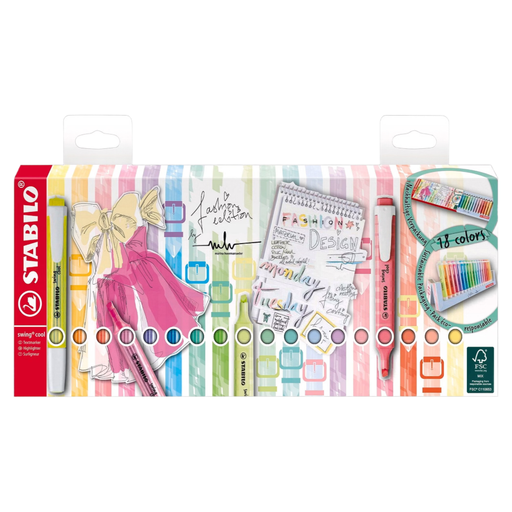
Why we chose it: This set is the perfect companion for bujo and creative planning enthusiasts. With 10 pastel colours and 8 fluorescent shades, it offers a complete palette to organise, decorate, and prioritise information with great freedom. Its slim pen format with a clip is incredibly convenient for carrying around.
The water-based ink is designed to minimise smudging and bleed-through on most papers. STABILO's anti-dry-out technology allows it to be left uncapped for up to 4 hours, preventing premature drying.
Dual-width chisel tip (1 and 4 mm) for maximum versatility. Wide range of colours including true and bright pastel shades.
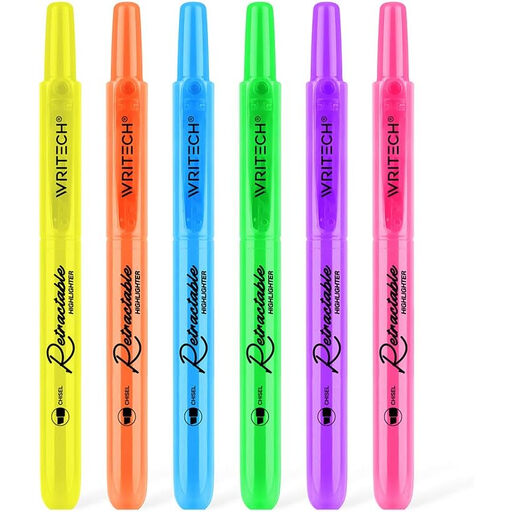
Why we chose it: For the student or professional juggling multiple tasks, the retractable design saves time and boosts efficiency. No more lost caps! The one-handed operation is perfect for quickly annotating documents in meetings or classes.
The ink formula is specifically designed to limit bleed-through on most papers. The patented seal prevents drying out, even without a cap, and the clip's auto-retraction mechanism prevents stains.
Retractable mechanism for one-handed use. Fade-resistant and smear-proof ink formula.
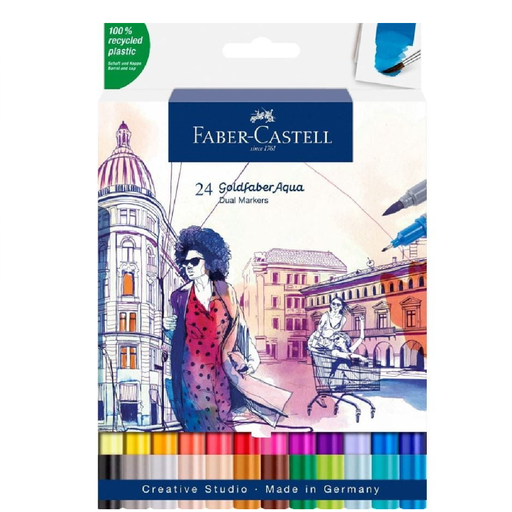
Why we chose it: Much more than just a highlighter, this is a complete creative tool. Ideal for artists, illustrators, and lettering enthusiasts who want to go beyond simple highlighting. The water-soluble ink opens up a world of infinite creative possibilities.
The water-based ink is designed not to bleed through most papers and applies without leaving streaks. The barrel and caps are made from 100% recycled plastic, a mark of sustainability.
Versatile dual tip (flexible brush tip and a 0.6 mm fine tip). Fully water-soluble ink for gradient and wash effects.
This guide is dedicated to paper highlighters, but your needs may be broader. To go further, we have selected a complete range of products that meet strict selection criteria, for all uses.
The choice of highlighter is crucial. Opt for models with a water-based ink and a "no-bleed" label. It is also recommended to choose notebooks with a paper weight of at least 90 g/m?, or even 120 g/m? for creative techniques. Before you start, always do a test on an inconspicuous page of your notebook.
The longevity depends on the frequency of use and storage conditions. To maximise it, always close the cap tightly after each use. Some models incorporate "anti-dry-out" technologies that allow them to remain functional even after several hours without a cap. Store your highlighters horizontally to ensure even ink distribution.
Yes, they are often an excellent option. Their softer colours are less harsh on the eyes during long study sessions than neon highlighters. Since textbook pages can sometimes be thin, it is particularly important to choose a no-bleed highlighter to avoid damaging the book.