Diners who want to understand “reduced in sugars”
You want to distinguish a nutrition claim from the simple “of which sugars” figure before choosing the pasta you’ll serve.


For a raclette evening, don’t choose pasta labelled “reduced in sugars” based solely on the “of which sugars” figure. Check for the claim and the comparison stated for the specific product. If your priorities lie elsewhere, compare the fibre in wholemeal pasta or the ingredients and protein in enriched recipes, without assuming that either is reduced in sugars.
You want to distinguish a nutrition claim from the simple “of which sugars” figure before choosing the pasta you’ll serve.
You’re looking for a whole wheat recipe and want to compare the fibre figures on the packaging, while checking allergens for your guests.
You’re considering pasta enriched with wheat or pea protein and want to check its ingredients rather than mistake it for pasta reduced in sugars.
When choosing pasta to serve with raclette, start with your priority: a reduced-sugars claim for the product you’ve chosen, the ingredients in wholemeal pasta or the protein in an enriched recipe. One product may meet several criteria, but you should check each one separately.
| Criterion | What to check | Who is it for? |
|---|---|---|
| Reduced sugars | The claim on the specific product and the comparison stated; the “of which sugars” figure per 100 g isn’t enough to establish a reduction. | I want to distinguish a genuine claim from a nutrition figure alone before serving this pasta; around 40% of consumers would make this their priority. |
| Fibre and whole wheat | The ingredients list and fibre per 100 g, followed by the allergens listed on the packaging. | For a meal shared with others, I prefer to choose wholemeal pasta and know what it contains; this would be the main criterion for around 30% of consumers. |
| Plant protein | Protein per 100 g or per serving, the ingredients and whether it contains wheat. | If I choose an enriched recipe, I want to know which ingredients provide its protein; around 30% of consumers would put this need first. |
The first is a nutrition figure; the second is a regulated claim. According to the DGCCRF, nutrition claims are covered by European Regulation (EC) No 1924/2006.
For a specific product, look for the claim on the packaging or product page and check the comparison stated. If there isn’t one, simply compare the “of which sugars” figures for similar products, using the same 100 g basis.
Wholemeal pasta is defined by its ingredients; the term alone doesn’t tell you whether its sugars have been reduced compared with another pasta.
Check the ingredients, fibre and sugars per 100 g separately. Compare like with like, for example dried pasta with dried pasta.
Carrefour and Auchan’s wholemeal pasta product pages list wheat and, depending on the product, warn that traces of other allergens may be present.
Keep the packaging and check the ingredients and any warnings about traces for every pack you serve.
According to Anses, improper storage or cross-contamination can encourage bacteria to grow. This precaution is particularly relevant to the cheese and charcuterie served with the pasta.
Keep refrigerated food chilled until serving, take it out as needed and avoid cross-contamination. Anses recommends keeping your fridge at 4 °C.
Barilla offers a range that includes classic, wholemeal, Protein+ and gluten-free pasta. Start by choosing the range that matches the criterion you want to check.
According to Panzani, the Les Protéinées range includes ridged macaroni, fusilli and serpentini.
Lustucru Sélection offers pan-fried gnocchi, filled pasta and tagliatelle, among other products.
Carrefour offers a 500 g pack of wholemeal durum wheat pasta.
Marque Repère’s Turini wholemeal penne is one example of a product you can compare using its nutrition figures.
Auchan offers 500 g packs of organic wholemeal wheat macaroni, among other products.
This farfalle is a wholemeal pasta option to serve with raclette. If a “reduced in sugars” claim is your deciding factor, check that it applies to the specific product before you buy.
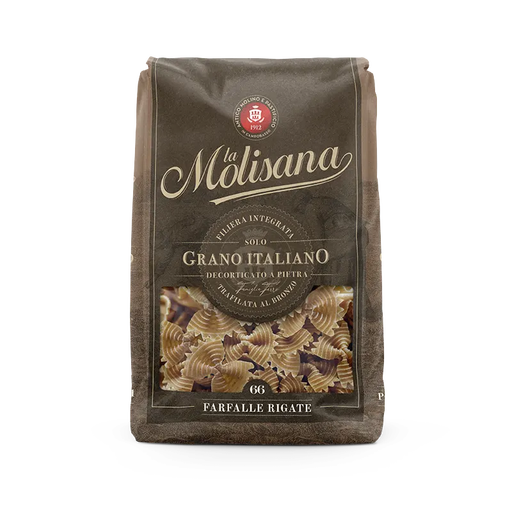 Image unavailable
To serve wholemeal farfalle with raclette, check the ingredients, allergens and nutrition figures per 100 g on the pack. This pack contains 500 g of pasta; its name alone isn’t enough to establish a “reduced in sugars” claim.
No. The “of which sugars” figure describes the composition of the pasta; it doesn’t establish a reduction compared with another product. According to the DGCCRF, nutrition claims are covered by European Regulation (EC) No 1924/2006. Check for the claim and the comparison stated for the product you’ve chosen.
No. “Wholemeal” describes the ingredients; it doesn’t guarantee reduced sugars. As examples of specific products, E.Leclerc’s product page for Turini penne and Auchan’s for organic macaroni list 3,0 g and 3,5 g of sugars per 100 g respectively. Compare pasta in the same state.
Check the ingredients and any warnings about traces on each pack rather than relying on the range name alone. Carrefour and Auchan’s wholemeal pasta product pages list wheat; depending on the product, they also warn that traces of egg, soya or mustard may be present.
Keep refrigerated food chilled until serving and avoid cross-contamination. Anses recommends keeping your fridge at 4 °C; it also highlights the particular vulnerability to listeriosis of pregnant women, people with weakened immune systems and those aged over 65.