Campers cooking on a camping stove
Your main aim is to keep cooking time after the water boils to a minimum, while making sure you have the pan and water needed for your chosen product.


For a meal cooked on a camping stove, start by checking the cooking time on the packet, and don’t forget to factor in the water you’ll need. Panzani says its 3 Minutes Penne and Spaghetti cook in 3 minutes, with instructions to use 1 L of water per 100 g. If sugar content matters more, compare the ‘of which sugars’ figures per 100 g across similar products. A low figure alone doesn’t prove that a pasta is ‘reduced in sugars’. Wholegrain or protein-enriched options meet different needs, and you’ll need to check the cooking time for each product.
Your main aim is to keep cooking time after the water boils to a minimum, while making sure you have the pan and water needed for your chosen product.
You check the ‘of which sugars’ figure without confusing it with total carbohydrates or assuming that a low figure means the product can be labelled ‘reduced in sugars’.
You compare the fibre or protein figures to put together a simple meal, even if that means choosing a product with a longer cooking time.
When packing pasta for a camping trip, start with what matters most for your meal: cooking time, sugars on the label, fibre or protein, then storage. The percentages below show the proportion of consumers who put each factor first.
| Factor | What to check | Consumers who prioritise it |
|---|---|---|
| Cooking time and camping stove | The cooking time after the water boils and the amount of water stated on the packet. Panzani says to use 1 L of water per 100 g of its 3 Minutes Penne. | When I’m cooking on a camping stove and have little time to prepare a meal, I prioritise a short cooking time without forgetting the water I’ll need to carry. Around 36% of consumers put this first. |
| Sugars on the label | The ‘of which sugars’ figure per 100 g across similar products, followed by total carbohydrates; a low figure doesn’t prove that the product can be labelled as reduced in sugars. | When I compare packets before setting off, I want to distinguish the sugars figure from total carbohydrates. Around 29% of consumers put this first. |
| Fibre or protein | The amounts per 100 g, the ingredients and the cooking time for the specific product. | For a meal with just a few ingredients, I look first at the fibre or protein figures, even if the pasta takes longer to cook. Around 21% of consumers prioritise this. |
| Pack size and storage | A pack size that suits your meal, storage instructions and allergen information on the packaging. | When I keep an opened packet for later in the trip, I want to protect it from moisture and store other ingredients separately. Storage is the priority for around 14% of consumers. |
The ‘of which sugars’ figure helps you compare labels, but it isn’t enough to establish a nutrition claim. The DGCCRF notes that such claims are governed by European Regulation (EC) No 1924/2006.
Compare the figures per 100 g, total carbohydrates and ingredients, and check any claim made on the product separately.
Panzani says its 3 Minutes Penne cooks in 3 minutes and also recommends 1 L of water per 100 g of pasta.
Before setting off, check the packet instructions against the water you have available and the capacity of your pan.
Lustucru lists 4.5 g of sugars per 100 g for one spaghetti product, while an Auchan listing gives 6 g per 100 g for Lustucru short spaghetti.
Check the nutrition information for the shape and recipe you’re actually buying.
Auchan’s quick-cook macaroni should be protected from heat and moisture. For perishable ingredients added to your meal, Anses also highlights the risks of poor storage or breaking the cold chain.
Reseal the pasta packet and keep it somewhere dry. Make sure sauces and other perishable accompaniments are stored appropriately.
The Protein+ and Integrale ranges meet different needs: the former lists protein, while the latter lists fibre.
The Les 3 Minutes range is designed for quick cooking, while Les Protéinées meets a different set of needs.
Some spaghetti products are listed with a 3-minute cooking time.
Quick-cook macaroni is another example of speedy pasta whose label lets you compare the sugars listed.
These two products suit different needs: Panzani torti advertised as quick-cooking, and konjac spaghetti to consider as an alternative to wheat pasta. For a camping meal, check the preparation instructions on each packet before you choose.
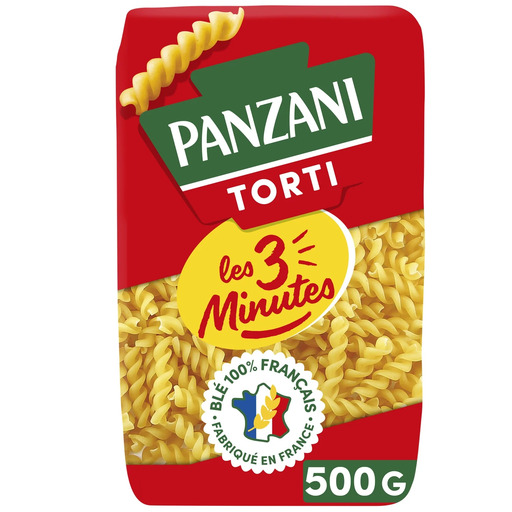 Image unavailable
Worth considering if cooking time on a camping stove is your top priority: this product is advertised as taking 3 minutes to cook.
Before setting off, check the packet for preparation instructions and how much water you’ll need for this torti.
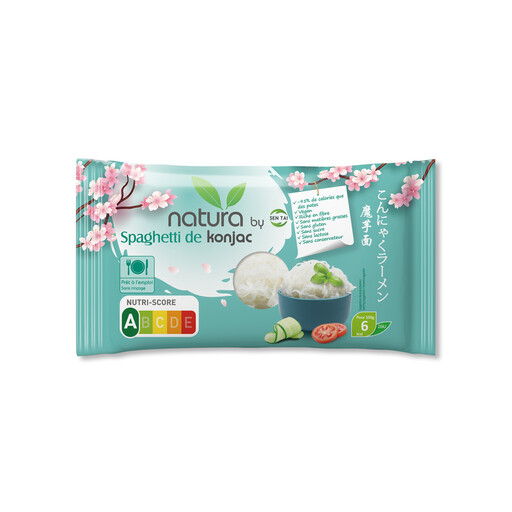 Image unavailable
Worth considering if you’d like to compare a konjac-based alternative with regular wheat pasta, without assuming it’s prepared in the same way.
Check the preparation instructions and water requirements on the packaging for your camping meal.
No. The ‘of which sugars’ figure is only part of the total carbohydrates shown in the nutrition information. Compare both figures per 100 g on similar products. A low figure isn’t enough to establish a ‘reduced in sugars’ claim: as the DGCCRF points out, nutrition claims are governed by European Regulation (EC) No 1924/2006.
Panzani recommends 1 L of water per 100 g for its 3 Minutes Penne. Check the instructions on the packet you’re taking with you: the cooking time alone doesn’t tell you how much water another product needs.
For its quick-cook macaroni, Auchan recommends protecting the pasta from heat and moisture and resealing the bag after opening. Make separate arrangements for storing perishable accompaniments.
Read the ingredients list and any ‘may contain’ warnings for the exact product. The information for Barilla Penne Protein+ lists wheat and possible traces of soya and mustard; the Auchan macaroni information lists durum wheat and possible traces of eggs, soya and mustard.