Shoppers keeping an eye on sugar
You want to compare the total sugars in sauces and understand the difference between a reduction compared with a similar product and having no added sugars.


When choosing a pasta sauce with weight management in mind, compare sugars, energy, saturated fat and salt per 100 g across similar sauces. A claim about sugar alone doesn’t tell you everything about its nutritional profile. According to France’s National Consumer Institute, ‘reduced in sugars’ means at least 30% less than a similar product; ‘no added sugars’ doesn’t rule out sugars naturally present in tomatoes.
You want to compare the total sugars in sauces and understand the difference between a reduction compared with a similar product and having no added sugars.
You also compare energy, saturated fat and salt, rather than basing your choice on a single claim on the packaging.
You prefer to start with a tomato base and choose the added ingredients yourself, even if it takes time to prepare.
Depending on what matters most to you, a ‘reduced in sugars’ sauce, a ‘no added sugars’ recipe or a tomato base to cook with will answer different questions. For each one, check the label of the specific product you’re considering and compare similar products per 100 g.
| Criteria | What to check | Who it’s for |
|---|---|---|
| Sugars in the sauce | Compare the ‘sugars’ line per 100 g across similar sauces. France’s National Consumer Institute distinguishes between a reduction of at least 30%, as indicated by ‘reduced in sugars’, and having no added sugars. | I want to know the total sugars in the sauce, beyond the claim on the front of the pack; around 36% of shoppers would prioritise reducing their sugar intake. |
| Energy and fat | Check the energy, fat and saturated fat per 100 g, then consider how much sauce you use in your dish. | If I add oil or cheese to my pasta, I want to consider the meal as a whole; around 29% of shoppers would put energy and fat at the heart of their choice. |
| Salt and the overall picture | Compare the salt per 100 g. If a Nutri-Score is shown, use it to compare similar sauces, but don’t let it replace checking the nutrition information. | A claim about sugars isn’t enough for me if I also want to compare salt; this would be the main concern for around 21% of shoppers. |
| Convenience | Check the pack size, whether it’s available at your store and the ingredients list for the product you choose. | When I’m looking for a sauce that’s easy to find and use, I still want to be able to check what’s in it; around 14% of shoppers would prioritise this balance. |
A sauce with no added sugars may still contain sugars naturally present in tomatoes. These are included on the ‘sugars’ line of the nutrition information.
Compare this figure per 100 g across similar sauces and read the ingredients list, rather than relying only on the claim on the front of the pack.
The claim ‘reduced in sugars’ refers to a comparison of sugar levels, not the sauce’s energy or fat content.
Check the energy, sugars, saturated fat and salt per 100 g for each product you’re considering.
The Nutri-Score takes several nutritional factors into account, but doesn’t detail total sugars or ingredients. E.Leclerc states that its ECO+ cooked tomato sauce with vegetables has a C score calculated using the previous method, in force before April 2025.
When displayed, compare the Nutri-Score across sauces in the same category, then check the nutrition information and any details about the calculation method.
A sauce may only be available at selected stores.
Check the product and local stock before making a special trip, then check the label on the product you buy.
The brand offers cooked tomato sauces as well as cooking bases such as Tomacouli Nature.
The range includes a Cooked Tomato Sauce designed for use with pasta, among other dishes.
The brand offers, among other products, a tomato sauce with Provence thyme PGI and tomato purées to use as cooking bases.
This own-brand range includes a 420 g jar of cooked tomato sauce.
The range includes a 420 g cooked tomato sauce with vegetables.
These two MUTTI tomato purées are cooking bases for making pasta sauce and choosing which ingredients to add. They are not presented here as ready-to-use sauces or as products ‘reduced in sugars’.
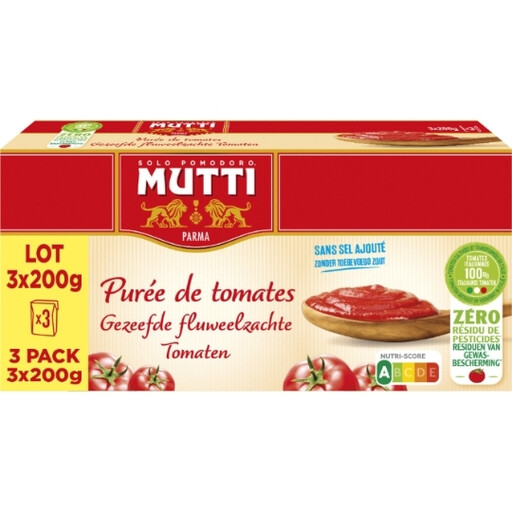 Image unavailable
This tomato purée is a good starting point for making your own pasta sauce and choosing which ingredients to add. The pack contains three 200 g units; remember to include any extra ingredients when comparing the finished dish.
 Image unavailable
This 500 g tomato purée is a base for making pasta sauce and seasoning to suit your recipe. Check the label on the product you buy for its ingredients, particularly the salt content.
No. According to France’s National Consumer Institute, ‘reduced in sugars’ means a sugar content at least 30% lower than that of a similar product; it doesn’t mean the sauce contains no sugar at all. Compare the ‘sugars’ figure per 100 g.
No. This claim doesn’t rule out sugars naturally present in tomatoes, and it doesn’t tell you everything about energy, saturated fat or salt. Compare these figures per 100 g across similar sauces and consider the other ingredients in your dish.
If it’s displayed, use it as a guide when comparing sauces in the same category, but don’t make it your only criterion. Manger Bouger explains that it takes account of factors including energy, sugars, salt and saturated fat. Check the nutrition information and ingredients list too.