Students avoiding added sugars
You want to check the label and ingredients list to confirm whether sugars have been added, without assuming that the sugars naturally present in tomatoes have been removed.


For your first student kitchen cupboard, a tomato sauce labelled ‘no added sugars’ is a good starting point if you want to avoid added sugars. However, this does not mean ‘sugar-free’ or ‘reduced in sugars’. Compare the ‘of which sugars’ figure per 100 g for sauces of the same type, then choose a size and preparation method that suit your meals.
You want to check the label and ingredients list to confirm whether sugars have been added, without assuming that the sugars naturally present in tomatoes have been removed.
You want a pack size that suits the number of meals you have planned and the storage instructions once opened, without overlooking the ingredients.
You’d rather have a sauce that’s ready to use or easy to heat than a tomato base that needs seasoning.
For your first kitchen cupboard, start by checking the sugar-related claim and the nutritional information. You can then narrow down your options by looking at the pack size and preparation method.
| Criteria | What to check | Who is this for? |
|---|---|---|
| Sugars and ingredients | Check the exact wording on the label and compare the ‘of which sugars’ figure per 100 g for sauces of the same type. | If I want to avoid added sugars, I need to distinguish this claim from the sauce’s total sugar content. Around 42% of consumers make this their priority. |
| Pack size | Check the net weight and storage instructions once opened. | With limited space and only a few meals planned, I’d prefer a pack I can finish within the stated storage conditions. This is the top priority for around 33% of consumers. |
| Preparation | Check whether the product is a ready-to-use sauce or a base that needs seasoning, and how it should be heated. | When my kitchen is basic, I mainly want to keep the steps before serving pasta to a minimum. Speed is the priority for around 25% of consumers. |
A tomato sauce with no added sugars can still contain sugars that are naturally present in tomatoes.
Read the exact wording on the label, then check the ‘of which sugars’ figure per 100 g and the ingredients list.
Ingredients and allergens can vary from one sauce to another. For example, Carrefour’s product listing for a Heinz sauce with no added sugars states that one of its flavourings contains milk.
If an ingredient or allergen matters to you, check the label for the specific recipe and pack size you’re buying.
The weight of a jar alone doesn’t tell you whether you’ll be able to finish the sauce after opening, within the stated storage conditions.
Choose a size that matches the number of meals you have planned, and read the storage instructions.
A large pack that’s been opened but is too big for your meals could lead to waste.
A product listing online doesn’t guarantee that the item will be available when you shop.
Check the product with your chosen retailer and have a backup sauce that meets the same labelling and size criteria.
Panzani separates its cooked tomato sauces from its Tomacouli cooking bases. Its Tomates Cuisinées sauce is available in 210 g, 400 g and 650 g sizes, among others.
The range includes a 400 g Sauce Tomates Cuisinées, which Barilla presents as either an accompaniment for pasta or a sauce base.
Carrefour’s ranges include tomato sauces in different recipes and pack sizes.
The range includes a 390 g carton of Neapolitan-style sauce.
A Lidl France product listing features Baresa tomato sauce in a 560 g jar.
These two products suit different uses: a tomato sauce to serve with pasta and tomato purée to season and turn into your own sauce. For either product, check the label if sugars are your priority.
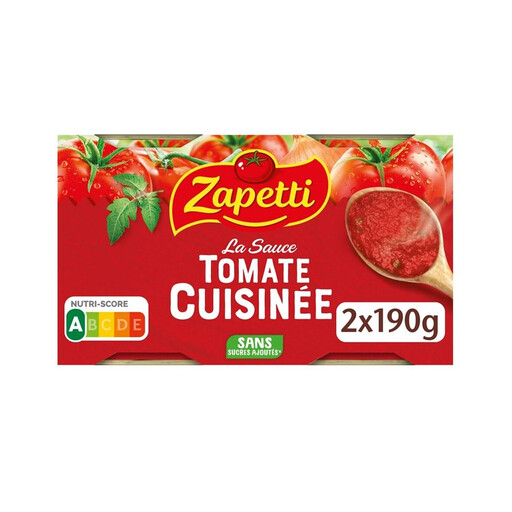 Image unavailable
A tomato sauce to consider if you want something to serve with pasta without having to make and season a base yourself.
The pack contains two 190 g pots. To check the sugar content of this recipe, read the ingredients list and nutritional information on the product.
 Image unavailable
This tomato purée is suited to making a pasta sauce that you season yourself, rather than serving as a ready-made cooked sauce.
The stated pack size is 500 g. Check the packaging for this variant’s ingredients, sugars per 100 g and storage instructions once opened.
No. Tomatoes can contribute naturally occurring sugars. To find out the total sugars declared, check the ‘of which sugars’ figure per 100 g and compare sauces of the same type.
No. The first claim indicates a reduction compared with another product, while the second refers to whether sugars have been added. The DGCCRF notes that nutrition claims are regulated. When choosing between two sauces, check their exact claims, ingredients and sugars per 100 g.
No. Nutri-Score doesn’t replace checking the ‘of which sugars’ figure or the ingredients list. On its own, it also won’t tell you whether the recipe carries a claim about added sugars.
Follow the instructions for your chosen sauce and use a container suitable for the appliance. Panzani’s product listing for its Tomates Cuisinées sauce says it can be heated in a microwave or in a saucepan. Instructions may differ for another recipe or a tomato base that needs seasoning.