People avoiding added sugars
You’re looking for a sauce whose ingredients list doesn’t include added sugar, while knowing that tomatoes naturally contain sugars.


For a quick pasta dinner, choose a cooked tomato sauce if you want to serve it without adding your own seasoning, or tomato purée if you’d rather make the recipe your own. Either way, compare the ‘of which sugars’ figure per 100 g with the ingredients list. ‘No added sugars’ doesn’t mean sugar-free, as tomatoes naturally contain sugars.
You’re looking for a sauce whose ingredients list doesn’t include added sugar, while knowing that tomatoes naturally contain sugars.
You want a sauce that’s ready to serve with pasta, without assuming that convenience means it contains less sugar.
You check several recipes and compare the ‘of which sugars’ figure per 100 g, the salt content and the ingredients list before choosing.
For a comforting dinner, decide whether you’d like a sauce that’s already seasoned or a base you can customise. Then compare the nutritional information for the products that suit your recipe.
| What to consider | What to check | Who it’s for |
|---|---|---|
| Added sugars | The ingredients list and the ‘of which sugars’ figure per 100 g: the claim ‘no added sugars’ doesn’t tell you the total amount of sugars. | I want to avoid added sugar in my tomato sauce without confusing this with avoiding naturally occurring sugars. Around 45% of consumers might make this their top priority. |
| Quick preparation | The difference between a cooked sauce that’s ready to serve and tomato purée that needs seasoning, as well as the preparation instructions. | After a busy day, I’d rather have a sauce that’s already seasoned and ready to serve with pasta. Around 33% of consumers might put convenience first. |
| Recipe and texture | The texture you want and the ingredients, followed by the sugars and salt per 100 g. | I’m happy to compare several labels to find a texture and seasoning I like, rather than relying on the claim on the front of the pack. This balance might matter most to around 22% of consumers. |
Tomatoes naturally contain sugars. So two sauces carrying the same claim may still have different sugar contents.
As well as checking the added sugars claim, read the ‘of which sugars’ figure per 100 g. Auchan’s product pages list 5.3 g of sugars per 100 g for Zapetti Provence et Languedoc sauce and 2.9 g for Italians Do It Better Pomodoro sauce.
The presence of vegetables or herbs doesn’t tell you whether sugar has been added. E.Leclerc’s product pages for ECO+ vegetable sauce and Turini Arrabbiata list sugar among the ingredients.
If you want to avoid added sugars, check the ingredients list for the specific product rather than relying on its name alone.
The size of a jar or the number of portions doesn’t give you a consistent basis for comparing the sugar content of two sauces.
Use the figures per 100 g shown in the nutritional information. The DGCCRF says that presenting this information per 100 g makes it easier to compare pre-packed foods.
A sauce’s product listing doesn’t guarantee that it will be available when you shop or that the packaging you see will show the same information.
Check the product, ingredients list and nutritional values for the one you choose.
Tomacouli can be used as a tomato base, seasoned to suit the dinner you have in mind.
Basilico is a tomato and basil sauce designed to be served straight with pasta.
The retailer stocks a range of third-party sauces, including some labelled as having no added sugars.
The retailer’s range lets you compare vegetable-based and spicy recipes by checking their labels.
The retailer stocks third-party sauces labelled as having no added sugars, including Zapetti and Italians Do It Better.
These two MUTTI packs are tomato purées that you can use as a base for pasta sauce. They’re a good choice if you’d like to season the sauce yourself rather than use one that’s already cooked and seasoned.
 Image unavailable
Use as a tomato base if you’d like to season your pasta sauce yourself.
500 g pack. This is tomato purée, not a ready-made sauce.
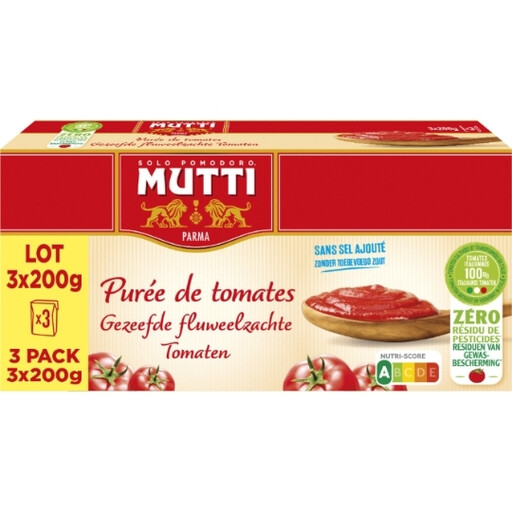 Image unavailable
Choose this as a tomato sauce base if you’d prefer to season your pasta to suit your recipe.
Pack of three 200 g portions. If salt content matters to you, check the packaging for the exact product.
No. Sugars naturally present in tomatoes are still included in the ‘of which sugars’ figure. For example, Auchan’s product pages list 5.3 g of sugars per 100 g for Zapetti Provence et Languedoc sauce and 2.9 g for Italians Do It Better Pomodoro sauce. Both are labelled as having no added sugars.
Compare their nutritional values per 100 g, particularly ‘of which sugars’ and salt, then read the ingredients lists. The DGCCRF says that presenting information per 100 g or 100 ml makes pre-packed foods easier to compare.
Not necessarily: sugar content alone doesn’t tell you whether the texture, seasoning or preparation time will suit you. Check the salt and ingredients too, and whether you’re choosing a ready-to-serve sauce or a tomato base that needs finishing.
Follow the instructions on the exact product you’ve bought. The listings for Italians Do It Better Pomodoro and Panzani Tomacouli give different storage times after opening, so don’t assume one product’s guidance applies to another.