People who prioritise monitoring fat
You compare the fat and saturates per 100 g. A claim about sugar doesn’t, by itself, address this priority.


If you’re looking to limit the fat in your pasta sauce, start by comparing the fat and saturates per 100 g in similar recipes. A ‘no added sugars’ claim addresses a different concern: naturally occurring sugars may still be present in the sauce, and the claim doesn’t mean that sugars have been reduced or that the sauce is low in fat.
You compare the fat and saturates per 100 g. A claim about sugar doesn’t, by itself, address this priority.
You want to distinguish added sugar from the sugars that occur naturally in the ingredients of a tomato sauce.
As well as fat and sugars, you should also check the salt, ingredients and any allergens that matter to you.
When comparing similar tomato sauces, check the values per 100 g first, then read the ingredients list and any claims on the recipe you’ve chosen.
| Criteria | What to check | Who it matters to |
|---|---|---|
| Fat | Compare the fat and saturates per 100 g in sauces from the same category. | To limit the fat in my sauce, I want to compare the amounts shown rather than rely on a claim about sugar. Around 46% of consumers would make this their priority. |
| Sugars | Distinguish between the ingredients list, the ‘of which sugars’ line per 100 g, and the exact wording of any sugar-reduction claim. | If I want to avoid added sugar, I also need to know how much sugar the recipe contains overall. This would be the priority for around 36% of consumers. |
| The whole recipe | Read the ingredients and any allergens that matter to you, as well as the salt per 100 g and storage instructions after opening. | If some ingredients aren’t suitable for me, the fat figures alone aren’t enough to help me choose. Around 18% of consumers would prioritise checking the whole recipe. |
According to Anses, no added sugar doesn’t mean a product contains no sugar at all. Sugars naturally present in the ingredients are still included in the ‘of which sugars’ figure.
Check this value per 100 g if the total amount of sugar matters to you. And don’t mistake this claim for a promise that sugars have been reduced.
A sauce with no added sugars isn’t necessarily the one with the least fat. For example, Carrefour’s listing for a Heinz sauce shows 4.3 g of fat per 100 g.
First compare the fat and saturates per 100 g in similar recipes, then apply your criteria for sugars.
Ingredients vary from one sauce to another. For example, Auchan’s listing for POUCE cooked tomato sauce mentions sugar and celery.
Check the ingredients list and allergen information for the product you plan to buy.
A cooked tomato sauce is one option for checking the sugar claim and nutritional values separately.
POUCE cooked tomato sauce is another recipe to compare by its nutritional values and ingredients. Don’t assume these details apply to the whole retailer.
The Sauce Tomates Cuisinées range is one option to consider when comparing ready-to-use tomato sauces.
Sauce Tomates Cuisinées is one of the meat-free tomato sauce recipes in Barilla’s range.
The Carrefour Classic’ range includes several tomato sauce recipes, including basil, cooked, Neapolitan and Provençal varieties.
This tomato purée is a base for making your own pasta sauce, not a seasoned sauce that’s ready to serve. When assessing the finished recipe, remember to include any ingredients you add.
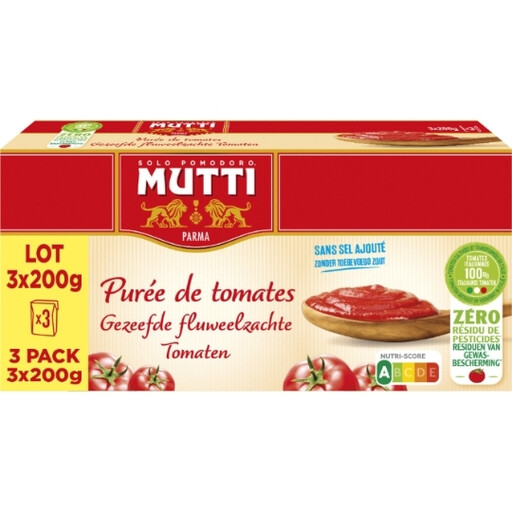 Image unavailable
Use it as a base to make pasta sauce, rather than serving it as a ready-seasoned sauce.
Pack of three 200 g portions. If fat and sugars guide your choice, check the nutritional values and ingredients for this variant on the packaging.
No. According to Anses, a product with no added sugar may still contain naturally occurring sugars. Check the ‘of which sugars’ figure per 100 g: Auchan’s listing for the Zapetti sauce mentioned above shows 5.3 g of sugars per 100 g.
Compare the fat and saturates per 100 g in sauces from a similar category. Nutri-Score can help you compare products in the same category, as Manger Bouger explains, but it doesn’t replace these figures if your specific concern is the amount of fat.
No. Carrefour’s listing for a Heinz sauce carrying this claim shows 4.3 g of fat per 100 g. Check the fat content of each recipe separately, regardless of its sugar claim.
Before buying, read the ingredients list and allergen information for the exact product. For example, Auchan’s listing for POUCE sauce mentions sugar and celery. Also follow the storage instructions on the product after opening.