People comparing salt levels
You want to check the ‘salt’ figure per 100 g, then factor in how much sauce you’ll serve and how the rest of the meal is seasoned.


To choose a pasta sauce with salt as your priority, compare the figures per 100 g for similar recipes. A Nutri-Score A or an organic label won’t tell you which has less salt. For a quick dinner, also check how to heat it, how much you need and how to store it once opened. Don’t assume that a lower salt content means the sauce is labelled as ‘reduced salt’.
You want to check the ‘salt’ figure per 100 g, then factor in how much sauce you’ll serve and how the rest of the meal is seasoned.
You’re looking for a ready-to-use sauce with simple heating instructions, so you don’t have to make a separate tomato base.
You choose the pack size based on how much you’ll use and how soon you’ll need to finish it after opening.
For a midweek dinner, start by comparing the salt per 100 g if that’s your priority. Then choose a sauce with preparation instructions and a pack size that suit the portions you’re planning.
| Criterion | What to check | Who it matters to |
|---|---|---|
| Declared salt content | Compare the ‘salt’ figure per 100 g for similar sauces, then consider how much you’ll serve. | If I want to limit the salt from the sauce, I check its nutrition information rather than relying on its Nutri-Score alone. Around 40% of consumers prioritise this comparison. |
| Quick preparation | Check the heating instructions and how much you’ll need for the meal. | When time is short in the evening, I prefer a sauce that saves me from making a separate tomato base. Around 30% of consumers put this convenience first. |
| Pack size and storage | Check the net weight and the storage instructions after opening for the product you’re considering. | If I won’t finish the pack in one meal, I want to know when I need to use the rest. Around 20% of consumers prioritise pack size and storage. |
| Ingredients and preferences | Read the ingredients list, allergen information and any organic or origin claims that matter to you. | For my pasta, I first choose a tomato and basil flavour or an ingredient feature that matters to me. Around 10% of consumers prioritise this criterion. |
According to E.Leclerc’s product listings, both Bio Village and Turini tomato and basil sauces have a Nutri-Score A, but contain 0.6 g and 1.0 g of salt per 100 g respectively.
If salt is guiding your choice, compare the salt figures in the nutrition information directly.
E.Leclerc and Auchan list 0.6 g of salt per 100 g for Bio Village organic tomato and basil sauce and 1.0 g for Auchan Bio tomato and basil sauce, respectively.
Treat the organic label as a separate consideration, and check the salt content and ingredients independently.
The sauce isn’t the only source of salt at dinner: salt added during cooking or at the table counts too.
Taste the pasta and sauce before adding salt. Herbs or spices can also change the seasoning.
According to Auchan, its 300 g tomato and basil sauce in a soft pouch should be refrigerated and used within 8 days of opening. Its 200 g Auchan Bio jar says to use within 48 hours and keep between 0 and 4 °C.
Choose a pack size that suits the portions you’re planning, and follow the instructions on the product you buy.
The range includes a ready-to-use tomato and basil sauce to serve with pasta.
Barilla’s Basilico tomato and basil sauce is available in 200 g and 400 g packs.
Carrefour’s range includes a 420 g jar of Classic’ tomato and basil sauce.
Two tomato and basil products to compare: Turini, at 420 g, and organic Bio Village, at 350 g.
The tomato and basil products considered include a 300 g soft pouch and a 200 g organic jar.
These sauces can be served with pasta for a midweek dinner. To choose based on salt, compare the nutrition information for the products available and check that the pack size suits your portions.
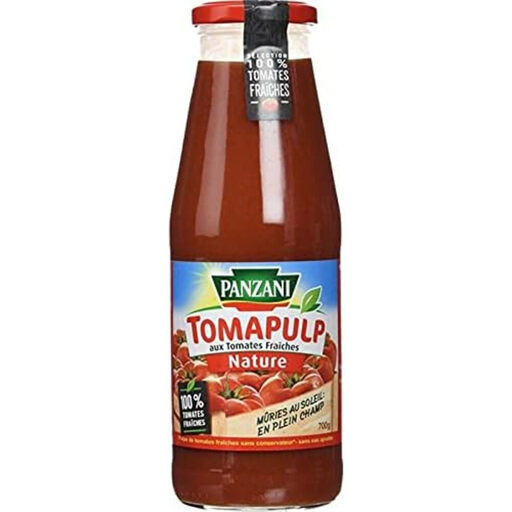 Image unavailable
A pack size to consider if you use sauce for several portions of pasta.
Stated pack size: 700 g. Check the salt content and storage instructions after opening on the product you buy.
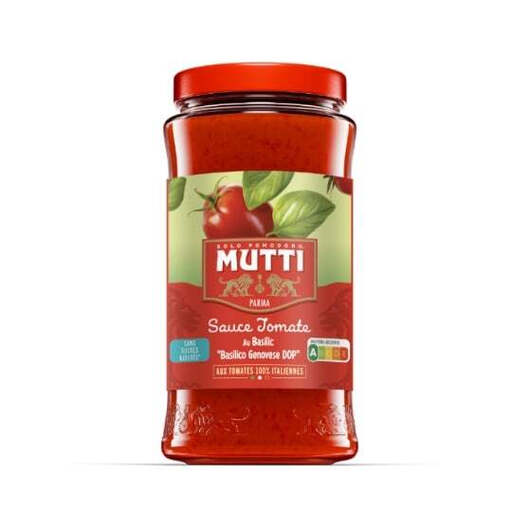 Image unavailable
A tomato and basil sauce to consider serving with pasta for a midweek dinner.
Before choosing it for its salt content, check the nutrition information and storage instructions on the product you buy.
If the sauces are used in a similar way, compare their ‘salt’ figures per 100 g, then factor in how much you’ll serve. For relevant prepacked foods in France, the Directorate-General for Competition, Consumer Affairs and Fraud Control states that nutrition declarations are given per 100 g or 100 ml.
No. According to E.Leclerc, both Turini and Bio Village tomato and basil sauces have a Nutri-Score A, but contain 1.0 g and 0.6 g of salt per 100 g respectively. If salt is your priority, check its figure in the nutrition information.
No. E.Leclerc and Auchan list 0.6 g of salt per 100 g for Bio Village organic tomato and basil sauce, compared with 1.0 g for Auchan Bio tomato and basil sauce. Compare the figures for the specific recipes you’re interested in.
Check the ingredients list, any highlighted allergens, the net quantity and the nutrition information. The Directorate-General for Competition, Consumer Affairs and Fraud Control explains this information for prepacked foods sold in France. Also check the storage instructions for the sauce you choose.