Organisers keeping an eye on salt
You’re preparing pasta for a group and want to compare the salt content per 100 g, rather than relying on the words ‘tomato sauce’ on the label.


For pasta at a school fundraiser, choose a tomato base if you want to decide which ingredients to add. A ready-made sauce needs less preparation, but its recipe is already set. In either case, compare the salt content per 100 g of products intended for the same use, then check the allergens on the exact product and follow the school’s guidance.
You’re preparing pasta for a group and want to compare the salt content per 100 g, rather than relying on the words ‘tomato sauce’ on the label.
You need to check the label of the product you’ll be using against the school’s guidance. The DGCCRF states that allergenic ingredients must be emphasised on prepacked foods. Their presence and any possible traces vary from product to product.
You need to choose between a ready-made sauce and a tomato base to season yourself, taking into account the preparation involved and how to store the product after opening.
Start by deciding how much preparation you want to do: a tomato base lets you choose the seasoning, while a ready-made sauce already has its own recipe. Neither category guarantees a lower salt content just because of its name.
Choose this if: you want to decide how to season the dish for your group.
Bear in mind: you’ll need to add your chosen ingredients and cook the sauce. A tomato base may not have the same texture as a ready-made sauce.
Choose this if: you’d prefer a sauce that’s already seasoned and needs less preparation.
The trade-off: the ingredient lists for the Barilla and Carrefour Classic’ cooked tomato sauces checked by Carrefour both include added salt.
| Criteria | What to check | Who is it for? |
|---|---|---|
| Salt content | Compare the ‘salt’ line per 100 g for products intended for the same use, as set out in the nutritional information described by the DGCCRF. | I want to choose the seasoning for a large batch without assuming that a tomato-based sauce is low in salt. Around 42% of consumers would make this their priority. |
| Allergens and school guidance | Read the ingredients, allergens and any possible traces listed for the exact product, then check them against the school’s procedure. | Before cooking for the fundraiser, I need to know whether the product I’m using meets the school’s requirements. This would be the main concern for around 33% of consumers. |
| Preparation and storage | Choose containers to suit the quantity you’re making and check the instructions for after opening. Auchan’s listing for Pouce sauce says to refrigerate it and use it within 48 hours. | I want to organise the preparation without opening more sauce than I need or forgetting about leftovers. This would come first for roughly 25% of consumers. |
The presence of tomatoes alone doesn’t tell you how much salt a product contains. Carrefour lists salt among the ingredients of the Barilla and Carrefour Classic’ cooked tomato sauces it checked.
Compare the salt content per 100 g on the packaging of the products you’re considering before you choose.
Barilla describes its Tomates Cuisinées sauce as gluten-free, while a Carrefour listing for a different tomato sauce mentions possible traces of wheat and other allergens. A statement about one product doesn’t apply to an entire brand or category.
Check the information on the batch you’ll actually be using and review it in line with the school’s guidance.
For its Pouce cooked tomato sauce, Auchan says to refrigerate it and use it within 48 hours of opening.
Plan how many containers you’ll need for the quantity you’re preparing, and follow the instructions for the product you buy.
Opening too many containers can leave you with leftovers that won’t be used within the recommended timeframe.
These examples refer to specific products. Check the label of the one you plan to use, and don’t assume its characteristics apply to the whole brand.
An option if you want to make your own sauce from a tomato base.
The Tomates Cuisinées sauce is a ready-made option.
The tomato and basil sauce is another ready-made recipe to consider.
Pouce cooked tomato sauce is one product for which a salt content is listed.
These tomato purées are suitable for making a pasta sauce that you can season yourself. For each one, compare the nutritional information and check the batch label and the school’s guidance before use.
 Image unavailable
An option to consider if you’d like to make and season the pasta sauce yourself.
Size: 500 g. Check the product for its salt content per 100 g, allergens and instructions for after opening.
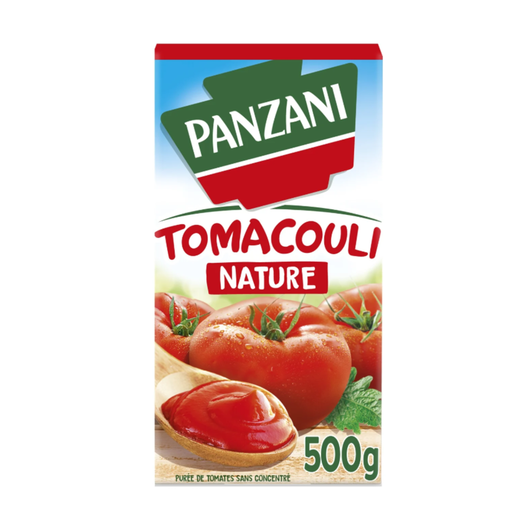 Image unavailable
Another base to season for a group pasta meal.
Size: 500 g. Check the salt content per 100 g, allergen information and storage instructions for this product.
Compare the ‘salt’ line per 100 g for products intended for the same use. The DGCCRF says that the nutritional information for prepacked foods is given per 100 g or 100 ml, so use the same basis when comparing products.
No. Information varies by product. Barilla describes its Tomates Cuisinées sauce as gluten-free, while Carrefour’s listing for Carrefour Bio tomato and basil sauce mentions possible traces of wheat. Check the packaging of the product you’ll be using and follow the school’s guidance.
The words ‘tomato purée’ alone don’t tell you whether a product is lower in salt. Check the salt content per 100 g for the exact product and compare it with products intended for the same use before deciding whether it meets your needs.
Follow the instructions for the product you’re using and factor them into your preparation schedule. For its Pouce cooked tomato sauce, Auchan says to refrigerate it after opening and use it within 48 hours.