People who check salt levels first
You check the value per 100 g before choosing a pasta sauce. ANSES lists sauces and condiments among dietary sources of sodium, so the recipe name is no substitute for checking the label.


To choose a lower-salt pasta sauce for Christmas, compare the “salt” value per 100 g across products intended for the same use, rather than relying on the recipe name. A ready-made sauce cuts down on preparation, while tomato purée lets you control the seasoning you add but needs to be turned into a finished sauce. In either case, choose a size that suits the number of guests and check how to store the product after opening.
You check the value per 100 g before choosing a pasta sauce. ANSES lists sauces and condiments among dietary sources of sodium, so the recipe name is no substitute for checking the label.
You’d rather add your own ingredients to tomato purée and decide how much salt to use. However, a tomato base takes more preparation than a ready-to-serve sauce.
You’re looking for a size that suits the amount of pasta you’re planning, without adding extra steps at serving time. The product’s weight and storage instructions after opening also matter.
For Christmas dinner, first decide whether you want to season a tomato base yourself or simply heat up a ready-made sauce. Then compare salt levels across products intended for the same use and choose a size to suit the number of guests.
| What to consider | What to check | Who is it for? |
|---|---|---|
| Salt content | Compare the “salt” value per 100 g across sauces intended for the same use. If you see a “reduced salt” claim, check the product’s nutrition declaration too. | I want to compare sauces by their salt content, rather than guessing from words such as “basil” or “fresh tomatoes”; around 42% of consumers put this comparison first. |
| Seasoning | Tell the difference between tomato purée that needs seasoning and a sauce that is already seasoned. Check the ingredients and salt content of the product you choose. | If I’m making the sauce myself, I want to choose the ingredients and how much salt to add. Around 33% of consumers prioritise this control over seasoning. |
| Size and storage | Check the net weight and the product’s storage instructions after opening, including whether it needs refrigerating and how long it will keep. | When serving several guests, I mainly need a suitable quantity and an easy serving option, without too many leftovers; around 25% of consumers prioritise this. |
These claims describe two different things. An Auchan Pomodoro sauce carries a claim relating to added sugars and contains 0,98 g of salt per 100 g.
If you’re choosing based on salt, compare the relevant value across sauces intended for the same use.
Tomato purée can be used as a base for your recipe, while a ready-made sauce is already seasoned.
Choose according to how much preparation you want to do, then compare salt levels within the category you’ve chosen.
Finishing a sauce from a base takes time and, depending on the recipe, requires other ingredients.
Instructions vary by product: Auchan says its tomato and basil sauce in a pouch should be kept in the fridge and used within eight days of opening, compared with five days for an Auchan Pomodoro sauce.
Plan how much you’ll need for your guests and follow the storage instructions on the packaging you buy.
Panzani describes Tomacouli Nature as tomato purée that can be used as a base for a pasta sauce.
Barilla offers tomato sauces for pasta and says its Sauce tomates cuisinées can also be used as a sauce base.
Carrefour offers a 420 g jar of Classic' tomato and basil sauce.
Auchan offers a 300 g tomato and basil sauce in a resealable pouch.
Lidl France offers a 560 g pack of Baresa tomato and onion sauce.
These tomato purées are suitable if you want a base to season for pasta. They aren’t ready-to-serve sauces, so check each product’s label to compare salt content or any relevant nutrition claim.
 Image unavailable
A tomato base to season to suit your pasta recipe.
To compare its salt content with another base, check the per-100 g values on the packaging. Follow the storage instructions after opening.
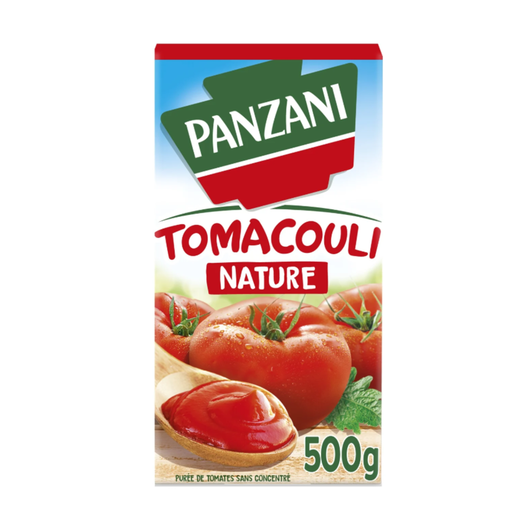 Image unavailable
This tomato purée is a good choice for a pasta sauce whose seasoning you want to finish yourself.
Before adding salt to your recipe, check the ingredients and per-100 g value on the packaging. Also check the instructions for storage after opening.
No. Also compare the “salt” value per 100 g across sauces intended for the same use. The DGCCRF notes that nutrition claims are regulated and only authorised claims may be used. The claim doesn’t replace checking the nutritional values for the product you choose.
Not necessarily: a claim about added sugars tells you nothing about the salt content. An Auchan Pomodoro sauce contains 0,98 g of salt per 100 g, so check both details separately on each product.
Follow the storage instructions on the product you buy, as they vary between products. Auchan says its tomato and basil sauce in a pouch can be kept in the fridge for eight days, while a different Pomodoro sauce should be refrigerated after opening and used within five days.
Choose tomato purée if you want to make the seasoning yourself, or a ready-made sauce if you’d like to cut down on the steps before serving the pasta. Either way, compare the salt per 100 g across products intended for the same use and plan a quantity to suit the number of guests.