
Livraison le jour même ou le lendemain

Qualité garantie

Débloquez vos offres de bienvenue: Livraison GRATUITE | Jusqu'à -80 % | 30 jours d'essai gratuits à JoyPlus
Téléchargez l'application
Buying cookware is about more than choosing a colour or diameter. A saucepan may turn out to be too small for family portions, a frying pan can quickly lose its performance if its coating is mishandled, and a non-magnetic stockpot will be unusable on an induction hob.
Before putting together your cookware collection, check three essential points: the material, compatibility with your hob and how you actually plan to use it. Here are the criteria to review to avoid impractical purchases and find the saucepan, Dutch oven or casserole that will genuinely fit into your everyday routine.
The phrase ‘suitable for all hobs’ should always be checked in the product specifications. To work on induction, the base will generally need to contain a magnetic material. Glass, ceramic and some aluminium cookware will not be detected directly by the hob.
An induction adapter can allow you to use certain non-magnetic pans, but it adds an extra step and becomes very hot during cooking. It does not turn every piece of cookware into a saucepan genuinely designed for induction.
A non-stick saucepan makes cleaning easier, but it requires a few precautions: avoid metal utensils, abrasive sponges and heating it when empty. As soon as the coating starts to flake or deteriorate, it is best to replace the cookware.
The claims ‘PFAS-free’, ‘PFOA-free’ and ‘PTFE-free’ do not all mean the same thing. Check the detailed composition provided by the manufacturer rather than drawing conclusions from a simple marketing claim.
A heavy casserole retains heat well, but can become difficult to move once full. Conversely, a very light pan heats quickly without necessarily offering the same stability. Diameter is not everything either: two 24 cm stockpots can have very different capacities depending on their height and the shape of their cooking chamber.
Finally, ‘dishwasher-safe’ does not mean that repeated washing will preserve the coating or exterior finish indefinitely. To maintain the cookware’s appearance and performance for longer, hand washing is often preferable.
Stainless steel cookware is valued for its rigidity and relatively simple care requirements. However, check that the base is suitable for your hob. The designations stainless steel 304 and 316L refer to material specifications found in some product listings; they do not replace the need to read the usage instructions.
Aluminium heats quickly and can feature a non-stick or ceramic coating. It is well suited to sauces, pasta and everyday cooking, provided you do not heat it when empty and follow the maximum temperature stated.
Borosilicate glass lets you monitor the cooking process and, depending on the product description, does not absorb odours. However, it remains sensitive to thermal shock: do not place a hot pan on a cold surface and follow the manufacturer’s temperature limit carefully.
If a pan is not compatible with induction, you can consider an adapter disc advertised as compatible. Place it flat on the cooking zone, then place the saucepan on top, remove the detachable handle before cooking and wait until it has cooled completely before cleaning it.
For one or two people, a saucepan of less than 2.5 litres is generally enough for sauces, noodles, milk or small portions. For a family, a Dutch oven, soup pot or 4 to 6-litre stockpot gives you more room for pasta, vegetables and slow-cooked dishes.
An insulated handle, transparent lid, pouring spout or steamer basket can also make everyday cooking easier. However, these features need to be weighed against the storage space available and the total weight of the cookware.
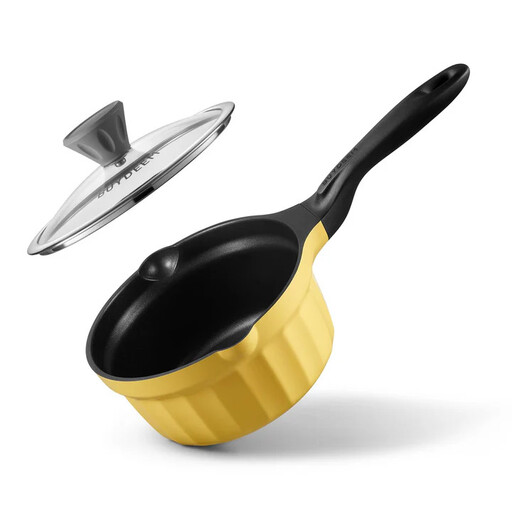
Why this choice suits this profile : with its 1.9 qt capacity, this model is suitable for small quantities, sauces, noodles and meals for one or two people.
The product listing states that it is compatible with all hob types and specifies the precautions to take with the non-stick coating.
Cast aluminium, integrated pouring spout and a coating advertised as free from PFOS, PFOA, lead and cadmium.
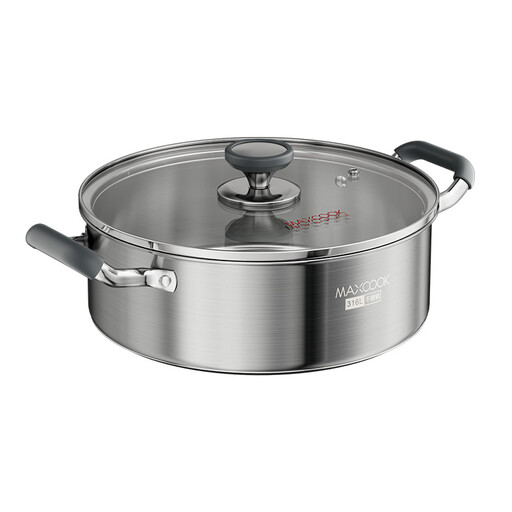
Why this choice suits this profile : its large capacity is ideal for families and for anyone who regularly prepares soups, slow-cooked dishes or meals to share.
Its composite base is advertised as compatible with induction, gas, electric, ceramic and halogen hobs.
Glass lid, silicone handles and polished inner walls, according to the product description.
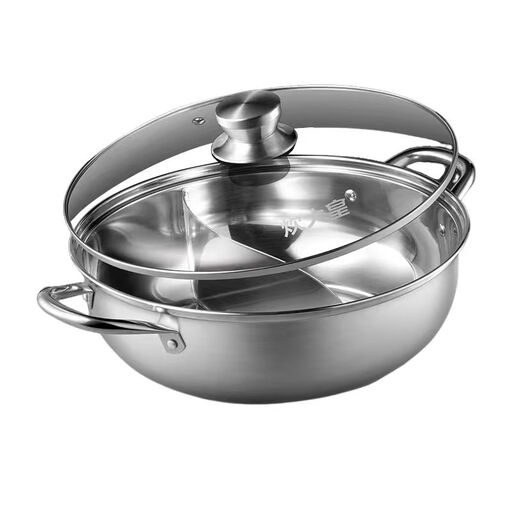
Why this choice suits this profile : its central divider lets you prepare two broths or two recipes at the same time, making it ideal for sociable meals.
Its 30 cm diameter and advertised induction compatibility reduce uncertainty around capacity and hob type.
304 stainless steel, two compartments and advertised use on gas, electric and induction hobs.
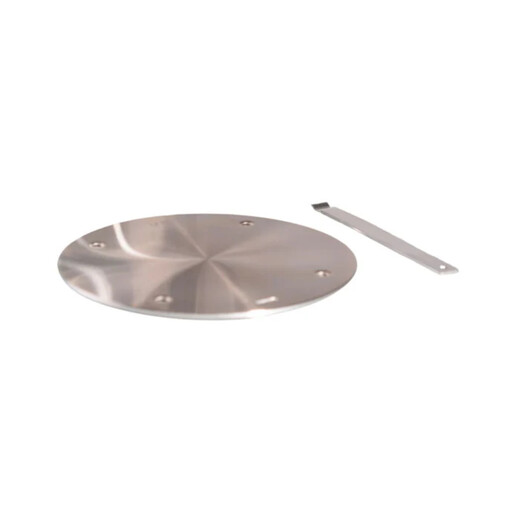
Why this choice suits this profile : it allows you to continue using certain non-magnetic pots or frying pans after switching to induction.
The product listing states that it is intended for induction hobs only and must be placed flat before the pan is put on top.
Steel construction, detachable handle and four integrated feet to encourage airflow beneath the disc.
We have put together a complete, real-time updated list of products that meet these demanding selection criteria and European safety standards.
A piece of cookware’s lifespan depends on its material, how often you use it and how well you care for it. To keep it in good condition for longer:
Glass or ceramic cookware requires particular care when temperatures change suddenly. A non-stick saucepan should be replaced as soon as its surface starts to flake or peel away.
Stainless steel with a magnetic base will generally work without difficulty in a kitchen equipped with an induction hob. Aluminium, glass and ceramic require compatibility to be explicitly stated or the use of a suitable adapter. A magnet can provide an initial indication, but the product listing remains the best source of information.
A cookware set can reduce the cost per piece and provide several complementary sizes. It is a worthwhile option if you need a saucepan, Dutch oven, soup pot and large-capacity pan. However, if you do not cook often or already own several pieces of cookware, buying individually helps you avoid items that will simply remain at the back of a cupboard.
Yes, in some cases, with an adapter disc designed for induction. Check its diameter, place it flat and follow the safety instructions: its surface can become extremely hot. For everyday or intensive use, cookware that is directly compatible with induction will nevertheless be easier and safer to handle.