
Livraison le jour même ou le lendemain

Qualité garantie

Débloquez vos offres de bienvenue: Livraison GRATUITE | Jusqu'à -80 % | 30 jours d'essai gratuits à JoyPlus
Téléchargez l'application
Choosing the right Pampers baby nappies is about more than simply comparing pack prices. Your child’s weight, mobility, how long the nappy is worn and the sensitivity of their skin all directly affect their comfort and the risk of leaks. A poorly fitting nappy can also lead to repeated purchases, more clothes to change and a daily budget that quickly adds up.
The age shown on some packaging is only a guideline. Two babies of the same age can have very different builds. When choosing a size, it is therefore best to prioritise the weight range specified by the manufacturer.
For example, Pampers size 4 nappies generally cover 9 to 14 kg, while some Pampers pants in the same size are designed for 9 to 15 kg. These differences show why it is better to check the product listing rather than relying solely on the size number.
A larger pack is not necessarily the best-value option. To compare Pampers nappies at the best price, calculate their cost per nappy and consider how many changes are needed each day. A large pack may also prove impractical if your baby is approaching the upper weight limit and will soon need the next size up.
Even a nappy marketed as leak-proof must be positioned correctly. The fastenings should hold securely without pressing on the tummy, the barriers around the thighs should be fully unfolded and the back should come up high enough. A nappy that is too small may leave marks and leak, while one that is too large can create gaps around the legs.
Here is a practical guide to some of the available options:
These indications vary by range. Always check the weight stated on the product listing and look out for any signs of tightness after a few uses.
When choosing baby nappies for night-time, look at the construction of the absorbent core, whether there is a wetness indicator and how the back is designed. According to the product description, the Baby-Dry ranges claim protection for up to 12 hours. This does not mean you should routinely wait 12 hours before changing the nappy: change it as soon as it is soiled or wet.
Stop & Protect back pockets, leg barriers and stretchy waistbands are all useful features to compare. However, they cannot eliminate every risk of leakage, particularly in the event of loose stools, an unsuitable size or an unusual sleeping position.
For baby nappies designed for sensitive skin, check the specific claims rather than relying on general promises. Some Pampers options state that they have been dermatologically tested and contain no perfume or no fragrance allergens listed under European regulations. The Harmonie models also mention an outer layer made with 50% plant-based ingredients, along with cellulose sourced from FSC-certified sources.
OEKO-TEX Standard 100 certification indicates that the product has been tested for certain undesirable substances according to the criteria of this certification. It is not a medical guarantee. Similarly, the term hypoallergenic refers to the formula or tests carried out by the manufacturer; it does not mean that there is absolutely no risk of irritation. If redness persists, stop using the product and seek advice from a healthcare professional.
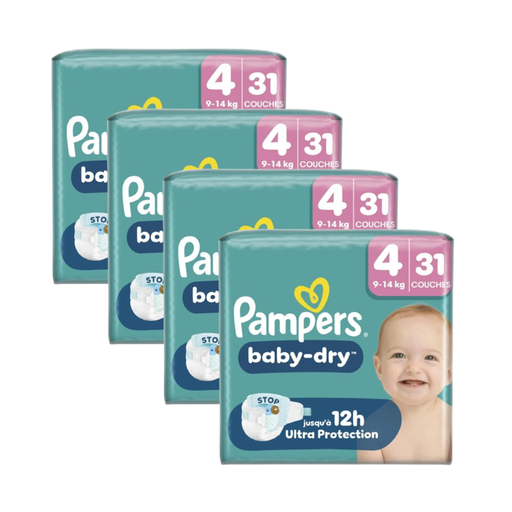
Why this choice suits this profile : A large pack can work well for families who already know the right size and want to avoid reordering too often for a baby weighing 9 to 14 kg.
The weight range and number of nappies are clearly stated, making it easy to calculate the cost per nappy before ordering.
Wetness indicator, Stop & Protect back pocket and fast-absorbing core, according to the product description.
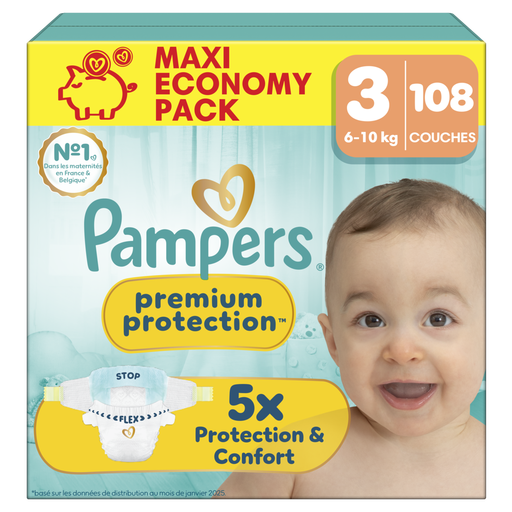
Why this choice suits this profile : This range is aimed at parents looking for a soft feel, fast absorption and comfort-focused details for a baby weighing 6 to 10 kg.
The features go beyond a simple promise of softness: absorbent cells, a Flex & Protect waistband and a back pocket are all clearly detailed.
Dermatologically tested according to the product listing, with no fragrance allergens listed by the European Union.
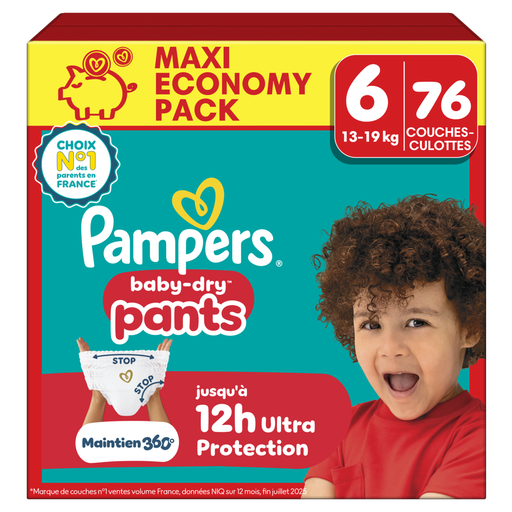
Why this choice suits this profile : The pull-on design suits active children weighing 13 to 19 kg, particularly for trips out, nursery or changes that have turned into a wrestling match.
The stretchy 360° waistband moves with your child, while the tear-away sides make it quick to remove the nappy.
Back pocket, leg barriers, absorbent core and adhesive strip for rolling up the nappy after use.
It is also worth comparing pack sizes: a box of 124 Pampers size 4 nappies or a pack designed to last a month can reduce the cost per nappy, but only if the size remains suitable throughout the period of use.
We have put together a complete, real-time updated selection of products that meet these demanding selection criteria and European regulatory safety requirements.
It depends on how much it has absorbed and whether it contains urine or stools. Even when a product promises extended protection, change a soiled nappy promptly and check regularly that your child is comfortable.
Persistent red marks, repeated leaks despite correct positioning or fastenings that are difficult to bring together in the centre may indicate that the size has become too small. Check the weight range for the next size up and compare the fit as well.
No marketing claim can guarantee the same tolerance for every baby. Check the list of materials, choose fragrance-free options if that suits your needs and stop using the product if irritation persists.