
Livraison le jour même ou le lendemain

Qualité garantie

Débloquez vos offres de bienvenue: Livraison GRATUITE | Jusqu'à -80 % | 30 jours d'essai gratuits à JoyPlus
Téléchargez l'application
Choosing Pampers nappies isn't just about comparing the price of packs. Between the recommended weight, the number of nappies, overnight protection and the differences between the Baby-Dry, Premium Protection, Harmonie and Baby-Dry Pants ranges, the wrong choice can quickly become uncomfortable or lead to leaks.
Here are the criteria to check before placing your order, along with a selection suited to different parenting needs.
Age gives you a general idea, but weight is the most reliable guide. Two babies of the same age may need Pampers size 2, size 3 or size 4 depending on their build. A nappy that's too big can let urine escape around the legs. On the other hand, one that's too small will press on the tummy and quickly reach its limit.
Weight ranges sometimes overlap. Size 3 is generally suitable for babies 6 to 10 kg, while size 4 is often recommended for 9 to 14 kg. Also look out for marks on the skin, fastenings you have to redo regularly, and repeated leaks.
A jumbo pack of nappies might look like a bargain, but the unit price varies depending on the range and pack size. To compare offers, divide the pack price by the number of nappies or pull-ups.
Also check the contents listed on the product page and on the packaging. Some commercial information can vary by country or format sold. The number of pieces, size and weight range should all be consistent before you confirm your basket.
Claims like "up to 12 hours of protection" refer to performance under certain conditions. They don't mean you can skip regular changes, especially after a bowel movement or in very hot weather. Your child's build, sleeping position and how you adjust the fastenings also play a key role.
A leak-proof nappy must first be fitted correctly: leg cuffs fully unfolded, back positioned properly and waist snug enough without being too tight.
Before choosing Pampers size 2, Pampers size 3, Pampers size 4, Pampers size 5 or Pampers size 6 nappies, compare your child's current weight with the one shown on the pack.
Here are the main guidelines for the references in this selection:
These values can vary between a standard nappy and a pull-up. Always check the label on the specific product you choose.
Nappies with a wetness indicator change colour when they're wet. This feature can be handy with a newborn, when changes are frequent and you'd rather not open the nappy every time you check.
However, it doesn't measure how saturated the nappy is and doesn't replace checking it yourself. The Premium Protection size 0, as well as several Harmonie and Baby-Dry references in this selection, offer this feature.
If your baby has sensitive skin, look at the specific details rather than just the marketing claims. Some Pampers nappies for sensitive skin are described as dermatologically tested, fragrance-free or free from allergenic fragrances listed in European regulations.
The relevant references also mention OEKO-TEX Standard 100, a certification that checks for certain undesirable substances in tested items. It doesn't mean all risk of irritation is eliminated. If redness persists, stop using the product and seek advice from a healthcare professional.
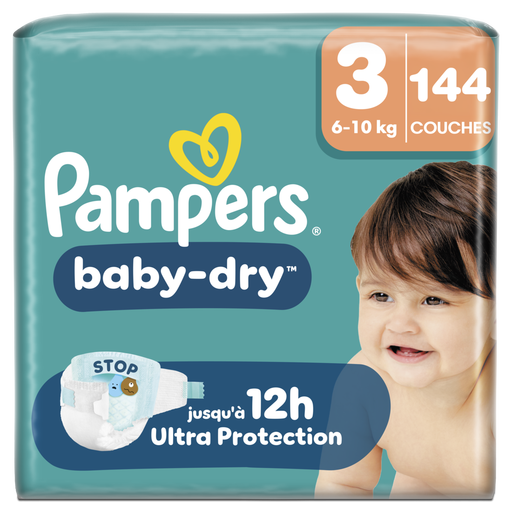
Why this choice suits this profile: This large pack can work well for parents who already know the Baby-Dry fit and want to cut down on frequent purchases for a baby weighing 6 to 10 kg.
The size and weight are clearly stated. The product page also mentions a wetness indicator and a Stop & Protect back pocket.
A fast-absorbing core, a ComfortTouch outer cover and a large pack worth comparing against the price per nappy.
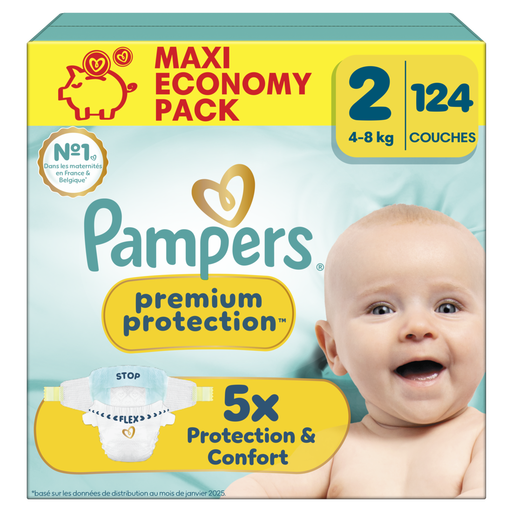
Why this choice suits this profile: This range is aimed at parents who value a gentle feel against the skin and fast absorption for a baby weighing 4 to 8 kg.
The choice is based on verifiable details: weight range, repositionable fastenings, back pocket and umbilical cut-out not applicable to this size.
Over 1,000 micro-absorbing cells claimed, ultra-soft materials and dermatologically tested as stated on the product page.
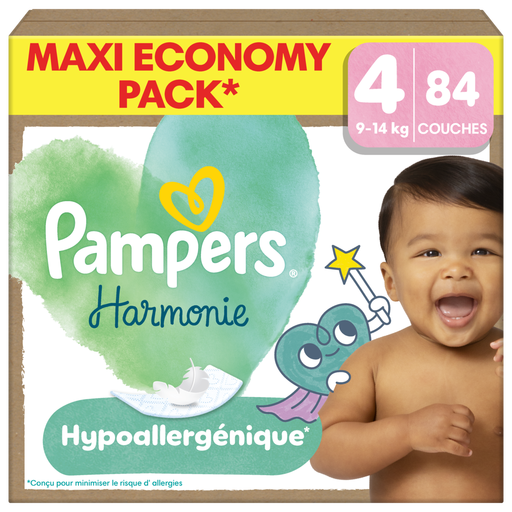
Why this choice suits this profile: For a baby weighing 9 to 14 kg, this range combines a topsheet that is partly plant-based with cellulose from FSC-certified forests, according to the product page.
The "plant-based" claim refers only to the stated topsheet: it doesn't mean the entire nappy is made from renewable materials.
A wetness indicator, a Stop & Protect pocket and OEKO-TEX Standard 100 certification are all stated.
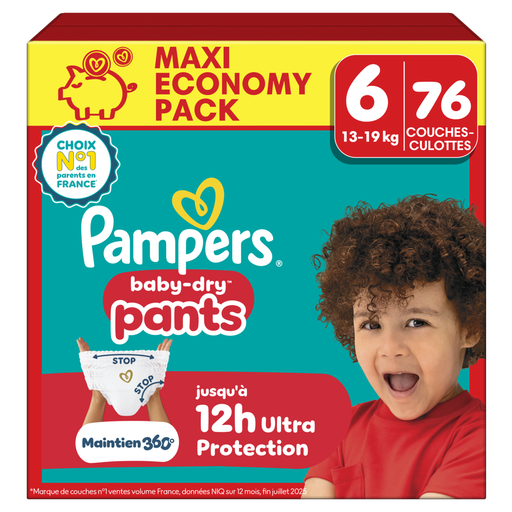
Why this choice suits this profile: Parents of an active child weighing 13 to 19 kg may prefer the quick pull-on design and 360° stretchy waistband.
The pull-up design avoids struggling with fastenings on the go, but it still needs to fit snugly around the legs to minimise leaks.
Leg cuffs, a back pocket, tear-away sides for removal and an adhesive strip for rolling up the used pull-up.
We've put together a full, real-time updated list of products that meet these strict criteria as well as European safety regulations.
At night, go for a fit that covers the back and legs properly, with an absorbent core and, where the product page specifies it, a back pocket. Night-time nappies shouldn't be left on after a bowel movement or if your child seems uncomfortable, though.
For a child who walks or wriggles during changes, Pampers pull-ups can be more practical. They go on like underwear, but aren't necessarily suitable for the first few months, when lying down makes nappies with fastenings easier to use.
Move up a size if the fastenings are at their limit, if marks around the legs persist, or if leaks become frequent despite a correct fit. Always compare your child's weight with the range given for the new size.
Some references are described as dermatologically tested, fragrance-free or designed for sensitive skin. That doesn't guarantee the same tolerance for every baby. Check the ingredients, change the nappy regularly and stop using the product if irritation occurs.
No. A nappy can include plant-based materials or certified cellulose while still containing other synthetic components. Read the full list of ingredients and clearly distinguish between the material against the skin, the absorbent core and the packaging.