
Livraison le jour même ou le lendemain

Qualité garantie

Débloquez vos offres de bienvenue: Livraison GRATUITE | Jusqu'à -80 % | 30 jours d'essai gratuits à JoyPlus
Téléchargez l'application
Choosing Pampers nappies for your baby isn't simply about comparing the number of nappies in a pack. Your child's weight, their level of mobility, how often you change them, and the sensitivity of their skin all directly affect comfort and the risk of leaks. A poorly fitted nappy can quickly cost you more in extra changes, even when the pack price seems good.
Here are the main criteria to consider before buying, along with a selection of models suited to different family situations.
The age shown on some packaging is just a rough guide. Two children of the same age can have very different body shapes. The most reliable criterion is weight in kilograms, checked against how the nappy actually fits around the waist and thighs.
For example, size 4 nappies generally suit children weighing between 9 and 14 or 15 kg, depending on the range. Size 5 nappies and size 6 nappies can also show different weight ranges depending on whether they are standard nappies or Pampers pull-up pants.
A nappy can have an excellent absorbent core without being perfectly suited to your child's shape. Leaks often appear at the back, around the legs, or when the nappy has become too small. The Stop & Protect back pocket, the side barriers and the stretchy waistband should all be considered together.
Claims like "night" or "up to 12 hours" correspond to the features stated for certain products. They do not mean you can skip changing the nappy when it is soiled or very wet.
Pampers nappies in bulk packs can sometimes reduce the price per nappy. But a large stock quickly becomes cumbersome if your child moves up a size quickly. To try a new range, it is better to start with a small pack to check the fit, whether it causes any discomfort, and how your baby's skin reacts.
Start by checking the weight range shown on the packaging. A nappy that is too tight leaves marks and can restrict movement; a nappy that is too loose creates gaps around the legs and back, which encourages leaks.
For babies who move around a lot, leak-proof baby nappies need to follow their movements without slipping. Pull-up pants usually have a 360° stretchy waistband and are easier to put on when your child refuses to lie still.
Ultra-absorbent nappies rely on a core made from absorbent materials designed to lock in moisture. Some Pampers Premium Protection nappies claim to have more than 1,000 absorbent cells or micro-pockets. This is a feature stated by the manufacturer, and should be assessed alongside the fit and how often you change the nappy.
For night-time, look in particular for:
Nappies with a wetness indicator change colour when they come into contact with urine. This can be a handy guide for newborns and during the first few months, when changes are particularly frequent.
For nappies designed for sensitive skin, check the information on the packaging: absence of perfume allergens listed by the European Union, whether lotion is present, the materials used, and any certifications shown. The products featured below mention dermatological testing or OEKO-TEX Standard 100 certification, according to their product information. These details describe the product, but do not guarantee it will suit every child. If irritation persists, stop using the product and seek advice from a healthcare professional.
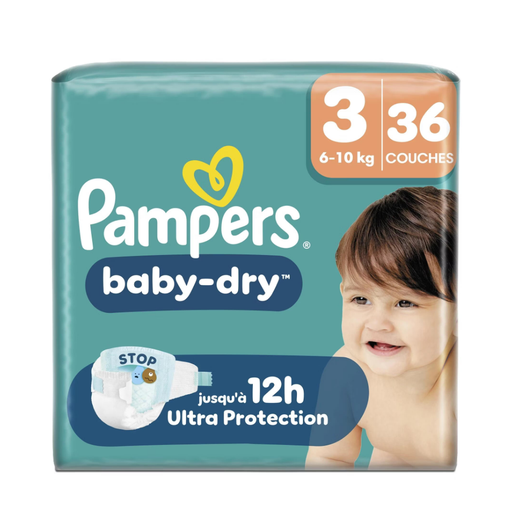
Why this choice suits this profile: A pack of 36 nappies lets you try the range without immediately having a large stock. It suits babies from 6 to 10 kg and includes a wetness indicator.
The recommended weight and the small pack size reduce the risk of buying a large quantity in the wrong size.
Fast-absorbing core, wetness indicator and Stop & Protect back pocket, according to the product information.
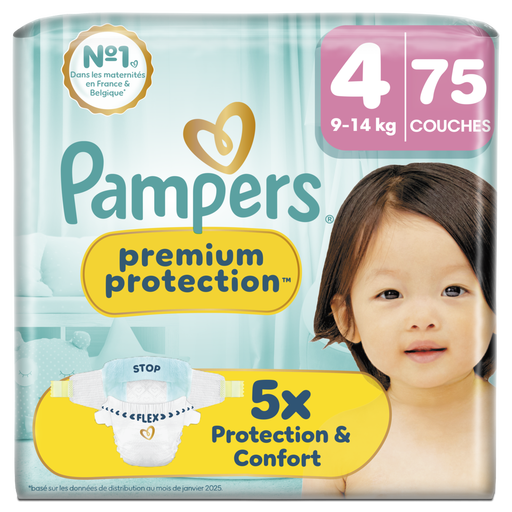
Why this choice suits this profile: This range is aimed at parents who want a nappy that feels soft against the skin and offers well-structured protection, day and night.
The product information highlights instant absorption, the back pocket and the micro-cells: several concrete features rather than a general promise.
Size 4 for 9 to 14 kg, soft materials, wetness indicator and 0% perfume allergens listed by the European Union, according to the product information.
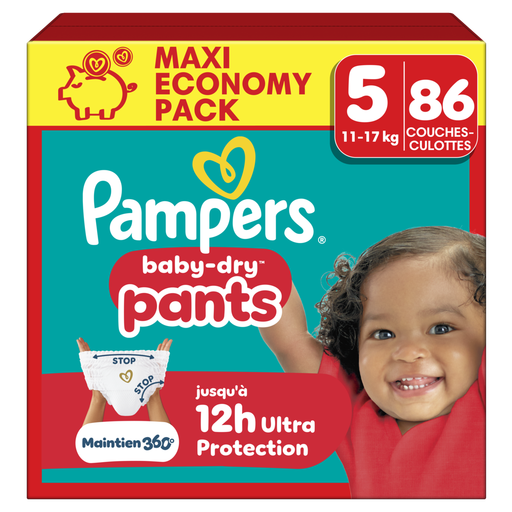
Why this choice suits this profile: Pampers pull-up pants are ideal for active children from 11 to 17 kg, who move around a lot or are starting to get dressed standing up.
The 360° waistband and the barriers around the legs help stop the nappy from shifting during play and changes of position.
One-step pull-on, tear-away sides and an absorbent core claimed to provide protection for up to 12 hours.
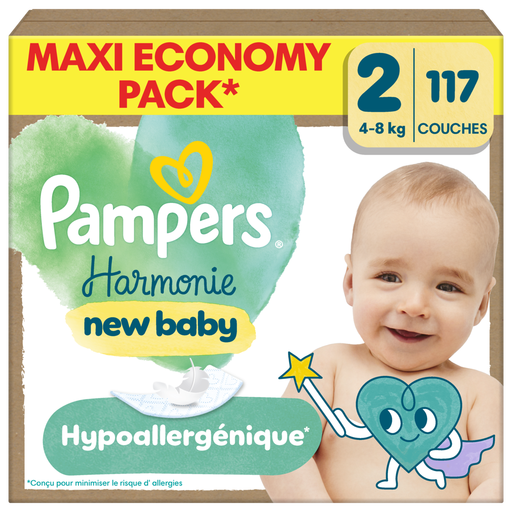
Why this choice suits this profile: This range is designed for babies from 4 to 8 kg and for parents who are careful about the materials that come into contact with their baby's skin and the stated composition.
The weight indications, the wetness indicator and the details about the materials allow you to make a decision based on clear criteria.
Top sheet made from 50% plant-based ingredients, cellulose from FSC-certified forests according to the product information, and a pack of 117 nappies.
We have selected a complete, real-time updated list of products that meet these demanding selection criteria and European safety regulations.
Size 4 generally corresponds to this weight range. However, always check the specific indications for the range you choose: Pampers Baby-Dry and Premium Protection state a compatibility of 9 to 14 kg here, while some size 4 pull-up pants cover children from 9 to 15 kg. If leaks appear even when the nappy is positioned correctly, try the next size up.
According to the product information, Pampers Baby-Dry nappies have a fast-absorbing core and a Stop & Protect back pocket. For night-time, choose the size that matches your child's weight, make sure the barriers around the legs are properly unfolded, and change the nappy as soon as it is soiled.
The price per nappy depends on the pack size, the number of nappies and any promotions available. Pull-up pants can save you time when changing an active child, but they are not automatically cheaper. Compare the price per nappy, the quantity you actually use, and the size before opting for a bulk pack.