
Livraison le jour même ou le lendemain

Qualité garantie

Débloquez vos offres de bienvenue: Livraison GRATUITE | Jusqu'à -80 % | 30 jours d'essai gratuits à JoyPlus
Téléchargez l'application
The diaper aisle can be a real headache for parents. Between the different product lines, overlapping sizes, and marketing jargon, it's easy to get lost. As the Head of Product Recommendations at Joybuy, my mission is to help you make sense of it all. The goal isn't to find the one "perfect" diaper, but the one that truly fits your baby's needs and your lifestyle.
To avoid buyer's remorse, here are the 3 most common pitfalls to avoid:
To avoid these pitfalls, focus on a few key criteria that will make all the difference for your baby's comfort and your peace of mind.
Choosing the right size is the first step to effective protection. A diaper that's too small will constrict your baby and cause overflow leaks. Too large, and it will gape at the thighs and back, leaving the door open for accidents.
Don't hesitate to move up to the next size (from a size 3 diaper to a size 4 diaper, for example) even if your baby hasn't reached the maximum weight indicated, especially if leaks become frequent.
The type of diaper should adapt to your child's development.
Pampers has two flagship lines that stand out with different promises.
To help you make your choice, here is our curated selection, tailored to specific parent and baby profiles.
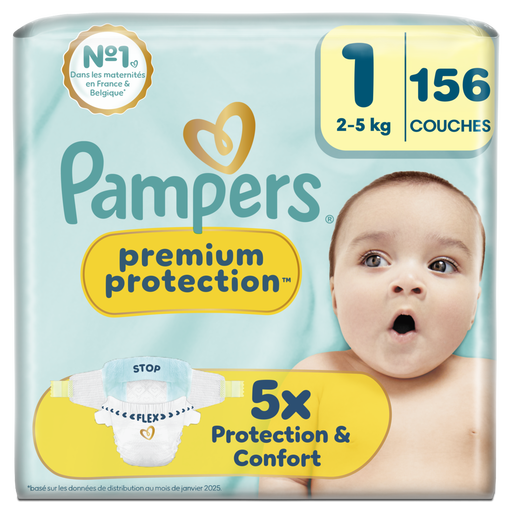
Why this pick? For the first few days, the absolute priority is softness to protect skin that is still very fragile. This model is designed specifically for that mission.
It addresses a specific need (a newborn's fragile skin) rather than just a weight guideline. The result: less risk of irritation from unsuitable materials.
Its Dermacomfort absorbent layer and ultra-soft materials are specifically designed for contact with a baby's delicate skin.
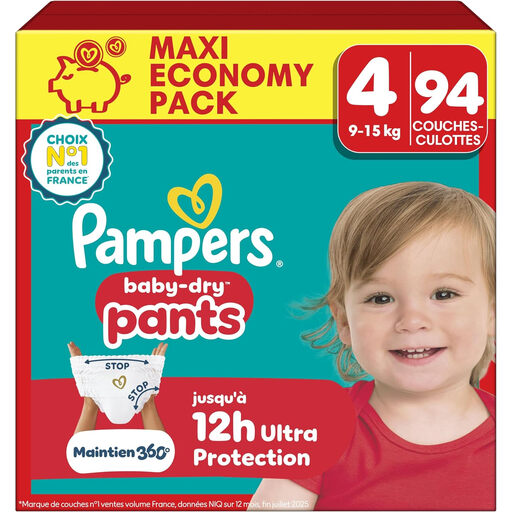
Why this pick? Perfect for babies who can't stay still. Changing becomes a breeze, and the diaper stays perfectly in place despite all the tumbling, reducing the risk of leaks.
It directly tackles the problem of leaks caused by movement, where a poorly-fitted standard diaper on a wriggly baby quickly shows its limits.
The 360° stretchy waistband conforms to your baby's shape for reliable protection during play and effortless changes for parents.
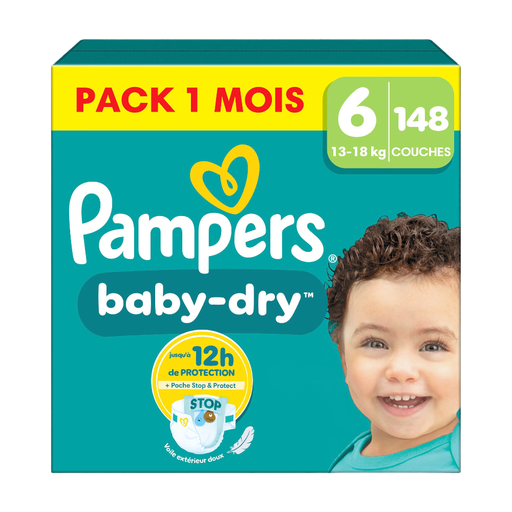
Why this pick? For parents who want to streamline their shopping and have peace of mind with a reliable stock. The size 6 diaper is often the final stretch before potty training: growth stabilises, making bulk buying much less risky.
By opting for a 1-month supply pack in a size the child will wear for longer, you limit the risk of waste while enjoying a better price per diaper.
The combination of the value pack format and Baby-Dry's anti-leak technology (with its Stop & Protect pocket) offers a solution that is both practical and reliable for day and night.
We have selected a full range of products that meet our selection criteria and European safety standards.
It's all a matter of priority. Pampers Premium Protection goes all-in on extreme softness to protect very sensitive skin, making it the go-to choice for newborns. Meanwhile, Pampers Baby-Dry focuses on maximum absorption and reinforced anti-leak barriers (like the Stop & Protect pocket) to ensure dry nights, even for older, more active babies.
Your baby is the best indicator. If they start to wriggle in every direction, roll over, or try to escape as soon as you bring out the diaper, it's a sign that it's time to switch to diaper pants. They pull on in a single motion and radically simplify changing a child who's always on the move.
Use the 3-point check: