
Livraison le jour même ou le lendemain

Qualité garantie

Débloquez vos offres de bienvenue: Livraison GRATUITE | Jusqu'à -80 % | 30 jours d'essai gratuits à JoyPlus
Téléchargez l'application
Buying Pampers baby nappies is not simply about choosing the pack with the most units. Your child’s weight, build, changing routine and skin sensitivity all directly affect their comfort and the risk of leaks.
Marketing claims can also make the choice more complicated. A nappy described as highly absorbent will not necessarily suit a baby who wriggles a lot. And a large pack can quickly turn out to be a false economy if your baby outgrows the size a few days later. Here are the criteria to consider before placing your order.
Age is only an approximate guide. When choosing between newborn nappies, size 1, size 2 or a larger size, it is better to refer to the weight shown on the packaging.
A nappy that is too large can leave gaps around the thighs and back. Conversely, a nappy that is too small may press against the tummy, leave marks on the skin and reach its maximum capacity more quickly. In both cases, leaks are more likely.
A pack of 124 nappies may seem better value than a pack of 92, but several factors need to be included in the calculation:
To compare two packs objectively, divide their price by the number of units. Also check delivery costs and the price difference between standard nappies and baby pants.
Claims such as “overnight protection”, “leak protection” or “up to 12 hours” refer to the manufacturer’s stated performance under certain conditions of use. They do not guarantee the same result for every child.
A suitable fit, regular changes and correctly positioned elasticated barriers are still essential. If irritation occurs, stop using the product and seek advice from a healthcare professional.
The guidelines below can help you choose, but they do not replace observing your baby’s build:
Weight ranges may overlap. If the fastenings are almost at the edge, the nappy leaves marks or leaks continue despite being positioned correctly, you may wish to try the next size up.
An effective nappy should quickly draw moisture away from the skin and retain liquid in its absorbent core. Several Pampers references state that they feature a wetness indicator, a Stop & Protect back pocket or barriers around the legs.
These details are particularly useful at night and when you are out and about. However, the nappy should be changed as soon as it is soiled or wet, even if it has a high absorption capacity.
When choosing baby nappies suitable for sensitive skin, check in particular:
Nappies described as eco-friendly may also contain plant-based materials or cellulose sourced from certified forests. This does not necessarily mean that the entire nappy is biodegradable. Read the full composition and environmental information before making your decision.
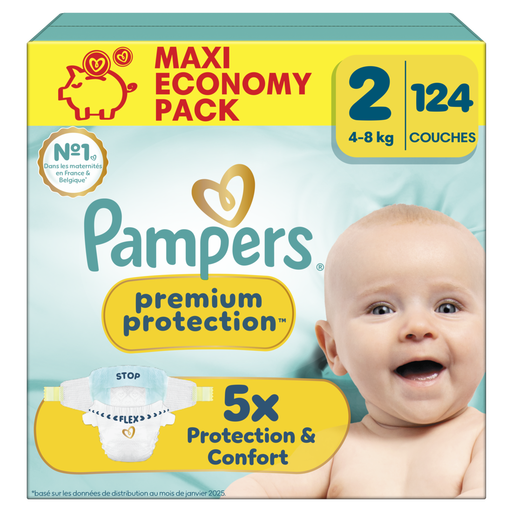
Why this choice suits this profile : its 124-unit pack is ideal for parents who want to avoid reordering too often for a baby weighing 4 to 8 kg.
The weight range and number of units are clearly stated. This makes it easier to calculate the price per nappy and avoid buying an unsuitable size.
The product details mention more than 1,000 absorbent cells, a Stop & Protect back pocket and a Flex & Protect waistband.
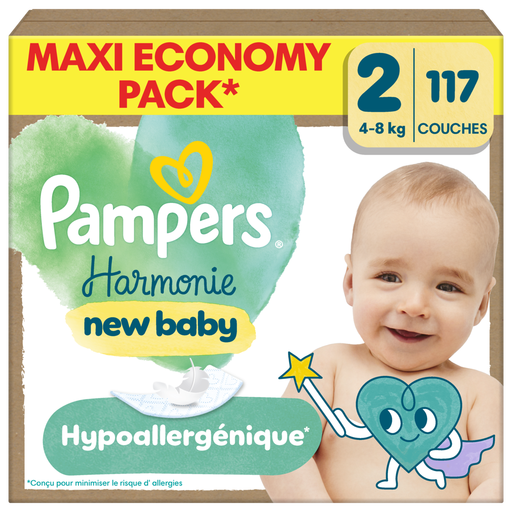
Why this choice suits this profile : this reference is aimed at families who pay close attention to the materials used, certifications and comfort for sensitive skin.
The product details specify the proportion of plant-based materials in the top sheet, FSC-certified cellulose and the stated OEKO-TEX certification.
The product details state that there are 117 size 2 nappies, plus a wetness indicator and a Stop & Protect back pocket.
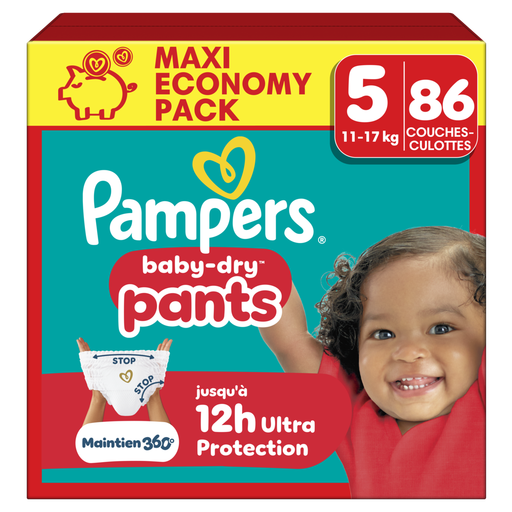
Why this choice suits this profile : this pants-style design is suitable for active children who are standing, walking or no longer willing to be changed while lying down.
The 360-degree stretch waistband and leg barriers move with your child. The sides tear open for easy removal.
Size 5 is suitable for children weighing 11 to 17 kg and the pack contains 86 units. The product details also mention a super-absorbent core.
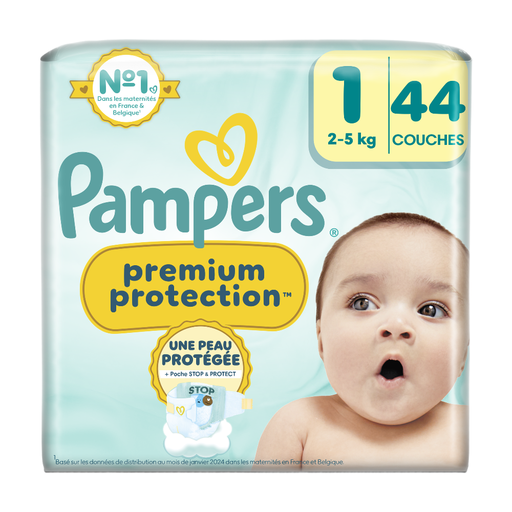
Why this choice suits this profile : the notch designed for the umbilical cord is suitable for the first few days, when this area needs particular care.
The 2 to 5 kg range and newborn-specific fit help prevent choosing a standard size that is too loose around the tummy.
The product details mention refastenable tabs, a wetness indicator and materials free from fragrance and allergens listed by the European Union.
We have brought together a complete, real-time selection of products that meet these strict criteria, as well as European safety requirements.
Adults experiencing urinary leaks can compare a women’s incontinence product, Always Discreet incontinence underwear or TENA Pants Protect+, depending on the level of leakage, size and number of units. Capacity information should be treated as usage guidance, not as a medical guarantee.
At home, non-slip slippers should be chosen based in particular on the sole’s grip, any drainage features and the size. For riding, a modular motorcycle helmet should fit your head circumference and display clearly stated approval, such as ECE R 22.06 when this appears in the product details.
Change size when the fastenings are difficult to close, the nappy leaves marks on the skin, leaks become frequent or your baby’s bottom is no longer properly covered. Also check your child’s weight against the range shown on the pack.
Keep nappies in a clean, dry, moderate-temperature place, away from moisture and heat. A nappy that is wet, soiled or damaged must not be used. Where applicable, durability information and the batch number can be found on the packaging.
They are particularly practical once your child is moving around a lot or starting potty training. For a newborn, standard nappies with refastenable tabs generally allow a more precise fit around the tummy and legs.