
Livraison le jour même ou le lendemain

Qualité garantie

Débloquez vos offres de bienvenue: Livraison GRATUITE | Jusqu'à -80 % | 30 jours d'essai gratuits à JoyPlus
Téléchargez l'application
When your little one starts walking, running or climbing, disposable nappy pants often become more practical than standard nappies. They pull on like underwear and make standing changes easier, whether at home or at nursery. But with all the different packs, sizes and marketing claims out there, it can be tricky to know which Pampers baby nappy pants to choose.
Before you pick your Pampers Baby-Dry Pants, there are three common pitfalls that are particularly easy to avoid.
Age gives you a rough idea, but it’s no substitute for your child’s weight. Two babies of the same age can have very different body shapes. A nappy pant that’s too big may leave gaps around the thighs or back. One that’s too small can press on the tummy and leave marks on the skin.
A value pack of Pampers may contain more nappy pants, but the total price alone doesn’t tell you if it’s a good deal. Instead, look at the price per nappy pant, the corresponding weight range and how many changes you need each day. A large pack is worthwhile as long as the size stays suitable for several weeks.
The phrase “360° leak protection” refers to a design that combines a stretchy waistband with barriers around the legs. It doesn’t guarantee no leaks in every situation. The result also depends on how the nappy pant is positioned, your child’s shape and how often you change it.
For children weighing roughly 9 to 19 kg, the available Pampers Baby-Dry Pants references cover the following sizes:
These ranges can vary depending on the reference and the market. If you’re unsure, watch out for red marks, gaps around the thighs and repeated leaks. These signs may mean it’s time to move up a size.
The Stop & Protect system featured on Baby-Dry Pants references is built from several elements:
These features are especially useful for active baby nappy pants, provided you make sure the elastics are fully unfolded around the thighs. Even with a size that matches the stated weight, a poorly positioned nappy pant can still leak.
Small packs of 20, 23, 24 or 27 nappy pants are handy for trying a size or topping up a changing bag. Packs of 64, 76, 80, 86, 92 or 94 units are better suited to everyday use.
Most of the models shown include a superabsorbent core. Depending on the reference, the brand claims protection for up to 12 hours. This is a manufacturer’s promise, but it doesn’t mean you should leave a soiled nappy pant on for too long – especially to keep your child’s skin comfortable.
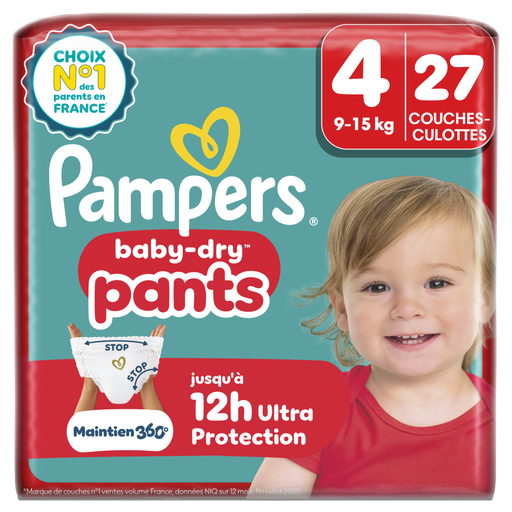
Why this choice suits this profile: This smaller pack lets you try Pampers Baby-Dry Pants for a child weighing 9 to 15 kg without committing to a large stock straight away.
The stated weight range helps you avoid choosing a size based only on age or a promotion.
27 nappy pants, a 360° stretchy waistband and tear-away sides for easy removal.
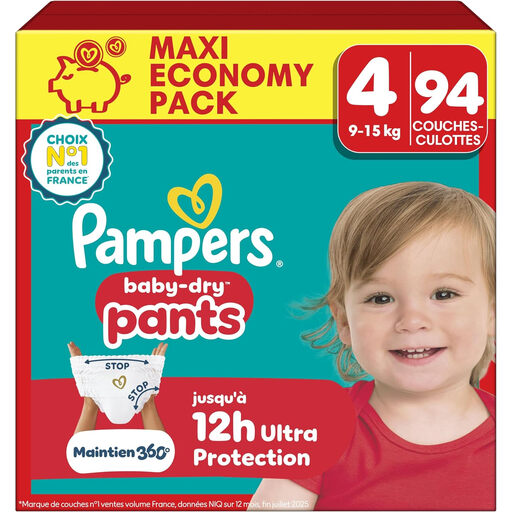
Why this choice suits this profile: This family-sized pack is ideal for households that use nappy pants every day for a child weighing 9 to 15 kg.
The large pack means fewer repeat purchases and makes it easy to work out the price per nappy pant.
94 units, the Stop & Protect system and an ultra-stretchy waistband according to the product sheet.
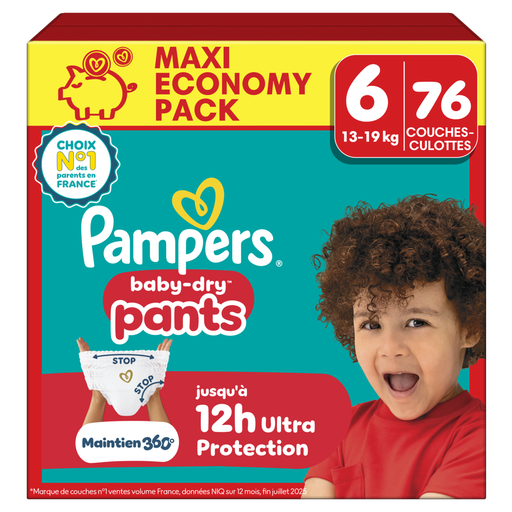
Why this choice suits this profile: This size 6 reference is designed for children weighing 13 to 19 kg and works well for busy days as well as night-time changes.
The size and weight range are clearly stated, reducing the risk of a nappy pant being too tight during movement.
76 nappy pants, advertised 360° protection and an absorbent core designed for both day and night.
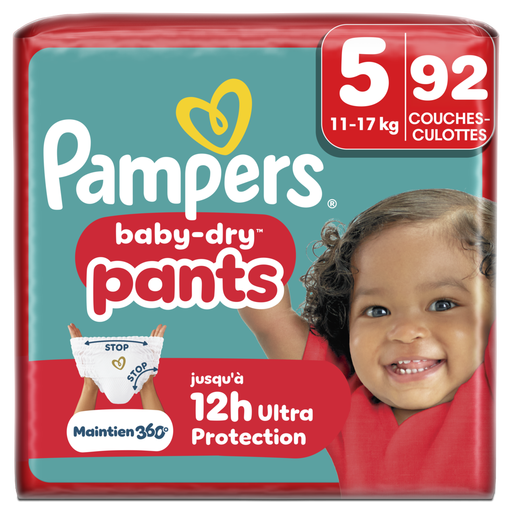
Why this choice suits this profile: This pack of 92 units is ideal for frequent use with a child weighing 11 to 17 kg, especially when changes come thick and fast.
The high number of nappy pants makes it easy to compare the unit price, without confusing a large quantity with the right size.
92 units, tear-away sides and a 360° stretchy waistband according to the description.
We’ve selected a full range, updated in real time, of products that meet these demanding criteria and European safety standards.
To put a nappy pant on, gently pull it up to the waist, then check that the leg barriers are fully unfolded. To take it off, tear the sides, roll it up and use the adhesive tape if the model has one. Never flush a nappy pant down the toilet.
Product sheets often mention that the design has been dermatologically tested and is free from certain listed fragrance allergens under European regulations. This doesn’t rule out the risk of irritation. If you notice persistent redness or an unusual reaction, stop using the product and seek advice from a healthcare professional.
Size 4 generally suits children from 9 to 15 kg, size 5 is for those around 11 to 17 kg and size 6 is for those from 13 to 19 kg, depending on the reference. Size 7 shows a different range on its product sheet here, from 11 to 16 kg. Always go by the weight printed on the pack.
The descriptions say they are for day and night use, with protection claimed for up to 12 hours. The actual duration depends on the amount of liquid absorbed, your child’s position and the fit. You should still change the nappy pant as soon as it’s soiled or saturated.
Not necessarily. Divide the pack price by the number of nappy pants, then check that your child is within the stated weight range. A large pack loses its value if you need to move up a size before you’ve finished it.