
Livraison le jour même ou le lendemain

Qualité garantie

Débloquez vos offres de bienvenue: Livraison GRATUITE | Jusqu'à -80 % | 30 jours d'essai gratuits à JoyPlus
Téléchargez l'application
Choosing Pampers baby diapers is not simply a matter of counting the pieces in the pack. Your child’s weight, body shape, changing routine and skin sensitivity all directly affect comfort and the risk of leaks.
Among Pampers Premium Protection, Pampers Harmonie, Pampers Baby-Dry and Pampers pants, some differences are very real. Others are more closely tied to marketing claims and deserve a more careful look. Here are the key points to check before placing your order.
Age is only a guideline. A baby diaper should primarily be selected according to weight, then according to your child’s build. Two children of the same age may well wear different sizes.
A diaper that is too large may leave gaps around the thighs or back. If it is too small, it can press against the stomach, leave marks on the skin and reach saturation more quickly. Before ordering a large pack, check the weight range indicated on the packaging.
A generously sized pack is not necessarily the best value. To compare prices, calculate the cost per diaper and take your child’s usual number of changes into account. A pack of 124 diapers may be convenient for everyday use, but a smaller pack is preferable when changing size or range.
Babies sometimes grow very quickly during their first few months. Buying several boxes in advance can therefore leave you with unusable stock if your child moves up a size sooner than expected.
Claims such as “up to 12 hours” or “up to 100% protection” reflect test conditions and the manufacturer’s stated specifications. They do not guarantee leak-free protection for every child.
A leak-proof diaper must first and foremost fit properly: the edges should be fully unfolded, the fasteners should be symmetrical and the size should be appropriate. Night-time leaks may also be caused by changing the diaper too late, your child’s sleeping position or a diaper that has become too small.
The main size correspondences offered in this selection are as follows:
These ranges may vary between taped diapers and Pampers pants. If red marks persist, a gap appears at the back or leaks occur repeatedly, reassess the fit rather than relying solely on the number of diapers left.
The models featured have an absorbent core and, depending on the range, a Stop & Protect back pocket designed to help prevent leaks and liquid from escaping up the back. Several references, particularly those intended for newborns, also feature a wetness indicator.
The product details for Premium Protection models sometimes mention more than 1,000 absorbent microcells. This is a feature advertised by the manufacturer and should be considered alongside other factors such as the cut, flexibility and changing frequency.
For hypoallergenic Pampers diapers or products intended for sensitive skin, review the composition and information provided on the packaging. Some references state that they contain no perfume or fragrance allergens listed under European regulations.
Certifications such as OEKO-TEX Standard 100 mean that the product has been tested according to the corresponding standard. However, they do not replace monitoring your baby’s skin. If irritation occurs, stop using the product and seek advice from a healthcare professional.
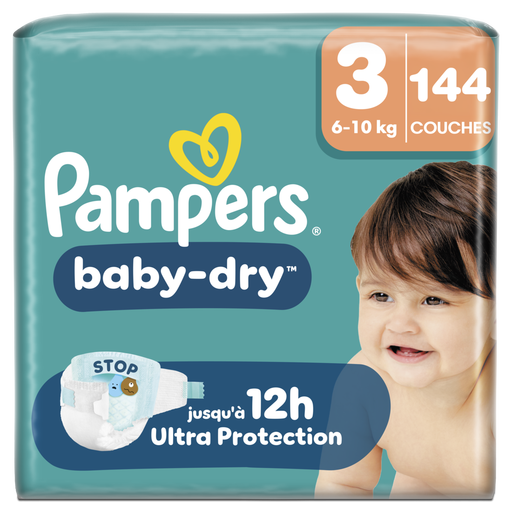
Why this model suits this profile: A large pack simplifies regular shopping for a baby weighing 6 to 10 kg, provided the fit is right for them.
Compare the price per diaper, not just the total pack price. The range includes a wetness indicator and a Stop & Protect back pocket, as stated by the manufacturer.
144 diapers, advertised rapid absorption and a ComfortTouch outer layer. A practical everyday option when size 3 is the right fit for your child.
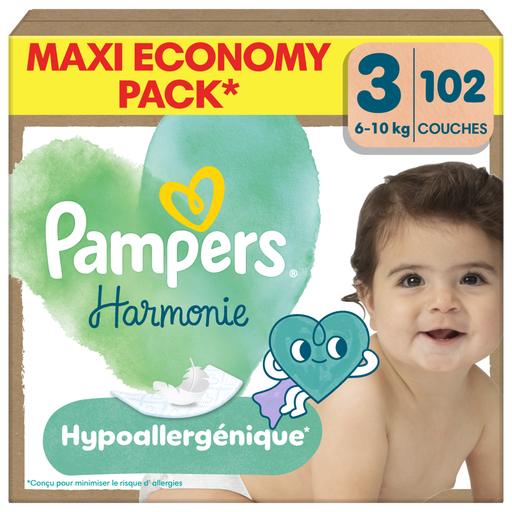
Why this model suits this profile: This range is presented as hypoallergenic and dermatologically tested. Its top sheet contains 50% plant-based ingredients.
The “sensitive skin” claim does not eliminate the need to monitor your child’s reaction. Check the composition, the OEKO-TEX Standard 100 certification and the manufacturer’s recommendations.
A wetness indicator, a Stop & Protect back pocket and cellulose sourced from FSC-certified forests, according to the product information.
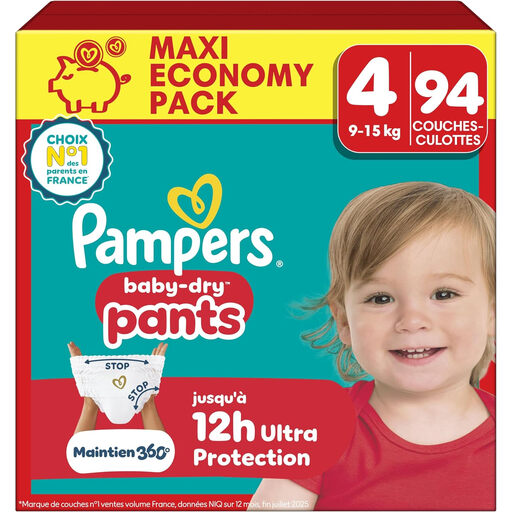
Why this model suits this profile: These pants pull on in one easy step and move with a child who is walking, turning over or beginning toilet training.
Pants cannot compensate for an incorrectly chosen size. Check the 9 to 15 kg range and make sure the stretchy waistband remains comfortable without slipping.
A 360° stretchy waistband, leak guards, a back pocket and adhesive tabs for rolling up the used pants.
We have brought together the available references so you can compare sizes, pack formats and ranges according to your purchasing criteria.
Used diapers should be disposed of with household waste, never flushed down the toilet. Also keep the packaging out of children’s reach to reduce the risk of suffocation or strangulation.
For a baby weighing under 3 kg, size 0 may be suitable if the range indicated on the pack matches their weight. Pampers newborn diapers in size 1 can then take over, again depending on the child’s weight and build. The umbilical cord cut-out can be particularly practical during the first few days.
The Harmonie range is presented as hypoallergenic and dermatologically tested. According to the product information, its top sheet contains 50% plant-based ingredients. Since every baby may react differently, monitor your child’s skin and stop using the product if irritation occurs.
It depends entirely on the pack price and the number of pieces it contains. Always compare the price per pair of pants, while also considering how easy they are to pull on and the risk of waste when your child is very active. Larger packs may reduce the unit cost, but only if the size remains suitable throughout the period of use.