Organisers planning the quantities
For a jumble sale or charity fundraiser, the number of pastries matters just as much as their weight. You’ll need to plan how many portions to hand out without ending up with too many leftovers.


For a jumble sale, start by choosing a format based on the number of portions you need to serve and the equipment available. A ready-to-eat pack makes it easy to hand them out straight away, while frozen pains au chocolat can be baked in batches if you have a freezer and an oven. A pastry from a supermarket bakery counter means you won’t need to bake on site, provided it’s available at your chosen store. Also compare the weight of each pastry, the recipe, allergens and nutritional information per 100 g.
For a jumble sale or charity fundraiser, the number of pastries matters just as much as their weight. You’ll need to plan how many portions to hand out without ending up with too many leftovers.
If there’s no oven or freezer at your stall, a ready-to-eat product means you won’t have to rely on baking on site.
The ingredients list lets you distinguish recipes made with butter from those containing oil or palm fat. The labelling also helps you check the sugars and allergens in the product you choose.
For a jumble sale, start with the portions you need to serve, then rule out any formats that aren’t compatible with the storage and preparation options available on site.
| Criterion | What to check | Best for |
|---|---|---|
| Quantity you need | Number of pastries and net weight; compare these with the portions you plan to serve. | I want to make sure I have enough pains au chocolat for visitors without building up a stock of leftovers; around 33% of consumers would prioritise having the right quantity. |
| Ready to serve | Whether the product is ready to eat or needs baking; for a bakery-counter product, check the store’s range. | Without cooking equipment at the stall, I need to be able to hand out the pastries as soon as they arrive. Around 27% of consumers would prioritise this convenience. |
| Recipe and labelling | Ingredients, allergens and nutritional information per 100 g on prepacked products. | If the ingredients determine my choice, I check the type of fat used and the declared allergens in particular; around 20% of consumers would put these checks first. |
| Storage and baking | Freezer space and the product’s specific baking instructions. | If I’m serving at different times, I’d rather bake portions as needed. Around 20% of consumers would prioritise this approach. |
According to Légifrance, the contribution in question applies to non-alcoholic drinks, not pains au chocolat, which are solid pastries.
To compare their ingredients, check the sugars listed in the nutritional information per 100 g instead.
Santé publique France explains that displaying it is voluntary. Its absence alone therefore doesn’t tell you what a product contains.
If it is displayed, read it alongside the ingredients list and nutritional information. The DGCCRF states that nutritional declarations are required for most prepacked foods, subject to the applicable exceptions.
The formats listed by E.Leclerc, Auchan and Carrefour don’t all contain the same number of pastries or have the same weight. Two packs may therefore meet different serving needs.
First estimate how many portions you need, then check the number of pastries and their weight.
You could be left with surplus pastries after the jumble sale, while underestimating the number of portions may mean you have to restock.
Frozen pains au chocolat that need baking require cold storage and an oven. A pastry from a supermarket bakery counter, on the other hand, depends on the store having the right equipment and stocking it.
Before choosing either format, check where you’ll store it, the baking instructions and whether the product is available at your chosen store.
Bridor’s professional range includes a 75 g pain au chocolat, worth considering if you have access to suitable catering or baking facilities.
Carrefour offers a ready-to-eat pack of 16 pains au chocolat, weighing 720 g.
E.Leclerc lists an Epi d'Or pack of 8 pastries weighing 360 g, as well as a frozen Eco+ pack of 20 pastries weighing 1.2 kg.
Auchan lists, among other options, a pack of 20 pastries weighing 900 g and another recipe containing 19.5% butter.
Lidl offers a pure-butter pain au chocolat from its in-store bakery counter, made with a recipe containing 24% butter.
ALDI offers a chocolate and crème pâtissière pastry from its in-store bakery counter.
This frozen, bake-at-home option is for organisers with a freezer and an oven who want to prepare portions as they serve them.
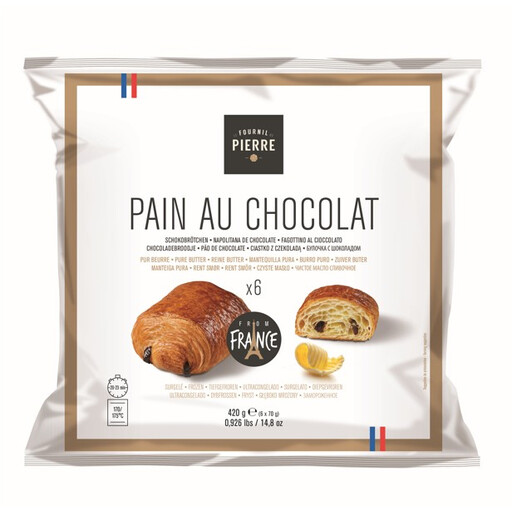 Image unavailable
Prepare portions in batches if you have a freezer and an oven. This frozen pack contains 6 pastries and weighs 420 g. Store at −18 °C and follow the baking instructions on the packaging. Also check the allergens listed on the pack.
Choose a ready-to-eat pack if you need to serve without baking and can hand out the planned number of pastries. Frozen pastries that need baking are a good choice if you have a freezer and an oven to prepare several batches. Just follow the product instructions.
Check the allergens for each product on its packaging or with the seller. Depending on the recipe, product listings may mention wheat, milk, eggs or soya, among other allergens. Don’t assume a product has the same ingredients as another, even if they’re sold under the same supermarket brand.
No. According to Santé publique France, displaying the Nutri-Score is voluntary. For prepacked foods where a nutritional declaration is required, the information described by the DGCCRF lets you check sugars and fat per 100 g, among other things.
No. The contribution outlined by Légifrance in its section on non-alcoholic drinks doesn’t apply to this solid pastry. The sugar content is still worth checking in the product’s nutritional information.