Families who want to bake at home
You’d like to serve hot pains au chocolat for breakfast or an afternoon treat, and can make room in the freezer as well as set aside the baking time shown on the packet.


To serve hot pains au chocolat after baking at home, choose a frozen product labelled ‘ready to bake’ and follow its own instructions. A ready-baked product is better suited to immediate consumption. If you’re looking for a blend of white and wholemeal flour for children, check that it’s explicitly listed in the ingredients: the products reviewed don’t confirm that they contain this blend. Also compare the nutrition information per 100 g and the allergens declared for the product you choose.
You’d like to serve hot pains au chocolat for breakfast or an afternoon treat, and can make room in the freezer as well as set aside the baking time shown on the packet.
When choosing pastries for children, you want to compare sugars, fat, fibre and ingredients on the same per-100 g basis, without assuming that ‘wheat’ means wholemeal flour.
You need to check the ingredients and any possible traces before buying. Product listings for several options mention wheat, milk, egg or soya, with details that vary from one product to another.
First decide whether you plan to bake the pains au chocolat or serve them as they are. Then check the ingredients and any requirements specific to the product you’ve chosen.
| Criteria | What to check | Who is it for? |
|---|---|---|
| Preparation | Whether it says ‘ready to bake’ or ‘ready-baked’, followed by the product’s defrosting, temperature and baking-time instructions. | If I want to serve them hot from the oven for breakfast, I need to be able to plan their preparation. Around 42% of consumers rank the option to bake at home as their top priority. |
| Ingredients and nutrition | Sugars, saturated fatty acids, fibre and salt per 100 g; and an explicit wholemeal flour declaration if you’re looking for a blend. | For fussy children, I want to know what’s in the recipe rather than judge by how the pastry looks. Comparing ingredients is the main priority for around 33% of consumers. |
| Allergens and storage | Allergens and traces listed on the packet for the batch; for a frozen product, its storage conditions and instructions after defrosting. | If I need to avoid an ingredient or plan how to store a frozen product, these details come first. Around 25% of consumers prioritise checking this information. |
A frozen pain au chocolat that’s ready to bake needs to be prepared in the oven, unlike a ready-baked pastry bought to eat as it is.
Before buying, check the product name, instructions and storage conditions. Don’t use the baking time for a different product.
According to the DGCCRF, Nutri-Score is optional in France, while nutrition declarations are generally required for prepacked foods. So, if the logo isn’t there, you’ll still need to check the nutrition table.
Compare the values per 100 g, particularly sugars, saturated fatty acids, fibre and salt. Use Nutri-Score as an additional guide when it’s shown.
The words ‘wheat flour’ don’t confirm that the product contains wholemeal flour or a blend of white and wholemeal flour.
If this blend is important to your purchase, look for an explicit mention of wholemeal or wholegrain flour in the ingredients list, and check the proportion if it’s stated.
Ingredients, traces of allergens and instructions for use after defrosting depend on the specific product. A photo or the product category alone isn’t enough to confirm these details.
Check the labelling on the batch, particularly if you need to avoid an allergen, then follow the frozen product’s storage instructions.
These examples show why it’s important to distinguish products that need baking from ready-baked pains au chocolat. Their features don’t apply to every recipe from the same brand or retailer.
Bridor offers a 70 g Pain au Chocolat that’s ready to bake.
The EPI D'OR and ECO+ ranges include frozen pains au chocolat that are ready to bake, with different recipes.
Auchan offers, among other options, a frozen pack of 6 that’s ready to bake and a pack of 10 that can be stored at room temperature.
The Carrefour Classic' pack of 16 and the Carrefour Traiteur option reviewed are both ready-made pains au chocolat.
Lidl describes an all-butter pain au chocolat baked in store at branches with an in-store bakery that stock this product.
If you’re baking at home, this selection features chocolate rolls to bake. If you’re specifically looking for pains au chocolat made with both white and wholemeal flour, check the ingredients list before choosing.
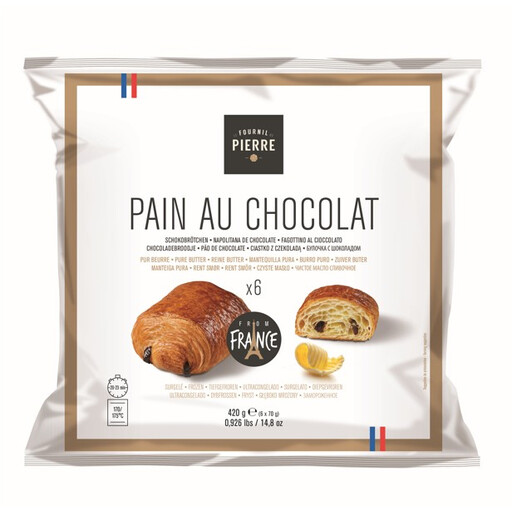 Image unavailable
An option to consider if you’d like to bake chocolate pastries at home. The pack contains 6 rolls, weighing 420 g in total. Before buying, check the packet for baking instructions, allergens and whether it contains wholemeal flour.
No. According to the DGCCRF, Nutri-Score is an optional label, separate from the nutrition declaration generally required for prepacked foods. If the logo isn’t shown, check the nutrition information per 100 g.
No. Follow the instructions for the product you’ve bought. For its frozen pack of 6, Auchan recommends defrosting for 15 minutes, then baking for 15 to 20 minutes at 180 °C. Bridor recommends around 16 to 18 minutes at 190 °C for its 70 g product. These instructions aren’t interchangeable.
Look for ‘wholemeal flour’ or ‘wholegrain flour’ in the ingredients list, and check the proportion if it’s given. The words ‘wheat flour’ alone don’t confirm that it contains the blend of flours you’re looking for.
Read the label for the product and batch you’re buying. Several listings for pains au chocolat to bake mention wheat or gluten, milk, eggs or soya, and some warn of possible traces of nuts or sesame. Ingredients and trace warnings vary by product.