What should you check before buying?
Start with your child’s dietary requirements. Then compare the labels of formats that genuinely suit the planned snack, whether it’s being taken out or prepared at home.
| What matters | What to check | Who is this for? |
|---|
| Allergens and school |
Check the allergens and any ‘may contain’ warnings for the exact product. If an individual healthcare plan applies, check the requirements for snacks. |
When my child has dietary requirements at school, making sure their snack is suitable comes before choosing the chocolate. Around 33% of consumers put suitability top of their list of concerns. |
| Ingredients and frequency |
Compare the sugars and saturated fat per 100 g in prepacked products, then consider the portion you’ll actually serve. |
If pain au chocolat is a regular afternoon snack, I want to compare recipes and decide how it fits alongside other snacks. For around 27% of consumers, ingredients and how often they eat it are top priorities. |
| Dark chocolate |
Look for the words ‘dark chocolate’ and distinguish the proportion of chocolate in the product from the cocoa percentage of that chocolate, if stated. |
My child prefers dark chocolate, so I look for a recipe that clearly says so, without assuming it contains more cocoa or less sugar. This preference is the top priority for around 20% of consumers. |
| Format and preparation |
Check the number of pastries and storage instructions. For a bake-at-home product, also check how long it takes to prepare. |
For a snack to take out, I need a format that’s easy to organise; for baking at home, I need to allow for the equipment and time involved. Around 20% of consumers put convenience first. |
Nutri-Score can be a useful extra when it appears on the product. The French Ministry of Agriculture notes that it remains voluntary in France, while the DGCCRF says the nutrition declaration for relevant prepacked foods is given per 100 g or 100 ml.
Brands to compare
These examples let you compare specific recipes and formats; the features of one product shouldn’t be taken to apply to a brand’s entire range.
Bridor
Bridor’s professional catalogue features pain au chocolat in different formats, including unbaked products to prepare at home.
- You can consider the format and preparation method to suit the way you organise snack time.
- Bridor’s listing for its 85 g unbaked product names gluten, milk, soya and eggs among its allergens. Follow the storage and baking instructions.
Carrefour
Carrefour’s listing for a butter pain au chocolat gives the ingredients for a product sold individually, depending on the store.
- The listing states that this recipe contains 21% Charentes-Poitou AOP butter and 10% chocolate.
- It doesn’t describe the chocolate as dark and warns that several allergens are handled in the bakery.
Auchan
Auchan’s listings let you look at both a pure-butter product and a family pack.
- For the 220 g pure-butter product reviewed, Auchan lists 10 g of sugars and 11 g of saturated fat per 100 g.
- The composition of the 20-piece family pack may vary depending on the click-and-collect store and the date, so check the current listing and packaging.
Brioche Pasquier
The listing for a Brioche Pasquier multipack lets you compare values per portion and per 100 g with other prepacked pain au chocolat.
- For this product, Auchan’s published listing states that it contains 12% chocolate, 14 g of sugars and 10 g of saturated fat per 100 g.
- These figures don’t describe the brand’s other recipes or confirm that the chocolate used is dark.
Lidl
Lidl France’s listing for a pure-butter pain au chocolat explicitly uses the words ‘dark chocolate’.
- It states that this pastry contains 11% dark chocolate, helping you identify the type of chocolate specified.
- This figure doesn’t tell you the chocolate’s cocoa content. Also check the allergens and whether the product is available in your store.
A bake-at-home option on Joybuy
This selection is a pack of pain au chocolat to bake at home for a homemade afternoon snack. It shouldn’t be presented as a dark chocolate option.
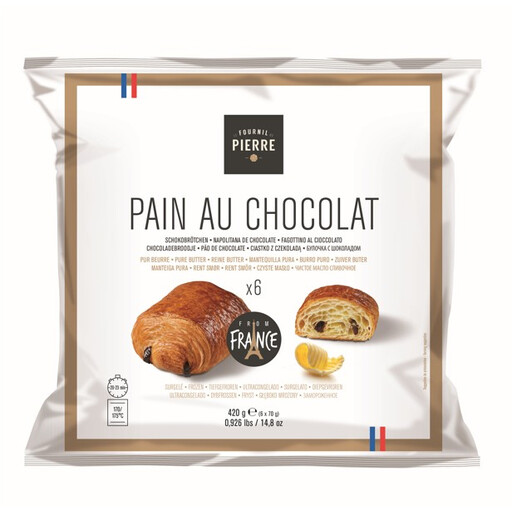 Image unavailable
Fournil de Pierre, pain au chocolat to bake x6, 420 g
This pack of six is suitable for a planned snack at home if you have a freezer and an oven. Store at −18 °C and bake before eating; do not refreeze after thawing. If your child has an allergy, check the packaging for wheat/gluten, milk, eggs, soya and any ‘may contain’ warnings. Also check what type of chocolate is used: this pack shouldn’t be chosen solely because your child prefers dark chocolate.
View on Joybuy
Frequently asked questions
Is Nutri-Score compulsory on pain au chocolat in France?
No. The French Ministry of Agriculture says Nutri-Score is voluntary in France, so its absence alone doesn’t mean a product fails to comply with the rules. For relevant prepacked foods, the nutrition declaration described by the DGCCRF lets you check sugars and fat per 100 g, among other things.
Does the ‘soft drinks tax’ apply to pain au chocolat?
No, not as a solid pastry. The provisions published by Légifrance for this levy cover drinks and liquid preparations for drinks, not pain au chocolat.
What should I check for a child with allergies taking a snack to school?
Check the allergens and any ‘may contain’ warnings on the exact product, then check the requirements that apply to your child at their school. The French Ministry of National Education explains that an individual healthcare plan can set out the adjustments needed when a long-term health condition makes them necessary.
Does ‘dark chocolate’ mean ‘high cocoa content’?
No. The wording identifies the type of chocolate specified, but the proportion of chocolate in the pain au chocolat and the cocoa percentage of that chocolate are two different things. To check the latter, look at the ingredients for the exact product, if they’re provided.
How can I serve pain au chocolat without making it an everyday snack?
Save pastries for occasional snacks and vary the other options you offer. Manger Bouger recommends limiting pastries and foods high in fat and sugar as part of your everyday diet. When comparing two prepacked products, look at their values per 100 g as well as the portion you’ll serve.


