Who are these formats for?

Smaller households looking to avoid leftovers

If you’re shopping for one or two people, start by thinking about how many pastries you’re likely to eat. A small pack of ready-to-eat pastries, a single pastry or a product to bake will suit different shopping habits.

Households with an oven and freezer

Frozen pastries to bake let you keep some for later, provided you have enough space and follow the storage, defrosting and baking instructions for the product you buy.

Shoppers who check the label

To compare recipes or check for allergens, read the ingredients list and nutritional information for the specific product. According to Santé publique France, displaying the Nutri-Score is voluntary, so if it’s not shown, you should still check this information.

What should you check before buying?

Small pack, ready to eat

Worth considering: if four pastries are about right for what you’ll eat soon and you don’t want to use the oven.

Bear in mind: check the packaging to see how long the pastries will keep after purchase and under what conditions.

Buying a single pastry

Worth considering: if you only want one pastry and don’t want to store the rest of a pack.

Bear in mind: at Lidl, the product mentioned is only available in stores with an in-store bakery and depends on the store’s range.

Frozen pastries to bake

Worth considering: if you have a freezer and an oven and want to bake pastries as and when you need them.

Bear in mind: preparation takes time, and defrosting and storage instructions vary by product.

Criteria What to check Who is it for?
Quantity and packaging Count how many pastries you’ll eat and check how many are in each pack, as well as whether they’re individually wrapped. If one or two people only eat pastries occasionally, avoiding leftovers is more important than buying a large pack; around 42% of consumers rank having the right quantity as their top priority.
Nutritional information and allergens Compare sugars, saturated fats and salt per 100 g; check the ingredients, allergens and any possible traces. If a product’s ingredients guide my choice, I want to be able to compare labels and identify declared allergens; around 33% of consumers make this a priority.
Baking and storage For a frozen product, check the storage temperature and the instructions for defrosting, baking and not refreezing. If I have a freezer and an oven, I may prefer to keep pastries to bake rather than buy a pack that’s ready to eat; for around 25% of consumers, baking pastries as needed is the main consideration.

Mistakes to avoid

  • Treating “half loaf” as a pain au chocolat pack size

    This term doesn’t tell you how many pastries are included or give you a useful weight for choosing pastries. The products mentioned here are described by their pack size, from single pastries to multipacks.

    Work out how many pastries your household will eat, then choose between a single pastry, a small pack or a product you can store in the freezer.

  • Buying a large pack without planning how to store it

    A pack of ten or twenty pastries calls for a different eating routine or storage space than a box of four. The number of pastries matters just as much as whether you can actually store them.

    Check the quantity, storage instructions and available space before choosing a pack size.

  • Assuming “all butter” tells you everything about the ingredients

    This description alone doesn’t tell you all the ingredients, nutritional values or allergens. The Carrefour, Auchan and Bridor products mentioned, for example, declare wheat, milk, eggs or soya, depending on the product.

    Read the label on the product you buy, including the allergens and any possible traces listed.

  • Assuming the soft drinks tax or Nutri-Score determines which pastries to choose

    The levy described by the French Ministry of the Economy applies to sugary drinks, not pain au chocolat. Santé publique France says that displaying the Nutri-Score is voluntary.

    To compare two pain au chocolat products, use the nutritional information and ingredients list; check the Nutri-Score as an additional guide when it’s displayed.

Brands to know

Carrefour

One all-butter, ready-to-eat pain au chocolat option comes in a box of four.

  • A four-piece pack you can compare with the amount you expect to eat.
  • The product lists wheat, milk, soya and egg among its ingredients; check the label on the product you buy.

Auchan

The products mentioned include eight individually wrapped pastries and six frozen all-butter pain au chocolat pastries to bake.

  • The two pack sizes suit different needs: pastries that are already wrapped or ones to bake in the oven.
  • For the pack of six frozen pastries, store at −18 °C and don’t refreeze after defrosting.

E.Leclerc

The Eco+ product mentioned is a 1.2 kg bag of twenty frozen pain au chocolat pastries.

  • The product listing shows nutritional values and a Nutri-Score of E for this product.
  • This is a large pack, so you’ll need to plan for storage and how quickly you’ll eat it. Check availability with your E.Leclerc store.

Lidl

A single all-butter pain au chocolat is available in selected stores.

  • Buying one pastry means you don’t have to open a pack when you only want one.
  • Availability depends on whether the store has an in-store bakery and on its product range; check the allergens listed in store too.

Aldi

The Pâtissades range includes a 450 g pack of ten pain au chocolat pastries.

  • The number of pastries and the pack weight make it easier to see whether it’s right for your household.
  • Check the packaging in store to compare ingredients, allergens and storage instructions.

Bridor

The manufacturer offers a 75 g Les Savoureux pain au chocolat pastry, ready to bake.

  • The manufacturer’s product information gives details of the recipe, allergens and preparation instructions.
  • This listing doesn’t guarantee that you’ll be able to buy the product individually during your usual shop.

An option to bake from Joybuy

This selection features a bag of six frozen pain au chocolat pastries to bake, worth considering if your household has a freezer and an oven.
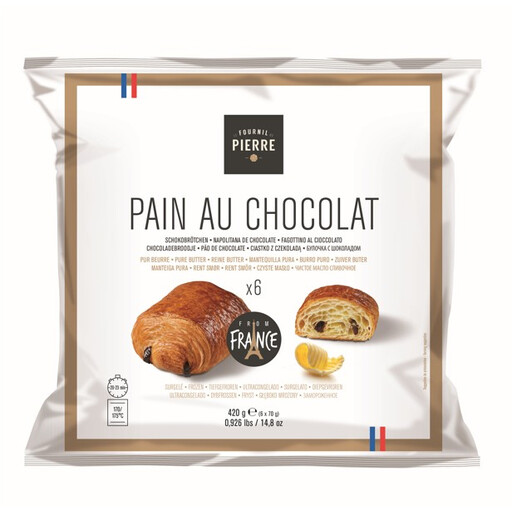
Fournil de Pierre pain au chocolat pastries to bake, bag of six

Fournil de Pierre pain au chocolat pastries to bake, 6 pieces, 420 g

This frozen format suits households that want to keep pain au chocolat pastries in the freezer and bake them at home.

  • Store at −18 °C; do not refreeze after defrosting.
  • Declared allergens: wheat containing gluten, milk, eggs and soya; may contain traces of sesame and nuts.
  • Nutri-Score D shown for the baked product. Check its nutritional information and ingredients too.
  • Before planning to bake one pastry at a time, check the packaging for preparation instructions and whether you can take out individual pastries without defrosting the rest.
View on Joybuy

Frequently asked questions

Are pain au chocolat pastries subject to the soft drinks tax in France?

No, not under the levy on sugary drinks described by the French Ministry of the Economy. The fact that pain au chocolat contains sugar doesn’t make it a drink covered by this levy.

Does pain au chocolat packaging have to show the Nutri-Score?

No. According to Santé publique France, displaying the Nutri-Score is voluntary and it supplements the nutritional information. If it isn’t shown, compare the values listed on the products, particularly per 100 g, as well as their ingredients lists.

What do you need to bake frozen pain au chocolat pastries?

You’ll need a freezer, an oven and enough time to follow the preparation instructions on the packaging. For its pack of six, Auchan recommends defrosting for around 15 minutes, then baking for 15 to 20 minutes at 180 °C. It also says never to refreeze a defrosted product. Follow the instructions for the specific product you buy.

Can you rely on “all butter” to tell you about allergens?

No. Depending on the recipe, the products mentioned may list wheat containing gluten, milk, eggs or soya, as well as possible traces of other allergens. Check the list on the packaging of the specific product before eating it.