Hosts planning a small birthday party
If you’re expecting a small group, work out how many pastries you’ll need before choosing a pack. A pack with roughly the right number can help keep leftovers to a minimum.


For a small birthday party, start by counting your guests. A small pack that’s ready to serve is ideal if you want to avoid baking, while frozen pastries that are ready to bake let you plan serving time around the oven. Check the storage instructions before choosing, and for pre-packed products, compare the ingredients, allergens and sugars per 100 g. Nutri-Score labelling isn’t compulsory.
If you’re expecting a small group, work out how many pastries you’ll need before choosing a pack. A pack with roughly the right number can help keep leftovers to a minimum.
If you have access to an oven before serving, you could choose frozen pastries that are ready to bake. Check the preparation time and the instructions for your chosen product.
If any guests need to avoid certain ingredients, check the ingredients list and allergens for the product you’re actually buying. Nutritional values per 100 g make it easier to compare pre-packed products on a like-for-like basis.
To choose between a small pack, pastries to bake or a ready-to-serve option, first work out how many you need and when you’ll be serving them.
| What to consider | What to check | Who it’s for |
|---|---|---|
| Number of pastries | Compare the number of pastries and the pack weight with the number of guests. | When you’re hosting a small group, the priority is having enough pastries without ending up with too many leftovers; around 33 % of consumers would put finding the right pack size first. |
| Serving time | Check whether products are ready to serve, frozen and ready to bake, or sold defrosted. | To serve at the planned time, some people prefer to arrange for baking, while others opt for pastries that are ready to eat. Around 27 % of consumers would prioritise having control over when they’re served. |
| Ingredients and allergens | For pre-packed products, read the ingredients, allergen information and sugars per 100 g. | If a guest needs to avoid an ingredient, or you want to compare sugar content, check the label on the specific product rather than relying on its name alone. Around 20 % of consumers would make this their priority. |
| Planning your purchase | Check availability, collection arrangements and storage instructions. | When you’re short on time for preparations, being able to collect and store the pastries until the party can make all the difference; this would be the main concern for around 20 % of consumers. |
France’s DGCCRF states that displaying the Nutri-Score is voluntary in France. Its absence alone doesn’t tell you what a pain au chocolat is made of.
To compare pre-packed products, check their nutritional information per 100 g, including sugars, saturated fatty acids and salt, then take the portion you’ll serve into account.
A pack that’s too large for your group may leave you with pastries you won’t use. Storage instructions differ for packaged, frozen and defrosted products.
Work out how many pastries you need before you buy and check how to store your chosen pack. Carrefour Traiteur, for example, says its pack of eight AOP pain au chocolat is defrosted and must not be refrozen.
This describes one aspect of the recipe; it doesn’t replace the ingredients list, nutritional information or allergen checks.
Read the label for the specific product and pack you’ll be serving, especially if a guest needs to avoid an allergen.
Bridor offers an 80 g pain au chocolat that’s ready to prove, aimed in particular at food-service professionals.
E.Leclerc sells a pack of six frozen, ready-to-bake pain au chocolat made with pure butter under this brand.
Carrefour Traiteur offers a pack of eight AOP pain au chocolat, weighing 520 g and advertised as serving eight people.
Auchan offers, among other options, a pack of four pain au chocolat made with pure butter and a pack of 20 individually wrapped pastries.
ALDI says it bakes its pain au chocolat and other pastries in store every day.
This pack of chocolate rolls to bake could suit hosts with access to an oven. If you’re specifically looking for pain au chocolat, check that this is the type of pastry you want.
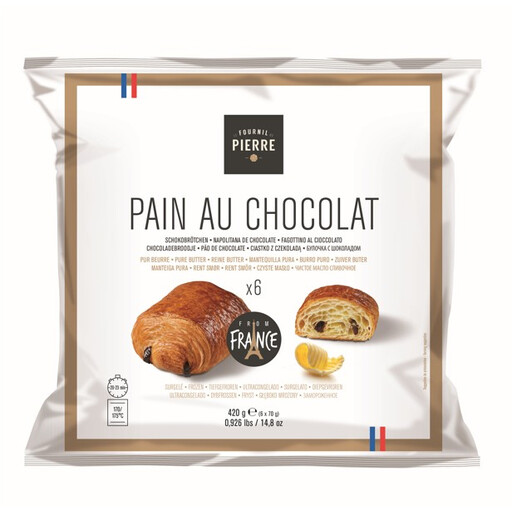 Image unavailable
This pack of six could suit a small group if you’re planning to bake them before serving. The product is described as frozen and ready to bake, so you’ll need freezer space and should follow the instructions on the packaging. Before choosing it instead of pain au chocolat, check exactly what type of pastry it is, along with the ingredients and allergens in the pack you buy.
Start by choosing a pack with roughly the right number of pastries for your needs. A small pack is a good choice if you want to serve them without baking; frozen pastries that are ready to bake give you another way to plan preparations, as long as you follow their storage instructions.
Read the ingredients list and allergen information for the product you actually buy. Depending on the product, it may contain wheat, milk, eggs or soya, among other allergens. Don’t assume that all recipes from the same retailer are identical.
No. France’s DGCCRF states that displaying the Nutri-Score is voluntary in France. To compare pre-packed products, check their nutritional information per 100 g instead, even if there’s no logo on the packaging.
Follow the instructions for the specific product. Carrefour Traiteur says its pack of eight AOP pain au chocolat is sold defrosted and must not be refrozen; other products may have different instructions.
No. The French tax authority’s official bulletin describes the levy as applying to non-alcoholic drinks containing added sugars, not to pain au chocolat. To compare the sugar content of pre-packed products, check the value per 100 g.