Sunday hosts on a tight budget
You want enough pastries for your guests without buying a pack that’s too large for the meal. The number of pieces and the net weight help you compare pack sizes.


For a budget-friendly Sunday meal, start by counting your guests and choosing a pack size you’ll use up, then decide between ready-to-serve pain au chocolat and products that need baking. Bake-at-home options let you serve them warm if you have an oven, enough time and freezer space. Whichever you choose, check the ingredients and allergens for the product you’re buying.
You want enough pastries for your guests without buying a pack that’s too large for the meal. The number of pieces and the net weight help you compare pack sizes.
You can plan to bake them before the meal. If so, check the instructions for the product you’ve chosen, how much time you have and how much freezer space you’ll need.
You compare ingredients, allergens and nutritional information. The DGCCRF explains that Nutri-Score is voluntary: if it appears on the packaging, it adds to the information on the label but doesn’t replace it.
Start with how many people you’re serving and whether you want a ready-baked product or one you can bake at home. Then check the recipe and label of the product you choose.
| What to consider | What to check | Who is this for? |
|---|---|---|
| Quantity and pack size | Number of pieces and net weight, based on how many guests you’re expecting. | If I’m having several people over on Sunday, I want enough pain au chocolat without ending up with lots left over. Around 36% of consumers prioritise a pack size that suits the meal. |
| Serving and preparation | Ready-baked or bake-at-home; cooking and storage instructions. | If I want to serve them warm, I can plan ahead for the oven and get them ready before my guests arrive. This is the top priority for around 29% of consumers. |
| Recipe | Ingredients list and type of fat; the proportions of butter or chocolate, if given. | I’m looking for an all-butter recipe, so I’d rather check the label than judge by appearance alone. Around 21% of consumers prioritise the ingredients in the recipe. |
| Labelling and allergens | Allergens and any warnings about traces; nutritional values per 100 g and Nutri-Score, if shown. | Before serving, I need to know which allergens are in the product I’ve chosen and check its nutritional information. This is the main priority for around 14% of consumers. |
This describes one aspect of the recipe, not its overall nutritional value. The ingredients lists can also differ between products.
Compare the ingredients and nutritional information per 100 g. Check the Nutri-Score if it’s shown, but don’t assume on that basis alone that a product is right for your needs.
A bake-at-home product isn’t the same as ready-baked pain au chocolat: you’ll need time, an oven and somewhere to store it as directed.
Check the pack instructions and make sure you have enough freezer space before planning to serve them on Sunday.
Preparation adds baking to your meal plans, and storing the pastries incorrectly could mean you can’t use them as intended.
In France, the DGCCRF describes Nutri-Score as a voluntary label and says that relevant prepacked foods carry a nutrition declaration. The levy described by the Official Bulletin of Public Finances – Tax applies to non-alcoholic drinks, not pain au chocolat.
To compare prepacked products, check their ingredients, allergens and nutritional information. Don’t assume that Nutri-Score will always be displayed.
Carrefour offers a frozen, bake-at-home all-butter option in a pack of 6, weighing 420 g.
The Epi d'Or product featured by E.Leclerc is a pack of 6 frozen, bake-at-home all-butter pain au chocolat, weighing 450 g.
E.Leclerc offers, among other options, a pack of 10 Eco+ pain au chocolat weighing 450 g, as well as a separate frozen pack of 20.
Auchan offers several different pack sizes, including 16 individually wrapped pieces weighing 720 g and an all-butter option with 10 pieces weighing 550 g.
Lidl offers all-butter pain au chocolat baked in store and sold individually at stores with an in-store bakery that stock this product.
Bridor offers a frozen, bake-at-home pain au chocolat weighing 70 g.
This selection features bake-at-home pain au chocolat for serving warm on Sunday. Check the pack instructions before deciding what time to eat.
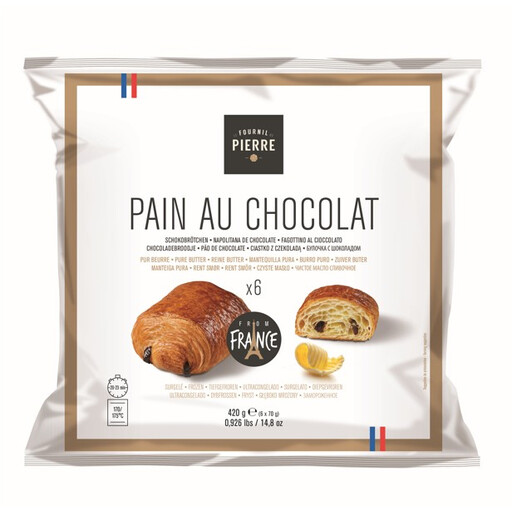 Image unavailable
A pack of six pastries to bake when you want to serve them warm. You’ll need an oven. Before adding them to your meal, check the packaging for the baking time, temperature, storage instructions and allergen information.
No. In France, the levy described by the Official Bulletin of Public Finances – Tax applies to certain non-alcoholic drinks that meet the specified conditions, not to pain au chocolat. To check the sugar content of a prepacked product, look at its nutrition declaration.
No. The DGCCRF says that Nutri-Score is voluntary. Relevant prepacked foods do, however, carry a nutrition declaration. Check it to compare the sugar and fat content per 100 g, for example.
Check the label on the product and batch you’re going to serve. Depending on the product, those mentioned here contain wheat, milk, eggs or soya. Some listings also warn of possible traces of tree nuts or other allergens.
Follow the instructions for the product you’ve bought rather than assuming the same baking time applies to them all. For one of its frozen products, Auchan recommends defrosting for 15 minutes, then baking for 15 to 20 minutes at 180 °C. Carrefour gives a baking time of 18 to 20 minutes for its own product.
Follow the instructions for the product you’ve bought. Bridor’s listing for its 70 g pain au chocolat says not to refreeze it after defrosting and to store it at −18 °C before use.