For a train journey, choose a pain au chocolat that’s ready to eat if you can’t prepare it before you leave. One that needs baking is suitable if you have time to bake it and let it cool. If Fairtrade/Max Havelaar certification for the cocoa matters to you, check the logo and information on the back of the pack, as recommended by Fairtrade/Max Havelaar France. A Rainforest Alliance claim, such as the one on an Auchan product listing, refers to a different certification and isn’t a substitute for this check.
Who is this choice for?
Travellers who prioritise Fairtrade certification
If certified cocoa is your main priority, look for the Fairtrade/Max Havelaar label on the pain au chocolat itself. Fairtrade/Max Havelaar France recommends checking the back of packs bearing a logo with an arrow to find out which ingredients are covered and how they’re traced.
Travellers who want something ready to eat
A ready-to-eat product means you won’t need to plan for baking before boarding the train. If you’re taking several pain au chocolat with you, individually wrapped portions, as listed by Auchan for one of its products, can make them easier to carry separately.
People who check ingredients
Check the label on the pack you’ve bought for allergens, and compare the nutritional information per 100 g. This is particularly important if any of the recipe’s ingredients aren’t suitable for you.
What should you check before your journey?
First decide whether your pain au chocolat needs to be ready to eat when you buy it. Then check the certification you’re looking for, the label and the quantity that suits your journey.
| Criterion |
What to check |
Who it matters to |
| Cocoa certification |
Look for the Fairtrade/Max Havelaar logo on the pack. If it has an arrow, check the back for details of which ingredients are covered and how they’re traced, as advised by Fairtrade/Max Havelaar France. |
If certified Fairtrade cocoa is my top priority, another claim about the chocolate doesn’t meet my criteria. Around 31% of consumers prioritise this check. |
| Ready to take with you |
Check that the product is ready to eat and see whether it’s individually wrapped. A frozen product that needs baking will have to be prepared before you leave. |
If I want something to eat on the journey without having to cook, I look first for a ready-to-eat product that’s easy to take with me. Around 31% of consumers are said to have this priority. |
| Ingredients and allergens |
Read the ingredients and check which allergens are highlighted on the pack. To compare products, use the nutritional values per 100 g, particularly sugars, saturated fat and salt. |
Some ingredients aren’t suitable for me, or I want to compare labels before choosing a snack. Around 23% of consumers prioritise ingredients. |
| Quantity and preparation |
Check how many pieces are in the pack and how they should be stored. If the product needs baking, allow time to bake it and let it cool before travelling. |
I’m preparing a snack for several people, or I have time to cook before I leave, so the quantity and preparation time guide my choice. Around 15% of consumers put this need first. |
Common mistakes to avoid
-
Confusing Rainforest Alliance with Fairtrade/Max Havelaar
Auchan lists chocolate certified by Rainforest Alliance for one of its pain au chocolat products. This doesn’t mean the product carries the Fairtrade/Max Havelaar label.
If Fairtrade is your priority, look for its logo on the pack and check the details on the back, particularly if the logo has an arrow.
-
Assuming Nutri-Score is compulsory
In France, the DGCCRF distinguishes between Nutri-Score, which is voluntary, and the nutrition declaration, which is generally required for prepacked foods.
If there’s a Nutri-Score on the pack, consider it alongside the nutritional information. Compare values per 100 g rather than drawing conclusions from the absence of a score.
-
Buying a product that needs baking when you want to eat it straight away
A frozen pain au chocolat that needs baking, such as the Epi d’Or product described by E.Leclerc, won’t meet the same needs as one that’s ready to eat.
If you’re leaving soon, choose a ready-to-eat product. Otherwise, allow time to bake it and let it cool before your journey.
-
Relying on the ingredients from a previous purchase
Auchan notes that ingredients may vary depending on the delivery service and the date. So check the ingredients that matter to you on the pack you’re taking with you.
Read the ingredients list and check the highlighted allergens, even if you recognise the product name.
Retailers to compare
These examples illustrate the formats and information to look for on product listings and packaging; they don’t guarantee that a product carries the Fairtrade/Max Havelaar label.
Auchan
Auchan lists a pack of eight pain au chocolat, weighing 360 g in total, in individual wrappers, made with Rainforest Alliance-certified chocolate.
- The individual wrappers can make the pieces easier to carry in a bag.
- Rainforest Alliance isn’t the Fairtrade/Max Havelaar label. Also check the ingredients on the pack you buy, as they may vary depending on the delivery service and the date.
Carrefour
The Carrefour Classic’ listing features a 360 g pack of pain au chocolat, with an ingredients list, allergen information and nutritional details.
- This information lets you check the ingredients before choosing a pack.
- If Fairtrade certification is essential for you, look for the label on the packaging of the product you choose.
E.Leclerc
E.Leclerc listings include Eco+ pain au chocolat that’s ready to eat, as well as a frozen Epi d’Or product that needs baking.
- Knowing the difference between a ready-to-eat product and one that needs baking helps you plan your snack before you leave.
- The product that needs baking requires preparation in advance. If Fairtrade certification matters to you, check the pack rather than assuming the presence of chocolate means it’s certified.
A Joybuy option to prepare before you leave
This selection is for pain au chocolat that needs baking, so you can prepare a snack before your journey. It isn’t ready to eat as soon as you buy it.
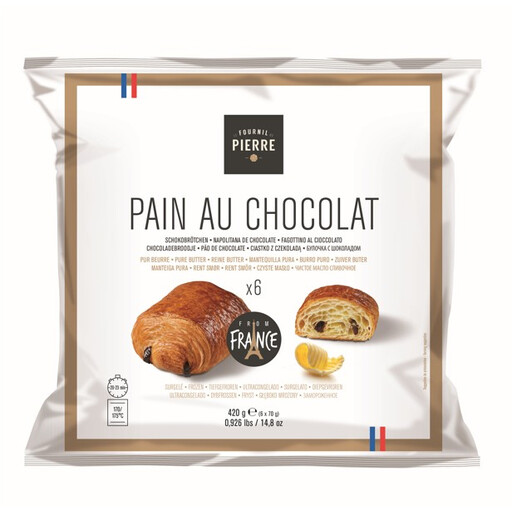 Image unavailable
Fournil de Pierre pain au chocolat to bake x6, 420 g
This product could suit you if you have time to bake the pain au chocolat and let it cool before catching the train. The pack contains six pieces and weighs 420 g. If Fairtrade/Max Havelaar certification matters to you, check the logo and details on the packaging. Also check the allergens on the pack you buy.
View on Joybuy
Frequently asked questions
How can I tell if a pain au chocolat carries the Fairtrade/Max Havelaar label?
Look for the Fairtrade/Max Havelaar logo on the packaging. Fairtrade/Max Havelaar France explains that for a composite product with a logo featuring an arrow, you should check the back to see which ingredients are covered and find details of how they’re traced.
Can I take frozen pain au chocolat on the train?
A frozen product that needs baking must be baked and cooled before you can take it as a snack. This is the preparation required for the Epi d’Or product listed by E.Leclerc, for example. If you want something that’s ready to eat, choose a ready-to-eat product instead.
Is Nutri-Score compulsory on pain au chocolat in France?
No. According to the DGCCRF, Nutri-Score is voluntary, while a nutrition declaration is generally required for prepacked foods. You can use the values per 100 g to compare products.
Where can I check allergens before travelling?
Read the ingredients list on the pack you’re taking with you. The DGCCRF says allergens must be listed and highlighted on the label. Check the exact product rather than relying on a pack you bought previously.
Does the “soda tax” apply to pain au chocolat?
No. The levy described by the French Ministry of the Economy applies to sugary drinks, not pain au chocolat. When choosing your product, check its ingredients and nutritional information if these matter to you.


