For a small household, start by choosing the number of pain au chocolat you’re likely to eat. A pack of 4 or 6 means you don’t have to open a large multipack, while frozen pastries you bake at home let you spread out the batches if you have a freezer, an oven and enough time. Buying them individually means you won’t need to store a packet, provided the shop offers this option. In every case, check the storage instructions, ingredients, allergens and nutritional information for the specific product you choose.
Who are these formats for?
Small households looking to avoid leftovers
If there are one or two of you, start with the number of pastries you expect to eat for breakfast or a snack over the next few days. A small pack, buying them individually or choosing pastries to bake at home could all work, depending on the storage instructions for each product.
Parents getting school mornings organised
A ready-to-eat pastry doesn’t need the same preparation as a frozen one that needs baking. If you’re short on time in the morning, check whether you can buy one that’s already baked or bake it at another time.
Shoppers who pay attention to ingredients
Compare the ingredients, allergens and nutritional information for each product rather than relying on the pack size or a claim such as ‘made with pure butter’. If you have a food allergy, check the labelling on the exact product you’re considering.
What should you look for first?
For back-to-school shopping, match the quantity you want to the time you have, then read the label on the product you choose.
| What to consider |
What to check |
Who is it for? |
| Quantity and leftovers |
Number of pastries, pack weight and storage instructions. |
In a household of one or two, I look for a quantity we can finish without leaving a large packet open; around 45% of consumers would put choosing the right pack size first. |
| Morning preparation |
Ready to eat or needs baking; the time and equipment specified for that product. |
Before heading to school, I need to know whether the pain au chocolat can be served without baking; around 33% of consumers would put ease of preparation first. |
| Ingredients and allergens |
Ingredients, allergens and nutritional values per 100 g, then the portion you plan to eat. |
If I’m comparing recipes or need to avoid an ingredient, I read the label on the exact product; ingredients would be the top priority for around 22% of consumers. |
Common mix-ups to avoid
-
Searching only for a ‘half loaf’ format
This term alone won’t help you identify a pack of pain au chocolat in France. It could distract you from the number of pastries and how they need to be prepared, which matter more for a small household.
Look for the number of pastries you want, individually wrapped products if that matters to you, or the words ‘ready to bake’. Then check the details for the exact product.
-
Assuming Nutri-Score is compulsory or tells you everything
The DGCCRF states that Nutri-Score is voluntary. Even when it appears on the packaging, it doesn’t replace checking the ingredients, allergens and nutritional information.
To compare two pain au chocolat, check their values per 100 g, then consider how much you plan to eat.
-
Choosing a large multipack without planning how you’ll use it
A pack of 20 is a different commitment from a pack of 4 or 6, even when the pastries can be kept frozen.
Count the breakfasts or snacks you’re planning and check the storage instructions and equipment needed before choosing a large pack.
A pack that’s too large can take up freezer space or go unused if you haven’t planned when to eat it.
-
Taking ‘made with pure butter’ as a nutritional assessment
This claim describes the recipe; on its own, it doesn’t tell you everything about the product’s ingredients, allergens or nutritional values.
Read the label on the product you’ve chosen, including the allergens and the fat content shown in the nutrition table.
Brands and retailers to know
Bridor
An option for ready-to-bake pain au chocolat when you can plan ahead.
- Bridor lists a 75 g pain au chocolat in a mini-pack of 20, with defrosting and baking instructions for this specific product.
- A pack of 20 means you’ll need space to store it and a plan for using it; this pack size may not suit one or two people.
Carrefour
A retailer where you can compare small packs of ready-to-eat pastries.
- Carrefour’s listing for a La Boulangère product shows 6 organic pain au chocolat, weighing 270 g in total, individually wrapped.
- Check the ingredients and allergens before buying: individual wrapping doesn’t tell you what’s in the product.
E.Leclerc
A retailer to check if you want to compare two sizes of ready-to-bake frozen multipacks.
- The products mentioned include a 20-piece ECO+ pack weighing 1.2 kg and a 6-piece Epi d’Or pack weighing 450 g.
- Their ingredients differ. Choose according to the quantity you can use and the product label; don’t assume the same features apply across the retailer’s range.
Auchan
A retailer with an example of a small pack of ready-to-eat pastries.
- The product mentioned contains 4 pain au chocolat and weighs 220 g.
- The ‘100% butter’ claim on this product doesn’t mean you can skip checking its allergens and nutritional information.
Lidl
An option for buying one at a time, without having to store a packet.
- Lidl describes a pure-butter pain au chocolat baked in store.
- It’s available in supermarkets with an in-store bakery counter that stocks this product; also check the store’s allergen information.
Aldi
Another option for buying a freshly baked pastry in store, one at a time.
- Aldi’s listing shows a 60 g pain au chocolat.
- This offer is available at participating stores with in-store baking equipment; check whether your local store stocks it.
An oven-ready option on Joybuy
This small pack of chocolate pastries to bake at home is for households that can plan time for baking. If you’re looking for pain au chocolat, also check the product description on the packaging.
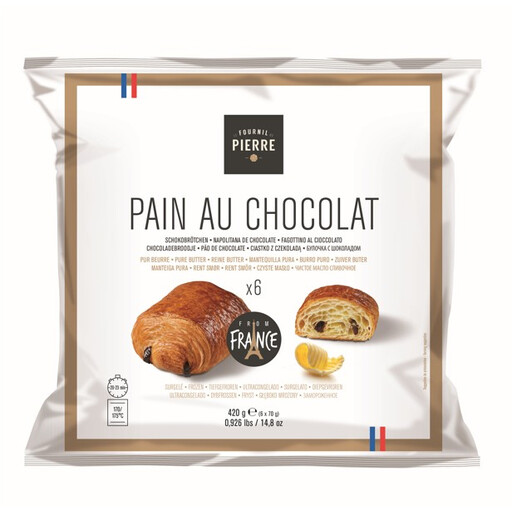 Image unavailable
Fournil de Pierre chocolate rolls to bake x6, 420 g
Worth considering if you’d rather bake the pastries at home than buy them ready baked. The pack contains 6 pastries and weighs 420 g; they must be baked before eating. Before planning several batches, check the baking instructions and storage guidance after opening on the packaging.
View on Joybuy
Frequently asked questions
Is Nutri-Score compulsory on pain au chocolat?
No. The European Commission and the DGCCRF state that this front-of-pack nutrition label is voluntary. For prepacked products, also read the ingredients list, highlighted allergens and nutrition declaration.
Which allergens should you check before buying?
Check the information for the exact product. The products mentioned may list wheat, milk, egg or soya, as well as possible traces depending on how they’re made. A ‘made with pure butter’ claim or the label on another product from the same brand doesn’t tell you what’s in the one you’re buying.
When should you choose frozen pastries over ones that are already baked?
Choose frozen pastries if you have the storage space, equipment and time to follow the baking instructions. A pastry that’s already baked saves you the preparation and means you don’t have to buy a packet, but availability may vary by store: Lidl and Aldi specify conditions relating to their in-store baking facilities.
Does the ‘soda tax’ apply to pain au chocolat?
No. The contribution described by Légifrance applies to drinks and liquid preparations for drinks, not solid pastries like these. To compare their sugar content, check the nutritional values per 100 g for each product.


