Planning your first food shop
You’re planning several breakfasts or snacks and want to buy the right amount for the first few days. The pack weight and number of pastries can help you avoid buying more than you need.


For your first shop, choose a multipack if you’re planning several portions, a single pastry if you want to eat one straight away, or frozen pastries to bake if you have a freezer and an oven. The number of pastries isn’t the only thing to consider: also check the recipe, allergens and storage instructions for the specific product.
You’re planning several breakfasts or snacks and want to buy the right amount for the first few days. The pack weight and number of pastries can help you avoid buying more than you need.
You want to distinguish products made with palm fat from those that state they’re made with butter, or you need to check for allergens. Compare the labels on the specific products rather than relying on the retailer’s name alone.
You have a freezer and an oven, and prefer to bake portions when you want them. Frozen pastries also need to be stored at the right temperature and prepared according to the instructions.
For your first shop, start with how much you’ll use, then compare the formats based on the recipe and how you can store or serve them.
| What to consider | What to check | Who is it for? |
|---|---|---|
| How much you need | Compare the net weight and number of pastries, then estimate how many portions you’ll use. | If I’m putting together my first food shop, I want to plan enough breakfasts without leaving an opened pack unused. Around 42% of consumers prioritise keeping to budget by choosing an appropriate quantity. |
| Recipe and label | Read the ingredients and allergen information; compare the nutritional values per 100 g. | If the presence of butter, other fats or allergens matters to my choice, I need to check the exact product. For around 33% of consumers, the recipe and label information come before other considerations. |
| Storage and serving | For frozen products, check the storage requirements, equipment needed and cooking instructions. For a single pastry, check that it’s available in store. | If I want to eat one straight away or bake portions later, the format needs to suit my equipment and schedule. This is the main consideration for around 25% of consumers. |
The product listings for E.Leclerc Eco+ and Auchan Pouce mention palm fat, while some products from Carrefour, Auchan and Lidl state that they contain butter. You can’t tell what’s in a product from its format or retailer alone.
Check the ingredients and allergen information for the product you’re buying, even if you’re already familiar with another version from the same brand.
The Carrefour Classic’ pack of pastries to bake needs to be kept at -18 °C and cooked in an oven for 18 to 20 minutes. Carrefour says not to refreeze the product once it has been defrosted.
Before choosing this format, make sure you can store and prepare it according to the instructions on the pack.
Freezer space and preparation time are also things to factor in.
According to Santé publique France and the DGCCRF, Nutri-Score is voluntary. Whether or not it appears on a product, it doesn’t replace checking the nutritional information and ingredients.
To compare two packs, check the sugars and fats per 100 g, as well as the ingredients list and allergen information.
The Eco+ product reviewed comes in a pack of 10 pain au chocolat, with a total weight of 450 g.
The Pouce product featured by Auchan contains 10 pain au chocolat in a 450 g pack.
The Carrefour Classic’ pack contains 6 frozen, all-butter pain au chocolat to bake, weighing 420 g.
Lidl’s all-butter pain au chocolat is sold individually and baked in store at branches with an in-store bakery that stock this product.
The Les Pâtissades product featured by Aldi comes in a 450 g pack of 10 pain au chocolat.
Bridor offers a 75 g pain au chocolat to bake in its range for foodservice professionals.
This selection features a pack of pain au chocolat to bake, worth considering if you have an oven and want to prepare several portions.
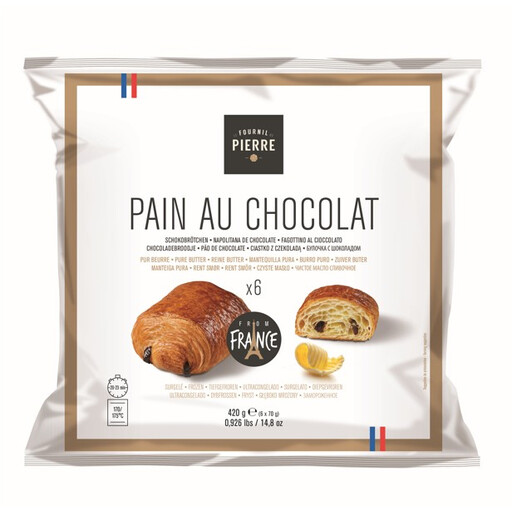 Image unavailable
This pack is ideal for a household planning several portions and with an oven. Check the cooking and storage instructions on the packaging before choosing it, along with the ingredients and allergen information if these affect your purchase.
No. Article 1613 ter of the French General Tax Code, published on Légifrance, applies to drinks and liquid preparations for drinks under the conditions it sets out, not to solid foods such as pain au chocolat. You can compare the sugars listed on the packaging, but this check isn’t required by that tax.
No. In France, Santé publique France and the DGCCRF describe Nutri-Score as voluntary labelling. Most prepacked foods do have a nutrition declaration, though. Use the values per 100 g and the ingredients list to compare two products, whether or not a logo is shown.
Check the net quantity, ingredients, highlighted allergens and nutritional information. When comparing packs of different sizes, the values per 100 g let you compare sugars, fats and salt on the same basis.
Follow the instructions for the specific pack. The Carrefour Classic’ product featured here should be kept at -18 °C, baked for 18 to 20 minutes and not refrozen after defrosting. Don’t assume the same instructions apply to another product.