Hosts who want to serve without baking
For coffee, brunch or afternoon tea, individually portioned pastries are easy to hand round. Auchan, for example, offers a pack of 16 individually wrapped pain au chocolat.


For a Mother’s Day breakfast or afternoon tea, start by considering how many people you’re catering for and how much time you have. Ready-to-eat portions make serving easier, while frozen pain au chocolat are a good choice if you have an oven and want to serve them warm. A catering platter saves you baking at home, but you’ll need to arrange collection and follow the storage instructions. In every case, check the number of pieces, ingredients and allergens for the product you choose.
For coffee, brunch or afternoon tea, individually portioned pastries are easy to hand round. Auchan, for example, offers a pack of 16 individually wrapped pain au chocolat.
If you’d like to serve warm pain au chocolat, frozen pastries that are ready to bake could be just the thing. Make room in the freezer and check the baking instructions before the day.
Recipes and allergen warnings vary between products. Compare the ingredients, fats, chocolate, sugars and any possible traces listed on the packaging you plan to buy.
For a Mother’s Day get-together, first work out how many portions you need. Then choose between serving them straight away, baking at home or collecting a platter.
| What matters | What to check | Who is this for? |
|---|---|---|
| Number of portions | Count the pieces and check their individual weight, as well as whether they’re individually wrapped. | When several guests are gathering round the table, I want to make sure there’s enough pain au chocolat without buying an oversized pack. This is a priority for around 31% of consumers. |
| Preparation time | Look for “ready to eat” or “ready to bake”, then check the baking and storage instructions. | If the food needs to be served straight away, I prefer portions that are ready to eat. If I want to serve them warm, I can plan time to bake them. Around 25% of consumers put serving arrangements first. |
| Ingredients and allergens | Read the ingredients, declared allergens and any possible traces listed for the exact product. | Before serving my guests, I need to know whether the recipe suits their dietary requirements or my ingredient preferences. For around 25% of consumers, this is their main concern. |
| Storing leftovers | Choose a pack size that suits your group and check how to store the product after opening or defrosting. | For a small group, I’d rather avoid portions that I can’t store as directed on the label. This is the top consideration for around 19% of consumers. |
A large pack may contain frozen pain au chocolat that need baking. If you don’t have an oven, freezer space or time to prepare them, they won’t suit your needs in the same way as a ready-to-eat pack.
Check whether the product is frozen or ready to eat, how it needs to be prepared and how it should be stored before choosing a pack size.
Individual wrapping doesn’t tell you what’s in the recipe. The products shown by Carrefour and Auchan have different recipes and allergen warnings.
Read the ingredients and allergen information for the exact product. Compare the proportions of butter or chocolate where these are listed.
According to the DGCCRF, Nutri-Score is a voluntary scheme. As for the so-called “soda tax”, the text published by Légifrance applies to drinks and liquid preparations for drinks, not solid pain au chocolat.
To compare two packs, check their ingredients, portion sizes and nutritional information instead, particularly the sugars per 100 g.
A pack intended to serve several occasions needs to be stored as directed for that particular product. Frozen and previously defrosted products may not keep in the same way.
Check the storage instructions. If you’re collecting a platter, check the arrangements for your chosen service too. Don’t refreeze a defrosted product if the label says not to.
Carrefour offers a 420 g pack of six frozen, all-butter pain au chocolat.
Auchan offers a ready-to-eat pack of 16 individually wrapped pain au chocolat, each weighing 45 g.
E.Leclerc offers a frozen, ready-to-bake product with 20 pieces weighing 1.2 kg in total.
Bridor describes a 70 g pain au chocolat that’s ready to bake and sold in a consumer pack.
Carrefour Traiteur offers a platter of eight pain au chocolat, advertised as serving eight people and weighing 520 g.
For a small get-together with baking at home, here’s a pack of six pain au chocolat to bake. Check that the pack size suits the number of guests and the time you have available.
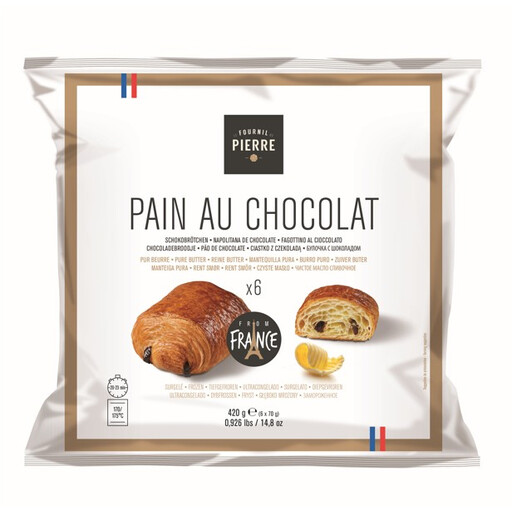 Image unavailable
This pack is a good choice for a small group if you can store the pain au chocolat in the freezer and allow time to bake them before serving.
It contains six pieces with a total weight of 420 g. Check the baking instructions on the packaging and store at −18 °C before use. Do not refreeze after defrosting.
Before serving, check the label for wheat/gluten, milk, eggs, soya and any possible traces of sesame or nuts.
No. The DGCCRF describes Nutri-Score as a voluntary labelling system. If it’s not shown on a pack, you should still read the ingredients and nutritional information.
No. According to the text published by Légifrance, this contribution applies to drinks and liquid preparations for drinks that meet the specified criteria, not solid pastries. You can compare the sugar content of pain au chocolat in the nutritional information per 100 g.
Read the label on the product you buy. The products shown by Carrefour and Auchan list wheat/gluten, milk, eggs and soya. Depending on the product or batch, traces of nuts may also be mentioned. Don’t assume the warning on one product applies to another.
Don’t refreeze it if the packaging says not to. This is the instruction given for the Carrefour Traiteur platter featured here. For any other product, follow the storage instructions for that specific product.