Hosts catering for a group
If you don’t want to bake for Friday drinks, work out how many portions you’ll need before choosing a pack. Auchan, for example, lists packs of 8 and 20, with individually wrapped pastries.


If you’re sharing pain au chocolat on Friday without any preparation and want to save some for packed lunches, choose a ready-to-eat multipack with the right number of pastries and individual wrappers for your needs. If you’d like to serve them warm, a frozen bake-at-home pack could be a good fit, provided you have a freezer and an oven, and enough time to prepare them. Either way, check the allergens and nutritional information for the product you choose.
If you don’t want to bake for Friday drinks, work out how many portions you’ll need before choosing a pack. Auchan, for example, lists packs of 8 and 20, with individually wrapped pastries.
Individual wrappers let you set some pastries aside without opening every portion. Also check the best-before date and the storage instructions on the pack.
A frozen, ready-to-bake pack means you’ll need space in the freezer and time to bake the pastries in the oven before serving.
| What to consider | What to check | Who it’s for |
|---|---|---|
| Number of pastries | Count the pastries and work out how many portions you’ll need for your guests. Packs listed include options with 8 or 20 pastries. | When a group gets together on Friday, I want to make sure there’s enough for everyone. Around 40% of the consumers surveyed would prioritise the number of pastries. |
| Portions to take away | Check whether the pack contains individual wrappers and read the storage instructions for after opening. | If I want to save a few pain au chocolat for packed lunches, I’d rather be able to separate the portions. This type of packaging would be the top priority for around 30% of consumers. |
| Serving warm | Check whether the product is ready to bake, read the cooking instructions and make sure you have enough freezer space. | If I want to serve them warm at Friday drinks, I can plan to bake them rather than choose a ready-to-eat pack. Around 30% of consumers would prioritise this way of serving them. |
The levy described by the French Directorate General of Public Finances applies to drinks, not solid pastries like these. It won’t help you choose between the packs.
If sugar content matters to you, compare the nutritional information per 100 g with the portion sizes you plan to serve.
France’s consumer protection authority, the DGCCRF, explains that displaying the Nutri-Score is voluntary in France. If it’s missing, you should still check the product’s other information.
To compare pre-packed foods, look at the nutritional information per 100 g, the ingredients list and the stated allergens.
A pack of 20 may leave you with leftovers if you’re catering for a smaller group. Individual wrappers don’t replace the need to follow the date and storage instructions.
Work out how many portions you’ll need for Friday drinks and packed lunches, then check exactly how the pack is presented.
This describes the recipe, but it doesn’t tell you everything about the ingredients, allergens or nutritional information. Frozen products also need to be prepared before serving.
Read the label and instructions for the specific product before choosing it for your guests.
Ready-to-eat packs of 8 and 20, so you can compare how many portions you’ll serve or save.
Carrefour Classic’ x6 is a frozen, bake-at-home option for serving warm.
E.Leclerc lists a 450 g pack of 6 frozen Epi d'Or pain au chocolat, ready to bake.
Bridor offers professional bake-at-home pain au chocolat, including a 75 g option and a 35 g Lunch format.
Lidl offers an all-butter pain au chocolat baked in store at some branches with an in-store bakery.
Aldi lists a 10-piece Les Patissades pain au chocolat pack.
This selection features a pack of six pain au chocolat to bake, for anyone planning to serve them warm. It’s an alternative to a large, ready-to-eat multipack to share between guests and packed lunches.
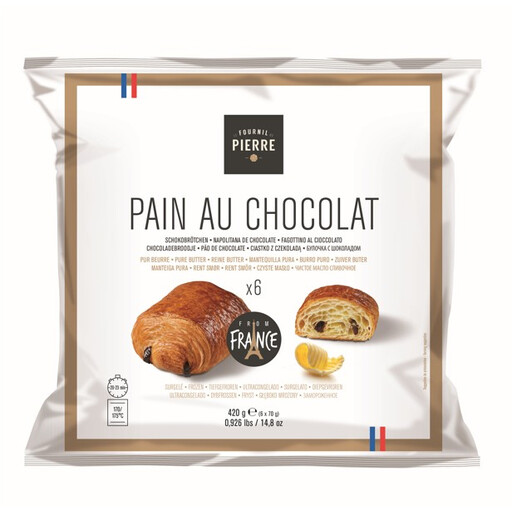 Image unavailable
This pack of six is a good option if you’re serving a small group and can store the pastries in the freezer before baking them in the oven. Check the cooking instructions on the packaging. If you’re planning to save some for packed lunches, check how they’re wrapped.
No. The levy described by the French Directorate General of Public Finances applies to drinks, not solid pastries like pain au chocolat. To compare packs by sugar content, check their nutritional information instead.
No. France’s consumer protection authority, the DGCCRF, describes Nutri-Score as a voluntary label in France. Pre-packed foods should generally include a nutritional declaration with values per 100 g to compare, even when the logo isn’t shown.
Read the allergen list on the pack you’re serving, along with any warnings about possible traces. Ingredients and warnings can vary between products or batches, so you can’t tell what’s in a pastry from the name “pain au chocolat” alone.
Check how the product is presented and how it needs to be prepared before you buy. The Carrefour Classic’ mentioned here is frozen and needs 18 to 20 minutes in the oven, while the pain au chocolat from Lidl’s in-store bakery is described as baked on site at the relevant branches.
Follow the storage instructions for the specific product. For its frozen Classic’ pain au chocolat, Carrefour recommends storage at −18 °C and says not to refreeze it after defrosting.