Planning several study breaks
A multipack could be a good choice if you’ll use its contents according to the storage instructions. Compare the number of pain au chocolat and the pack weight before you decide.


For several study breaks at home, choose a multipack if you can use and store all the pastries; frozen ones also require a freezer, an oven and time to bake. If you’re taking your snack with you, a ready-to-eat individually wrapped option means no preparation is needed. In every case, check the allergens and nutritional information for the product you buy.
A multipack could be a good choice if you’ll use its contents according to the storage instructions. Compare the number of pain au chocolat and the pack weight before you decide.
For a break between classes when there’s no oven, choose a ready-to-eat product. Auchan, for example, offers a pack of 20 pieces in 20 individual sachets; check the contents of the pack you buy.
If an ingredient or allergen affects your choice, read the label on the specific product. The phrase ‘made with pure butter’ doesn’t replace the ingredients list or nutritional information.
For study breaks, first decide whether you need something to take with you or a pack to enjoy at home. Then check the ingredients for the format you’ve chosen.
| What to consider | What to check | Who is this for? |
|---|---|---|
| How much you’ll use | Number of pieces, net weight and the pack’s storage instructions. | If I’m planning several breaks, I want to use all the pieces without leaving any over; around 45% of consumers put portion management first. |
| A no-prep break | Whether it’s ready to eat or needs baking; individually wrapped portions if you’re taking it with you. | Between classes, I want a portion I can take with me and eat without an oven. Having it ready straight away is the priority for around 33% of consumers. |
| Ingredients and labelling | Ingredients, allergens and nutritional information per 100 g. | Before choosing a pack, I need to check what’s in it and whether it contains any allergens I need to avoid; around 22% of consumers put this first. |
This phrase describes one aspect of the recipe, not the amounts of sugar or fat shown in the nutritional declaration. For example, the ECO+ and EPI D'OR products featured by E.Leclerc have a Nutri-Score E.
If this information matters to you, compare the nutritional declarations per 100 g and check the allergens separately.
The frozen Carrefour Classic' product needs 18 to 20 minutes in the oven. You’ll also need to store it according to the instructions on the pack.
Save this format for a planned break at home; if you’re out and about, choose a ready-to-eat product instead.
Auchan says that the ingredients may vary depending on the delivery service and purchase date, which matters especially when it comes to allergens.
Check the label on the pack you receive if you need to avoid an ingredient.
Carrefour offers frozen, made-with-pure-butter pain au chocolat in a pack of 6 weighing 420 g.
Auchan offers, among other options, a ready-to-eat pack of 20 pieces weighing 900 g, in 20 individual sachets.
Auchan’s POUCE range includes a pack of 10 pain au chocolat weighing 450 g.
E.Leclerc offers a ready-to-eat pack of 10 pieces weighing 450 g, as well as a frozen pack of 20 pieces weighing 1.2 kg.
This E.Leclerc range includes frozen, made-with-pure-butter pain au chocolat to bake at home, in a pack of 6 weighing 450 g.
Lidl offers a freshly baked, made-with-pure-butter pain au chocolat to enjoy straight away.
ALDI offers a pack of 10 Les Patissades pain au chocolat.
Bridor’s professional catalogue features an 80 g pain au chocolat, made with pure butter from Charentes-Poitou AOP, ready to bake.
This pain au chocolat is ready to bake, making it a good fit for planned study breaks at home, provided you have an oven and can store the pack according to its instructions.
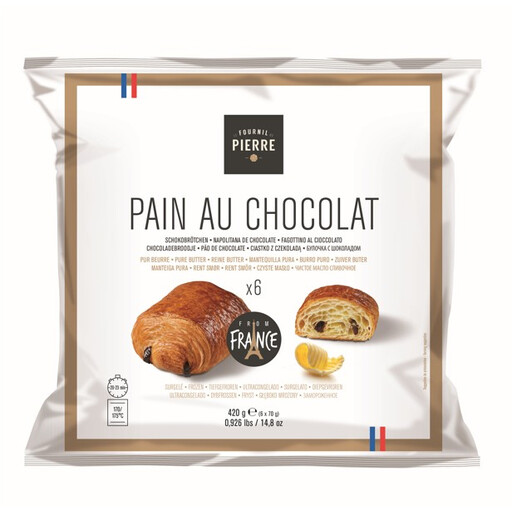 Image unavailable
Worth considering for planned breaks at home rather than as a snack to eat straight away.
The pack contains 6 pieces and weighs 420 g. Check the baking instructions and allergens on the packaging before use.
No. Displaying it is voluntary in France, as the DGCCRF explains. However, nutritional declarations are compulsory for most prepacked foods. They show, among other things, the amount of sugar and fat per 100 g.
Read the label on the specific pack before buying or eating it. Depending on the recipe, the products described by Carrefour, Auchan and E.Leclerc list wheat, milk, eggs or soya; some also warn that traces of nuts may be present.
The listing for the frozen Carrefour Classic' product says not to refreeze it after defrosting. For any other pack, follow its own storage and preparation instructions.
Compare the ingredients, allergens and nutritional information per 100 g, rather than relying on the phrase ‘made with pure butter’ alone. Also check the number of pieces and whether the product needs to be baked: these differences affect how useful it is for study breaks.