For an immediate late-night snack, choose a pain au chocolat that’s already baked, as long as you can buy one when you need it. If you’re planning ahead, frozen pastries that you bake at home let you keep some in the freezer, but you’ll need a freezer, an oven and time to prepare them. A pack of individually wrapped pastries is the simplest option. Whichever you choose, check the ingredients and allergen information for the specific product rather than relying on the word ‘premium’ alone.
Who are these formats for?
Fans of buttery recipes
If the ingredients matter more to you than the number of pastries, look for ‘all butter’ on the pack or check the stated butter content of the product you’re considering. Lidl, E.Leclerc and Bridor list different recipes, and the details given for one product don’t apply to every pain au chocolat sold under those brands.
Those who plan their snacks ahead
Frozen pastries that you bake at home may suit you if you have space in your freezer, an oven and time to follow the preparation instructions. Ready-to-proof pastries need time to prove as well, so check exactly what state the product is in before planning to eat it late in the evening.
Label-conscious shoppers
To compare products, read the ingredients, allergen information and nutritional values per 100 g, as well as per serving where given. The Nutri-Score can provide an additional point of reference if it appears on the packaging.
What should you look for?
First decide whether you want your pain au chocolat ready to eat or are happy to bake it. You can then compare products in your chosen format by looking at the ingredients, pack size and nutritional information.
Already baked
Choose this: if you want to eat it without any further preparation.
Bear in mind: check that it’s available at your chosen shop when you’re buying; the range of pastries baked in store can vary, particularly depending on whether there’s an in-store bakery.
Frozen and ready to bake
Choose this: if you’d like to keep some at home for a planned snack.
Bear in mind: you’ll need a freezer, an oven and enough time to follow the preparation instructions on the pack. Ready-to-proof pastries also need time to prove.
Pack of individually wrapped pastries
Choose this: if you want several pastries to hand without having to bake them.
Bear in mind: check the ingredients and storage instructions. Individually wrapped pastries aren’t necessarily made with all butter.
| What to consider |
What to check |
Who is this for? |
| Recipe and taste |
The fat listed in the ingredients and the proportions of butter or chocolate, where specified. |
If I’m eating a pain au chocolat as soon as I buy it, I want to know what’s in it rather than relying on the word ‘premium’; around 40% of consumers prioritise a buttery recipe and being able to enjoy it straight away. |
| Availability and preparation |
The number of pastries, whether they’re already baked or need baking, and, if necessary, the preparation and storage instructions. |
If I’m planning a late snack, I need a format I can store and prepare as directed; practical availability is the priority for around 30% of consumers. |
| Labels and allergens |
Declared allergens and nutritional values per 100 g, plus the serving size and Nutri-Score where displayed. |
If I’m comparing two products or avoiding an ingredient, I need to be able to read their labels before choosing; nutritional information and allergens come first for around 30% of consumers. |
Common pitfalls to avoid
-
Assuming ‘premium’ means ‘all butter’
A product’s positioning doesn’t tell you exactly what’s in it. E.Leclerc lists 21% butter for the EPI D’OR product reviewed, while Lidl lists 24% for its product. The Auchan product reviewed contains, among other ingredients, palm fat and concentrated butter.
Compare the ingredients of specific products and, where given, check the proportions of butter and chocolate.
-
Confusing frozen pastries that need preparing with ready-to-eat products
A ready-to-proof pain au chocolat, such as the product described by Bridor, can’t be eaten straight from the freezer: it needs time to prove and then must be baked.
Check the steps, timings, equipment needed and storage instructions before relying on this format for a late-night snack.
-
Assuming Nutri-Score information is compulsory
According to Santé publique France and the Ministry of Agriculture, displaying the Nutri-Score is voluntary and supplements the mandatory nutritional information. Its absence isn’t enough to judge a product.
If it’s shown, read it alongside the nutritional values, ingredients and allergen information for that product.
-
Linking the sugar in the product to the ‘soda tax’
The Ministry of the Economy describes this levy as applying to sugary drinks, not pain au chocolat. The ‘sugars’ line is still useful nutritional information when comparing products.
Check the values on each pack, rather than assuming that a rule applying to drinks also covers pastries.
Brands to know
These examples show the range of recipes and formats available. Always check the details of the specific product you’re thinking of buying.
Bridor
Bridor’s product listing describes an 85 g professional pain au chocolat that’s ready to proof and needs to be prepared before eating.
- The manufacturer states that this product contains 20% Charentes-Poitou AOP butter, and gives details of its storage and baking instructions.
- This format isn’t suitable if you want something you can eat straight away.
EPI D’OR / E.Leclerc
The product reviewed is a box of six frozen, all-butter pain au chocolat, ready to bake.
- The product listing states that it contains 21% butter and 11% chocolate.
- Check availability with your local E.Leclerc store and allow time to bake them.
Carrefour
Carrefour’s range includes Classic’, all-butter, organic and Charentes-Poitou AOP butter pain au chocolat.
- These product names make it easy to spot several different recipes to compare individually.
- Check the format and ingredients of each product; a range name alone doesn’t tell you what they are.
Auchan
The product reviewed contains 16 pain au chocolat, weighing 720 g in total, individually wrapped.
- The packaging keeps each pastry separate within the pack.
- The ingredients include palm fat and concentrated butter, among other things, so don’t assume this is an all-butter recipe.
Lidl
Lidl offers an all-butter pain au chocolat baked in store, which could suit you if you don’t want to bake at home.
- The product listing states that this pain au chocolat contains 24% butter and 11% dark chocolate.
- Check your local store’s range and the allergens listed for the product.
Aldi / Les Pâtissades
The product featured by Aldi is a 450 g pack of 10 pain au chocolat.
- The pack size makes it easy to plan a snack or share with others.
- To check the recipe or allergens, read the information on the packaging of the product you choose.
A bake-at-home option on Joybuy
If you’re planning a snack to prepare at home rather than something to eat straight away, this selection features a pack of pain au chocolat to bake. Check the preparation instructions before deciding when you’ll enjoy them.
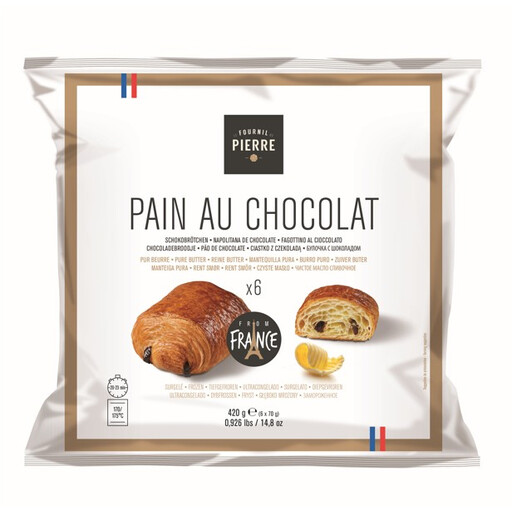 Image unavailable
Fournil de Pierre, pain au chocolat to bake x 6, 420 g
For a snack you’ve planned ahead and will prepare at home: this pack contains six pain au chocolat, with a total weight of 420 g. Before buying, check the preparation steps and timings, as well as the storage instructions.
View on Joybuy
Frequently asked questions
Does the ‘soda tax’ apply to pain au chocolat in France?
No. The Ministry of the Economy describes this levy as applying to sugary drinks, not pastries. To compare the nutritional content of pain au chocolat, check the ‘sugars’ line on the labels instead.
Does a pain au chocolat have to display a Nutri-Score?
No. According to Santé publique France and the Ministry of Agriculture, displaying the Nutri-Score is voluntary and supplements the mandatory nutritional declaration. If it’s shown, use it as additional information, but still check the ingredients, allergens and nutritional values.
Which allergens should you check before buying?
Check the allergens and ‘may contain’ statements for the specific product. The products described by Lidl and Bridor list ingredients or possible traces relating to wheat, milk, eggs or soya, depending on the recipe. Bridor’s product listing also mentions possible traces of sesame and nuts.
Can you bake frozen pain au chocolat at short notice?
Only if the preparation instructions fit the time you have. Bridor says its ready-to-proof product should be stored at −18 °C and needs time to prove before baking, so it can’t be treated like a pain au chocolat that’s already baked. Follow the instructions on the packaging of the product you choose.


