Hosts who want to serve them warm
For a Christmas breakfast or brunch at a set time, frozen pain au chocolat that you bake at home is a good choice if you can plan for the oven, preparation and serving.


For a Christmas meal with no preparation needed, choose ready-to-eat pain au chocolat. If you can plan ahead for baking, frozen pain au chocolat that you bake at home lets you serve it warm. Individually wrapped pastries are better suited to handing out over a longer period. In every case, compare the ingredients, number of pastries, allergens and nutritional information for the exact product.
For a Christmas breakfast or brunch at a set time, frozen pain au chocolat that you bake at home is a good choice if you can plan for the oven, preparation and serving.
If the ingredients matter more to you than the word ‘premium’, check the ingredients list and the stated proportions of butter and chocolate, where available.
Before serving several guests, check the declared allergens and any ‘may contain’ warnings on the packaging of the product you’ve bought. An all-butter recipe doesn’t remove the need to check.
First, choose a format that suits your mealtime and the time you have available to prepare it. Then compare products by checking their labels.
Choose this if: you want to serve them quickly without having to use the oven for pastries.
Bear in mind: if you’re buying pastries baked in store, check they’re available at your chosen shop. Lidl only offers its product at stores with an in-store bakery that stock it.
Choose this if: you can arrange to bake them just before serving.
Bear in mind: storage and preparation vary by product. Bridor’s 85 g raw product, for example, needs to be left to prove before baking.
Choose this if: you’re handing out pain au chocolat at different times.
Bear in mind: individual wrapping makes it easier to hand them out, but doesn’t tell you what the recipe is. La Boulangère describes this packaging for its product.
| What to compare | What to check | Who is it for? |
|---|---|---|
| Recipe | Ingredients list; stated proportions of butter and chocolate. | For a festive table, I want to know what ‘all butter’ means for the product I choose. Around 31% of consumers put the recipe at the top of their list. |
| Serving | Ready to eat or bake at home; preparation instructions and number of pastries. | If the oven is free just before brunch, I can choose a product to bake; otherwise, I’ll opt for one that’s ready to serve. How it’s served is the priority for around 31% of consumers. |
| Labelling | Allergens and ‘may contain’ warnings; sugars, saturates and salt per 100 g. | If guests have allergies, I need to read the packaging on the batch before serving. Checking allergens or nutritional information takes priority over other criteria for around 23% of consumers. |
| Pack size and availability | Number of pastries and pack weight; availability at your chosen shop. | For a large gathering, I want enough pastries in a pack I can actually buy before the meal. Around 15% of consumers prioritise pack size and local availability. |
This term doesn’t tell you the exact proportion of butter or chocolate, or what format and preparation you’ll need for your meal.
Compare the ingredients, stated quantities, storage instructions and nutritional values for each product.
The DGCCRF distinguishes between the mandatory nutrition declaration for relevant prepacked foods and the Nutri-Score, which is voluntary. So, even if the logo isn’t there, you can still check the nutritional values.
Where the information is on the packaging, compare the values per 100 g. Treat the Nutri-Score as extra information, and don’t assume on its own that a product suits your needs.
Ingredients and ‘may contain’ warnings vary between products. Anses reminds food businesses that substances which can cause allergies or intolerances must be highlighted in the ingredients list.
If you have an allergy or intolerance, check the packaging on the batch you’ve bought, including any warnings about production in a facility that handles other ingredients.
Bridor’s 85 g professional product is raw and needs to be prepared before serving.
Carrefour offers, among other products, a box of 10 all-butter pain au chocolat.
E.Leclerc’s product information is for six frozen all-butter pain au chocolat, with a total weight of 450 g.
Auchan offers a frozen pack of six all-butter pain au chocolat, weighing 450 g.
Lidl describes an all-butter pain au chocolat baked in store.
ALDI offers a 450 g pack of 10 Les Patissades pain au chocolat.
For a Christmas brunch where you’re planning to bake, this selection includes a pack of pain au chocolat to bake at home. Check that you can fit the preparation into your plans for the meal.
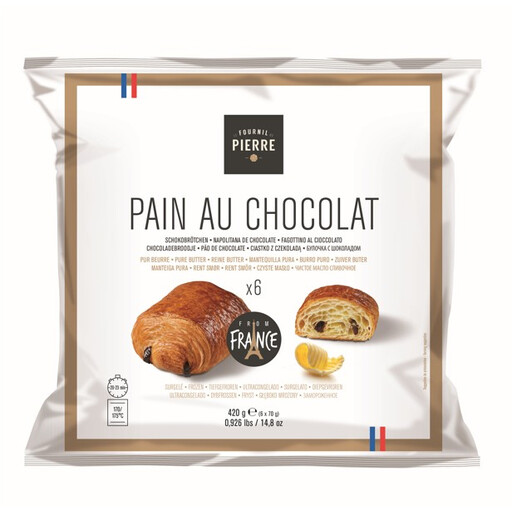 Image unavailable
This pack of six is a good choice for serving warm if you can bake them before brunch. Check the preparation instructions and allergen information on the packaging of the batch you buy.
No. The French Ministry of the Economy describes this levy as applying to sugary drinks, not pain au chocolat. To compare these pastries, check the ‘sugars’ line in the nutrition declaration where it applies to the prepacked product.
No. According to the DGCCRF, the Nutri-Score is voluntary, while a nutrition declaration is mandatory for relevant prepacked foods. If the logo isn’t shown, you can still compare the nutritional values per 100 g on the packaging.
Check the product and batch you’ve bought. Product information for the items mentioned lists, among other things, wheat, milk, eggs or soya, as well as possible traces depending on the product. Also check the packaging for any warnings about nuts and other allergens.
Auchan’s information for its frozen pain au chocolat says not to refreeze a defrosted product. Follow the storage instructions on the pack you’ve bought, as these depend on the product and how far it has been prepared.