Small household, occasional treat
If pain au chocolat isn’t a regular breakfast choice, compare the number of pieces with how often you expect to eat them. For multipacks, check how they’re packed and the storage instructions too.


For a small household that rarely buys pain au chocolat, buying one ready to eat avoids having to store a multipack. Frozen pastries to bake are a better option if you have an oven, freezer space and plans to use every piece. Don’t assume that “half loaf” or “demi-pain” refers to a specific size: compare the number of pieces, how they’re packed and the storage instructions.
If pain au chocolat isn’t a regular breakfast choice, compare the number of pieces with how often you expect to eat them. For multipacks, check how they’re packed and the storage instructions too.
Frozen pain au chocolat that’s ready to bake calls for an oven, room in your freezer and careful attention to the product instructions. Check these details before choosing a multipack for baking at home.
Check the ingredients list, declared allergens and nutritional information for the exact product you’re considering. This is especially important if you need to avoid an ingredient or compare products with different portion sizes.
Start with how many your household will use, then choose between eating them straight away and baking them at home. Once you’ve narrowed down your options, compare the ingredients of products that meet your needs.
| What matters to you | What to check | Who it’s for |
|---|---|---|
| Avoiding leftovers | Number of pieces, weight per piece and storage instructions; check whether the product you’ve chosen comes in individual wrappers. | If you only eat pain au chocolat occasionally, a large pack may be more than you need, even if the pieces are individually wrapped. Around 46% of consumers say avoiding leftovers is their top priority. |
| Baking at home | Look for “ready to bake”, check the preparation instructions and make sure you have enough freezer space. | If you want to serve pain au chocolat freshly baked at home, you’ll need to store the product properly and follow the preparation instructions. This is the main priority for around 36% of consumers. |
| Checking the ingredients | Check the ingredients and allergens for the exact product, along with the nutritional information per 100 g and, if provided, per portion. | If you need to avoid an ingredient or compare two recipes, the product name alone won’t tell you enough. Checking the ingredients is the top priority for around 18% of consumers. |
Bridor and retailers offer a range of formats, including mini pain au chocolat, individual pastries and multipacks to bake. The term “half loaf” on its own doesn’t tell you what kind of pack you’re looking for.
Check the number of pieces, the weight per piece and the storage instructions. If a product listing uses “demi-pain”, check exactly what it means for that particular product.
Individually wrapped pastries can still come in a multipack that’s too large for occasional consumption. The Auchan product described in the research contains 20 pains au chocolat, while you should confirm the individual wrapping details on the product itself.
Count how many pieces your household is likely to eat, and check the packaging for the exact product before you buy.
These claims don’t replace the ingredients list, declared allergens or nutritional information. According to Santé publique France, displaying the Nutri-Score is voluntary.
To compare two products, read their nutritional information on the same basis, particularly per 100 g. Check the packaging too if you need to avoid an ingredient.
Frozen pastries need to be stored and prepared differently from ones that are already baked. The Carrefour SIMPL multipack listing says never to refreeze the product after defrosting.
Before you buy, check the product’s condition, baking and storage instructions, and how much freezer space you have.
These examples show different pack sizes and preparation methods. The details given apply to the specific products listed, not to every pastry from each brand.
Bridor offers pain au chocolat in several weights, including mini formats and a 75 g frozen product that’s ready to bake.
The product described is a frozen multipack of 20 pains au chocolat, weighing 1.2 kg.
The product reviewed contains 20 pains au chocolat and weighs 900 g.
The listing for the individually wrapped pains au chocolat gives nutritional information per 100 g and per 45 g portion.
Lidl offers an all-butter pain au chocolat, baked in store and sold individually at stores with an in-store bakery that stock this product.
If you’d like to bake pain au chocolat at home, this selection includes a pack of six. Check whether the pack lets you take out only the pieces you plan to bake.
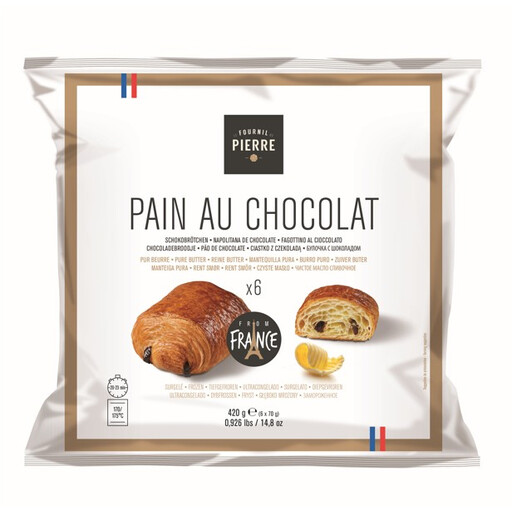 Image unavailable
This pack is for households planning to bake their pain au chocolat at home. It contains six pieces and weighs 420 g. Before relying on being able to bake them in batches, check the packaging to see whether the pieces can be separated, and to find the baking temperature and time.
No. The French Ministry of the Economy describes this levy as a tax on sugary drinks, not pastries. To compare pain au chocolat, check the sugars listed in the nutritional information instead.
No. Santé publique France says producers can choose whether to display the Nutri-Score. If it appears on a product, consider it alongside the ingredients list and nutritional information rather than using it as your only deciding factor.
Check the packaging for the exact product. The pain au chocolat products described by Bridor and the retailers mentioned may declare wheat, milk, egg or soya, depending on the recipe. The packaging may also mention traces of nuts. Don’t assume the allergen information for one product applies to another.
Not for the Carrefour SIMPL frozen multipack described here: Carrefour says never to refreeze a defrosted product. For any other multipack, follow the instructions on its own packaging.