Households planning several breakfasts
A large pack could last for several meals, as long as the number of pastries suits your household and you have somewhere suitable to store them.


For a weekend breakfast, first choose a quantity that suits the number of people you’re serving. Then decide between ready-to-eat pain au chocolat and pastries that need baking. A large frozen pack requires an oven and room in your freezer, while a ready-to-eat product saves you the preparation, but you’ll want to make sure the quantity matches how much you plan to eat.
A large pack could last for several meals, as long as the number of pastries suits your household and you have somewhere suitable to store them.
Ready-to-eat pain au chocolat means no defrosting or baking. However, a pastry from a bakery counter and a pre-packed product suit different needs when it comes to quantity.
To compare recipes made with butter or vegetable oils, or to check for allergens, read the ingredients list and nutritional information for the product you’re considering.
For a weekend breakfast, start by working out how many portions you need, then check how to prepare the product and what its label says.
| What to consider | What to check | Who is this useful for? |
|---|---|---|
| Budget and quantity | The net weight and number of pastries, in relation to the breakfasts you have planned. | If I’m planning several meals, I want to buy an amount my household can realistically get through. Around 42% of consumers would prioritise keeping their budget under control. |
| Preparation and storage | Whether it says ‘ready to eat’ or ‘bake at home’, the instructions and the amount of freezer space required. | If I want to serve breakfast as soon as everyone’s up, I don’t want to discover that baking is required. Around 25% of consumers would prioritise the product format and preparation. |
| Ingredients and allergens | The ingredients, allergens and, for applicable pre-packed products, the nutritional values per 100 g. | If there are ingredients I need to avoid, I have to be able to check the specific product I’m serving. Around 33% of consumers would put ingredients, nutritional information or allergens at the heart of their choice. |
The products mentioned by Carrefour and E.Leclerc contain 16 and 20 pastries respectively. That difference matters if you’re serving breakfast to a small number of people or plan to use the pack over several occasions.
Count the people and meals you’re catering for, then check the number of pastries, the weight and the storage instructions.
Pain au chocolat that’s ready to bake can’t be served straight away like a pastry from a bakery counter. Bridor’s product information says its product needs to be defrosted and baked.
Read the preparation instructions and make sure you have an oven and enough room in your freezer.
Defrosting and baking also take time before you can sit down to eat.
On its own, this claim doesn’t tell you about the sugars, salt or full list of allergens. The recipes listed by Lidl, Carrefour and E.Leclerc don’t contain the same ingredients.
Read the ingredients list and allergen information for each product. When comparing pre-packed products, check the nutritional values per 100 g too.
The DGCCRF describes Nutri-Score as a voluntary label. So its absence doesn’t mean you can skip reading the product label.
For applicable pre-packed foods, use the nutrition declaration, subject to regulatory exemptions, as well as the ingredients list and allergen information.
E.Leclerc lists a frozen pack of 20 pain au chocolat weighing 1.2 kg. It’s worth considering if you have an oven and enough room in your freezer.
The Carrefour Classic' product listed contains 16 ready-to-eat pain au chocolat, weighing 720 g.
Auchan lists a pack of 20 pain au chocolat weighing 900 g, intended to be enjoyed over several occasions.
Lidl describes an all-butter product baked in store, ready to eat without any baking at home.
Bridor offers a 65 g pain au chocolat that’s ready to bake, for anyone happy to use the oven.
This selection features frozen pain au chocolat to bake in the oven for a weekend breakfast.
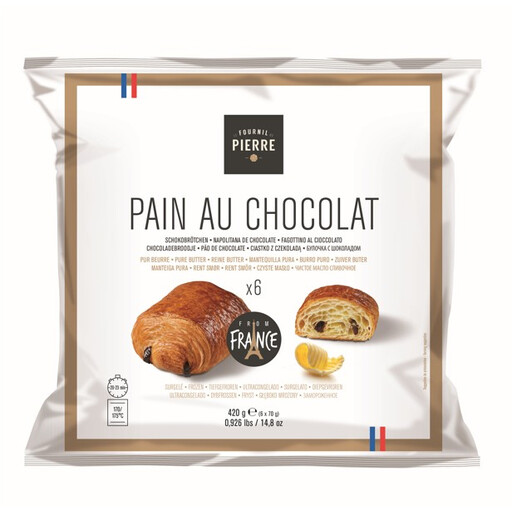 Image unavailable
This pack of six is a good choice if you want to prepare several portions and have an oven and freezer. The product is labelled as frozen and ready to bake, and should be stored at −18 °C. Check the baking instructions on the packaging before deciding what time to have breakfast. If you have an allergy, check in particular for wheat, soya, milk and eggs, as well as possible traces of sesame and tree nuts.
No. In France, Article 1613 ter of the General Tax Code, published on Légifrance, covers drinks and liquid preparations for drinks containing added sugars, not pain au chocolat. To check the sugar content of a pre-packed product, look at its nutrition declaration instead.
No. The DGCCRF describes Nutri-Score as a voluntary system. A nutrition declaration is a separate requirement for pre-packed foods, subject to the exemptions set out in the regulations.
Compare the nutritional values per 100 g, particularly the sugars, fat, saturated fatty acids and salt, then read the ingredients and allergen information. The absence of a Nutri-Score doesn’t, on its own, mean that a product is less suitable for your needs.
Not necessarily. Check the preparation instructions for the product you choose. The Bridor pain au chocolat described by the brand needs to be defrosted and baked, so allow time for both steps before breakfast.
Check the allergens listed for the product you’re buying rather than relying on the information for another size or type. The product information mentioned here lists, depending on the product, cereals containing gluten, milk, eggs or soya, as well as possible traces of sesame or tree nuts.