Anyone who wants to serve them warm at home
For breakfast, brunch or a special meal, frozen, ready-to-bake pain au chocolat lets you bake them at home. Check whether they need defrosting and allow enough time for baking.


To serve warm pain au chocolat at home for a special meal, choose a ready-to-bake option if you don’t want to plan for proofing. The 85 g Bridor ready-to-proof product needs to ferment first, while a product already baked in store won’t meet the need for home baking. To compare products designed for the same purpose, check the listed ingredients, number of pieces, preparation instructions, nutritional information and allergens.
For breakfast, brunch or a special meal, frozen, ready-to-bake pain au chocolat lets you bake them at home. Check whether they need defrosting and allow enough time for baking.
If ingredients matter to you, compare the stated amounts of butter and chocolate for each product rather than relying solely on terms such as ‘premium’ or ‘all-butter’.
Compare sugar content on a like-for-like basis, particularly per 100 g, and check the ingredients and allergen information on the packaging of the product you buy. Details vary by recipe.
First, decide whether you want to bake the pain au chocolat at home and whether you can allow time for proofing. You can then compare the ingredients and labels of products that fit your needs.
Choose this if: you want to bake them at home without a proofing stage.
Bear in mind: follow the instructions for the specific product. Carrefour recommends baking its product for 18 to 20 minutes, while Auchan advises defrosting its product first.
Choose this if: you can manage the proofing process before putting them in the oven.
Bear in mind: Bridor’s catalogue states that its 85 g pain au chocolat needs 2 h to 2 h 15 of proofing at 27–28 °C before baking.
Choose this if: you want to serve pain au chocolat quickly without baking them at home.
Please note: the products described by Lidl and Aldi are specific to the stores concerned and are not presented as products for home baking.
| Criteria | What to check | Who is it for? |
|---|---|---|
| Preparation | Look for ‘ready to bake’, ‘ready to proof’ or ‘baked in store’, then check the product’s specific steps and timings. | If you want to serve them warm at mealtime, you’ll need to know whether defrosting or proofing is required before baking. Around 43% of consumers would put this preparation first. |
| Ingredients and format | Check the proportions of butter and chocolate, where stated, as well as the weight and number of pieces. | If you’re choosing the recipe primarily for your guests, the term ‘all-butter’ isn’t enough to compare two products. Ingredients would be the top priority for around 29% of consumers. |
| Nutritional information and allergens | Check sugars per 100 g and any allergen or ‘may contain’ statements on the packaging. | If you need to consider ingredients or compare sugar content, check the label for the product you’re serving. This would be the top priority for around 28% of consumers. |
The 85 g Bridor product needs to proof before baking; the ready-to-bake products described by Carrefour and Auchan follow a different process. Pain au chocolat baked in store won’t meet the same need either.
Read all the preparation steps before planning when to serve them, not just the baking time.
Santé publique France explains that displaying the Nutri-Score is voluntary. Its absence alone isn’t enough to judge the ingredients in pain au chocolat.
Compare the nutritional information per 100 g and the ingredients list, whether or not the logo is shown.
The Auchan and Epi d’Or product pages reviewed list 10 g and 11 g of sugars per 100 g respectively. The term ‘all-butter’ doesn’t tell you about the other nutritional values.
To compare these products, use the same 100 g basis, then check the weight of the piece you plan to serve.
The products reviewed list wheat, milk, egg or soya, depending on the product; some may also contain traces of nuts.
If you have an allergy, check the ingredients and any ‘may contain’ statements on the packaging of the item you actually buy.
The 85 g pain au chocolat featured in the Bridor catalogue is an unbaked, ready-to-proof product that needs to be proofed and then baked.
The product reviewed is a 420 g bag of six frozen, all-butter pain au chocolat for baking at home.
The product reviewed is a 450 g pack of six frozen, all-butter pain au chocolat.
The product reviewed is a 450 g pack of six frozen, all-butter pain au chocolat, ready to bake.
The all-butter pain au chocolat described by Lidl is baked in store at selected locations.
The pain au chocolat featured by Aldi is an in-store offering, intended to be eaten without baking at home.
This selection is for baking pain au chocolat at home. Check the product instructions before deciding when to serve them.
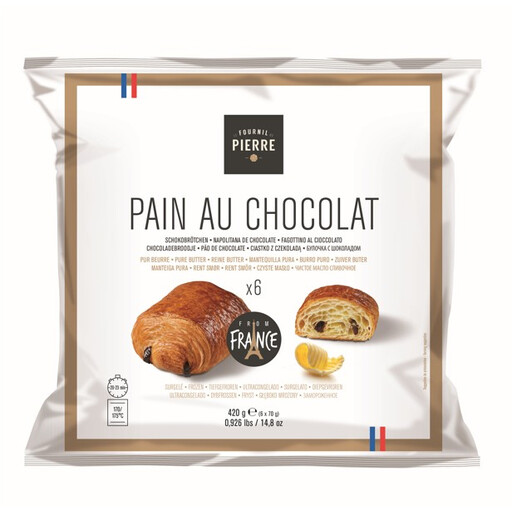 Image unavailable
A pack of six pieces to bake at home and serve warm. Check the packaging for baking instructions and allergen information before serving them to your guests.
No. The French Ministry of the Economy describes this French levy as a tax on sugary drinks. To compare pain au chocolat, check the sugar content in the nutritional information instead.
No. Santé publique France says that displaying it is voluntary and that it supplements the mandatory nutritional declaration. If the logo isn’t shown, check the nutritional values and ingredients list to compare products.
Check the product name and all the preparation steps: a ready-to-proof product needs to ferment before baking, as with the 85 g Bridor product described in its catalogue. The frozen, ready-to-bake products reviewed at Carrefour and Auchan each have their own oven instructions.
Check the product you’ve bought. Depending on the recipe, the products reviewed list wheat, milk, egg or soya, and some may contain traces of nuts. If you have an allergy, use the label on the pack you’re serving to guide your choice.
The Carrefour and Auchan product information reviewed says not to refreeze a product once it has defrosted. Follow the storage and preparation instructions on the packaging of the product you’re using.