Hosting breakfast for a group
If you’re planning several breakfasts or afternoon snacks, work out how many pieces you’ll need before choosing a large pack. For a frozen product, you’ll also need freezer space and time to bake it.


To serve pain au chocolat to a group after your first big shop, choose a large frozen pack if you have freezer space, an oven and time to bake them. Individually wrapped, ready-to-eat portions are better if you want to avoid cooking or take them with you; in-store baked pain au chocolat are best enjoyed straight away. In every case, check the number of pieces, ingredients and allergens for the specific product you choose.
Your choice mainly depends on how many people you’re serving, what facilities you’ll have after your shop and which ingredients you need to check.
If you’re planning several breakfasts or afternoon snacks, work out how many pieces you’ll need before choosing a large pack. For a frozen product, you’ll also need freezer space and time to bake it.
A pack of ready-to-eat pain au chocolat saves you having to bake them. Individually wrapped portions are also easy to hand out or take with you; check the storage instructions on the pack.
Compare the ingredients list for each product, paying particular attention to the fats used, declared allergens and any possible traces. You can’t tell what’s inside from the pack size.
For breakfast or an afternoon snack with others after your first big shop, start by checking the number of portions and storage requirements. Then check how the product is prepared and read the label for the one you choose.
| What to consider | What to check | Who is this important for? |
|---|---|---|
| Number of portions | Count the pieces and compare the total weight with the number of people and occasions you’re planning for. | When several people are having breakfast together, I want to be able to serve everyone without running short. Around 33% of consumers put sharing enough portions at the heart of their choice. |
| Preparation and taking with you | Check whether the product is ready to eat or needs baking. If it needs baking, make sure you have the right equipment and enough time. | If I don’t have an oven after shopping, or want to pop a portion in a bag, I’d rather avoid any preparation. Around 25% of consumers put convenience straight away first. |
| Ingredients and allergens | Read the ingredients, allergen information and any precautionary trace warnings on the exact product packaging. | If I need to avoid an ingredient or allergen, the pack size alone won’t help me decide what to buy. Checking the ingredients is the main priority for around 25% of consumers. |
| Storage and leftovers | Check how much space you have, the storage instructions and how many pieces you’ll use. | If I’m stocking up but don’t want pastries to go to waste, I look for a pack that suits my storage space. Around 17% of consumers prioritise managing leftovers. |
A large pack may contain frozen pain au chocolat that need baking. For example, Carrefour says its 6-piece Classic’ product needs 18 to 20 minutes in the oven.
Before buying, check whether the product is ready to eat or needs baking, and follow the instructions for the specific pack you choose.
Ingredients vary between products: some contain butter, while others use vegetable oils or fats. Individual wrapping doesn’t tell you which allergens are present, either.
Read the ingredients list and allergen information for the exact product, including any possible traces listed.
According to Santé publique France, displaying the Nutri-Score is voluntary. Whether it appears on the pack or not, you should still read the nutritional information and ingredients.
When comparing pain au chocolat, also check the serving size, sugars and fats listed for the products you’re considering.
A frozen pack needs enough space in your freezer. Bridor says to store its 70 g product at −18 °C and not to refreeze it after defrosting.
Think about how many portions you’ll actually use and follow the storage instructions on the pack you buy.
These examples show different pack formats. The details given apply to the specific products mentioned, not to every product from each brand or retailer.
Bridor describes Fournil de Pierre as its consumer brand. Its 70 g pain au chocolat product is frozen and needs baking.
The products mentioned include a 1.2 kg pack of 20 frozen SIMPL pieces and a 420 g pack of 6 all-butter Classic’ pieces.
One frozen Eco+ product contains 20 pain au chocolat, with a total weight of 1.2 kg.
Auchan offers pain au chocolat in individual portions, including packs of 8 pieces weighing 360 g and 16 pieces weighing 720 g.
Lidl describes an all-butter pain au chocolat baked in store at supermarkets with an in-store bakery that stock the product.
ALDI lists a LES PATISSADES® product containing 10 pain au chocolat.
This frozen pack of 6 could work for a small group if you have a freezer and an oven. If you’re planning several servings for lots of people, check whether six portions will be enough.
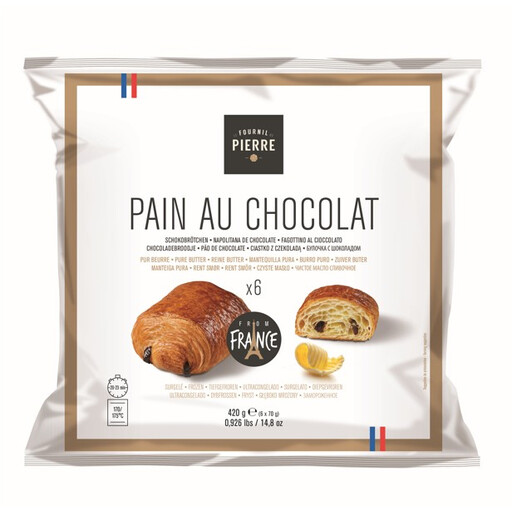 Image unavailable
For a small gathering with baking at home: the pack contains 6 pieces weighing 420 g and should be stored at −18 °C. You’ll need an oven, so check the baking instructions on the packaging. The ingredients list includes wheat, soya, eggs and milk, and says the product may contain traces of sesame and nuts. Check the label on your pack if this information affects your decision to buy.
You’ll need an oven if the product you choose needs baking, but not if it’s ready to eat. Check the packaging before your first big shop to see which type it is. For example, Carrefour says its frozen Classic’ product needs 18 to 20 minutes in the oven.
No. Santé publique France says producers display the Nutri-Score on a voluntary basis. If it appears on the pack, you can consider it alongside the nutritional information, ingredients list and serving size. Its absence doesn’t tell you anything about the recipe.
Check the allergens and any trace warnings on the packaging of the product you buy. Product information from Bridor and Carrefour lists wheat, milk, eggs or soya, depending on the recipe; some products also warn that they may contain traces of nuts or sesame. Don’t assume the information for one product applies to another.
Follow the temperature and storage instructions for the product you choose. Bridor says to store its 70 g product at −18 °C before use and not to refreeze it after defrosting. Make sure you have enough space before choosing a large pack.
No, not to pain au chocolat: the Ministry of the Economy describes this levy as applying to sugary drinks. To compare pastries, check their nutritional information for the sugar content instead.