Families looking to limit added salt
A tomato base with no added salt lets you choose how to season it. It’s still worth checking the ‘salt’ value on the label: the claim does not mean the product contains none at all.


To make pasta for a packed lunch while limiting added salt, choose tomato purée or passata labelled ‘no added salt’. You can season it yourself, but it takes more preparation than a ready-made sauce. If speed is your priority, compare the ‘salt’ per 100 g on ready-made sauces. In either case, check the allergens for the product you choose and follow its storage instructions.
A tomato base with no added salt lets you choose how to season it. It’s still worth checking the ‘salt’ value on the label: the claim does not mean the product contains none at all.
A ready-made sauce saves you from having to season a tomato base. To compare different recipes, check the salt per 100 g, then look at the ingredients in each one.
You can’t tell whether a sauce contains gluten, celery or milk just from the ‘tomato sauce’ category. Check the exact recipe and, if necessary, the school’s rules to see what can go in the lunch box.
Choose this if: you want to control how you season pasta prepared at home.
Bear in mind: this tomato base is not a ready-made sauce, so it may need some extra preparation.
Choose this if: keeping preparation to a minimum matters most for your meal.
Check: the recipe may contain added salt and allergens, which vary from product to product.
| What to consider | What to check | Who it matters to |
|---|---|---|
| Salt per portion | Compare the ‘salt’ per 100 g, then take into account how much sauce you’ll serve. Remember that ‘no added salt’ and ‘salt-free’ do not mean the same thing. | If I want to limit the salt in my pasta, I need to know how much the sauce actually adds to the meal. Around 36% of consumers prioritise this. |
| Allergens and school rules | Read the allergen information for the product you buy and check the school’s rules for meals. | If a pupil has an allergen to avoid, I need to choose a recipe that suits their needs and follows the school’s guidance. This comes first for around 29% of consumers. |
| Preparation and taste | Choose between a base you season yourself and a ready-made sauce. If you opt for the latter, compare its ‘salt’ value too. | When I need to prepare a meal quickly, I look for something the pupil will want to eat without adding lots of steps at home. Convenience is the main priority for around 21% of consumers. |
| Pack size and storage | Choose a quantity that suits the number of meals planned, and follow the pack’s storage instructions and guidance on how long to keep it after opening. | If I only use some of the carton, I want to plan future meals without keeping the rest for too long. Around 14% of consumers prioritise portion planning and storage. |
According to Auchan’s product listing, Jardin BiO étic passata with no added salt still contains 0.03 g of salt per 100 g.
Check both the claim on the product and its ‘salt’ value per 100 g, then consider that value in relation to the amount you use.
Barilla describes its Sauce Basilico as gluten-free, while the Carrefour Classic’ recipe described by Carrefour contains celery. The product category alone doesn’t tell you enough.
Check the label on the product you buy and, if an allergy makes it necessary, check the school’s rules for meals.
Storage instructions vary by product. Auchan’s listing for Mutti 500 g tomato purée says to keep it in the fridge and use it within 5 days of opening.
Choose a pack size that suits the meals you have planned, and follow the instructions on the packaging once opened.
Any leftovers you don’t use within the stated time may also go to waste.
Its organic tomato passata with no added salt is a base to season for pasta, rather than a ready-made sauce.
Its 500 g carton of tomato purée with no added salt is suitable for making a sauce and seasoning it at home.
Its 400 g jar of Sauce Tomates Cuisinées is a ready-made option.
Sauce Basilico is a ready-to-use tomato sauce available in 200 g and 400 g packs.
The 420 g jar of Sauce Tomates Cuisinées is another ready-made recipe.
These two tomato purées can be used to make and season a pasta sauce at home. They are not ready-made sauces to mix into a meal; check the label on the product you buy if you need to consider allergens.
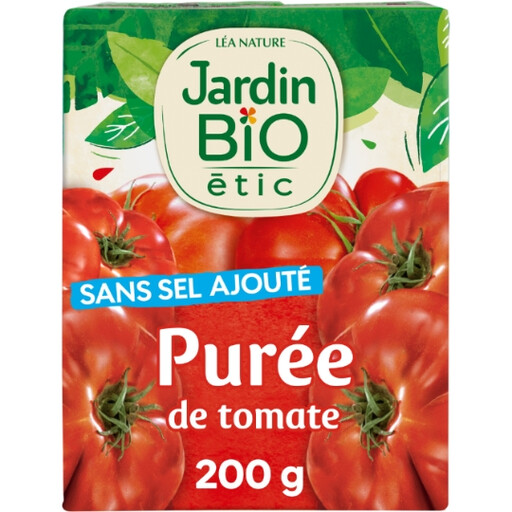 Image unavailable
A base to season at home if you want to avoid adding salt when making your sauce. Auchan’s listing for this product says ‘no added salt’ and gives a salt content of 0.03 g per 100 g. Once opened, follow the product’s instructions to refrigerate it and use it within 3 days.
 Image unavailable
A base with no added salt to season at home. Consider whether the 500 g pack is right for the number of meals you have planned. According to Auchan’s listing, this purée should be kept in the fridge and used within 5 days of opening; check the instructions on the pack you buy.
No. The product may contain naturally occurring salt: Auchan’s listing for Jardin BiO étic passata with no added salt states that it contains 0.03 g of salt per 100 g. To compare sauces, check the ‘salt’ value in the nutritional information, using the same 100 g basis.
No, it depends on the product. Barilla describes its Sauce Basilico as gluten-free, but this claim doesn’t apply to every tomato sauce. In France, allergens in the ingredients of pre-packed foods must be emphasised. Check the label on the product you buy and the school’s rules if they apply to the pupil.
Follow the storage instructions on the pack. Auchan’s listings say to keep Mutti 500 g tomato purée in the fridge and use it within 5 days of opening, compared with 3 days for Jardin BiO étic 200 g passata. Other products may have different instructions.
No. Nutri-Score doesn’t replace checking the specific factor you want to compare. For salt, look at the value per 100 g in the nutritional information, then consider how much sauce you plan to serve.