
Livraison le jour même ou le lendemain

Qualité garantie

Débloquez vos offres de bienvenue: Livraison GRATUITE | Jusqu'à -80 % | 30 jours d'essai gratuits à JoyPlus
Téléchargez l'application
An outdoor wall light can sometimes transform a dark entrance, highlight a façade or make a terrace feel more welcoming in the evening. However, some purchases can quickly become disappointing due to corrosion, poorly directed beams, hard-to-find bulbs or insufficient protection against the elements.
Before being won over by a particular style, it is therefore worth reviewing a few technical specifications. Here are the most common pitfalls, the criteria to check and a selection of solutions suited to different outdoor lighting projects in France.
A light fitting may look particularly robust without actually being designed to withstand direct exposure to rain. The IP rating should be clearly stated on the product page. An IP44 outdoor wall light resists water splashes, while an IP54 model also benefits from enhanced protection against dust.
These ratings do not make the fitting waterproof when immersed. Installing it beneath an awning, on an exposed façade or near a terrace does not subject the product to the same conditions. The installation position and the orientation of the wall also play a role.
Sea air accelerates the corrosion of ordinary metals. For a home in Brittany, Normandy, on the Atlantic coast or along the Mediterranean, look for an explicit statement regarding resistance to saline environments. A material treated for coastal areas, such as hot-dip galvanised steel or certain brass alloys, still requires suitable maintenance.
Conversely, a “rust-effect” finish is not necessarily designed to withstand salt exposure. It is important to distinguish decorative appearance from genuinely documented resistance.
GU10 wall lights and models with an E27 socket make it easy to replace the bulb and choose the colour temperature. However, check the maximum permitted wattage, dimmer compatibility and the amount of space available around the bulb.
Integrated LED fittings offer a cleaner, more streamlined look, but their light source generally cannot be replaced by the user. This option may work well for a portable terrace lamp, but is less suitable for façade lighting intended to evolve over the years.
The IP rating does not replace careful installation. Seals must remain correctly positioned, and cable entry points must be protected.
An outdoor GU10 wall light generally accommodates one or two spotlights directed upwards, downwards or in both directions. It allows you to alter the ambience by changing the colour temperature or beam angle.
An E27 wall light accepts a larger bulb and often pairs well with a lantern-style design. The maximum wattage specified by the manufacturer must always be respected.
At an entrance, downward-facing light improves visibility. For façade lighting, an upward-and-downward light distribution creates a highly attractive graphic effect, but it does not always replace sufficiently powerful functional lighting.
Class I products require an earth connection. Class II products feature double insulation and do not require a protective conductor, provided the instructions are followed.
Mains connections must be carried out by a qualified person in accordance with the electrical regulations in force in France. Switch off the power before carrying out any work and check compatibility with a 220–240 V supply.
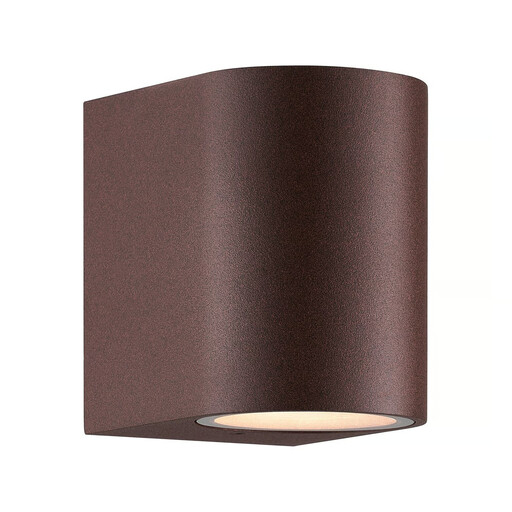
Why it is a suitable choice: Its compact design and downward-facing light make it easy to position near an entrance, alongside a pathway or on a small façade.
The product page specifies an IP44 rating and a replaceable GU10 socket. Nevertheless, plan to install it away from direct runoff.
A GU10 socket, a maximum wattage of 25 W and the option of parallel connection according to the product specifications.
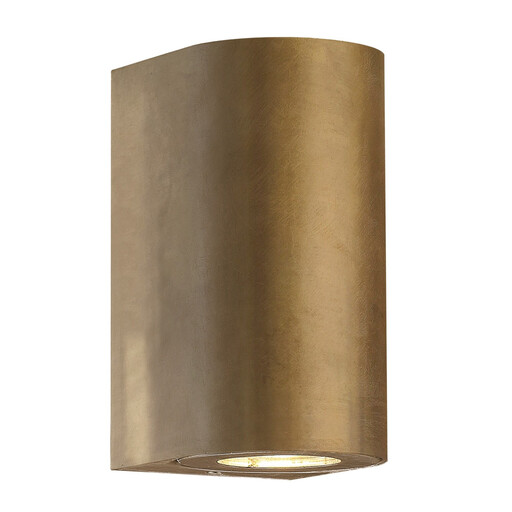
Why it is a suitable choice: Its solid brass construction and stated suitability for coastal environments address the demands of a home located near the sea.
The product page confirms its suitability for coastal use and recommends rinsing with fresh water. However, an IP44 rating should not be confused with protection against immersion.
Two GU10 sockets, upward-and-downward light distribution and a stated 15-year guarantee against surface deterioration.
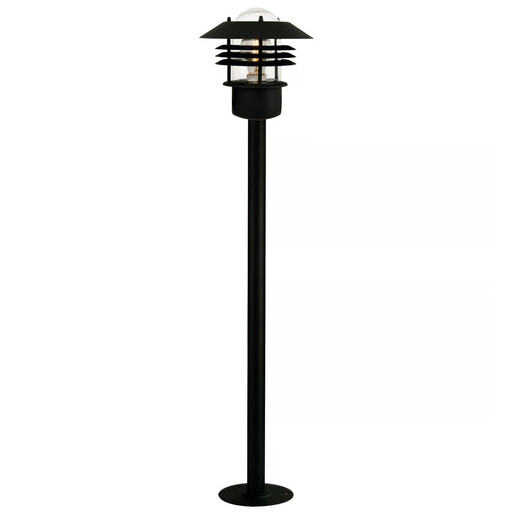
Why it is a suitable choice: To light a pathway, garage entrance or terrace, a bollard light effectively complements a wall light by distributing illumination at ground level.
The mounting base and ground-mounting support must be checked separately. An unstable installation may compromise water protection.
IP54 rating, E27 socket, 92 cm height and dimming capability when used with a compatible bulb.
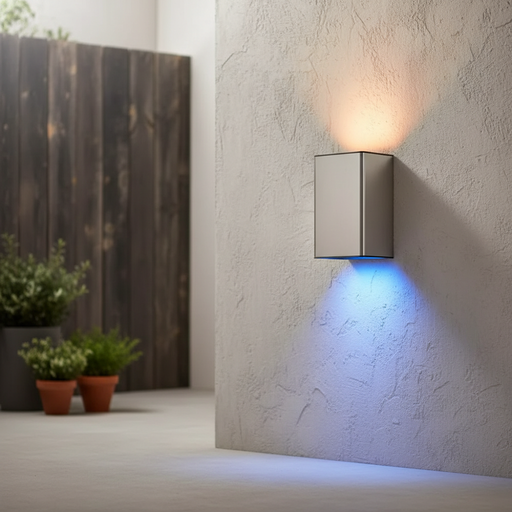
Why it is a suitable choice: This solution is designed for users who want to adjust the ambience of an entrance or terrace from an app.
The system requires a Philips Hue Bridge and a fixed electrical installation. These components may not be included with the light fitting.
Stainless-steel construction, adjustable white and colour LED lighting, app control and stated compatibility with voice assistants.
Install the wall light at a height that limits glare, generally near the door or above a walkway. For upward-and-downward lighting, make sure the beam does not disturb neighbours or people passing by.
In coastal areas, regularly rinsing the fitting with fresh water helps remove salt deposits. Use a soft cloth and avoid abrasive products. For an E27 or GU10 wall light, choose a bulb that complies with the maximum wattage and compatibility requirements specified by the manufacturer.
If you would like to complete your installation with an outdoor lighting bollard with a socket, also explore the dedicated Joybuy selection.
Discover a regularly updated selection of outdoor light fittings for a range of landscaping projects and technical requirements.
IP44 resists water splashes and is suitable for many correctly protected outdoor installations. IP54 adds protection against dust. On an exposed façade, this rating provides additional protection, but it still does not permit immersion.
A GU10 LED bulb is suitable for wall lights fitted with adjustable spotlights or designed to distribute light upwards and downwards. An E27 LED bulb is better suited to lantern-style fittings and wide diffusers. Check the maximum wattage, colour temperature and compatibility with any dimmer.
Consumption depends primarily on the LED’s wattage and the length of time it remains switched on. Connected features may result in slight standby consumption, while scheduling can also help limit operating periods. Check the wattage and operating conditions stated on the product page.