
Same-day & Next-day Delivery

Quality Guaranteed

Unlock Your Welcome Offers: FREE Delivery | Up to 80% OFF | Free 30-day JoyPlus trial
Download the APP
Choosing an outdoor wall light is more than just an aesthetic choice. It's a real investment that must combine design, security, and durability against the elements. Yet, too many buyers end up disappointed with a product that fails to deliver on its promises. As a product expert for Joybuy, my mission is to guide you through the maze of options and help you identify the criteria that truly matter.
Before you start, here are the three most common pitfalls to avoid:
To make an informed choice, it's crucial to focus on a few key technical specifications, looking far beyond the marketing buzz.
Deciphering a few specifications is often enough to distinguish a quality product from a disappointing one. Here are the points you should never overlook.
The IP rating is an international standard that classifies a device's resistance to solid objects (like dust) and liquids (like rain). For an outdoor wall light, this is an absolutely non-negotiable criterion.
The material of your wall light directly determines its ability to resist corrosion, UV rays, and thermal shock.
Outdoor lighting can serve several functions: marking a path, securing an entrance, or simply creating an atmosphere.
To illustrate how these criteria apply in practice, here are a few models that meet very specific needs.
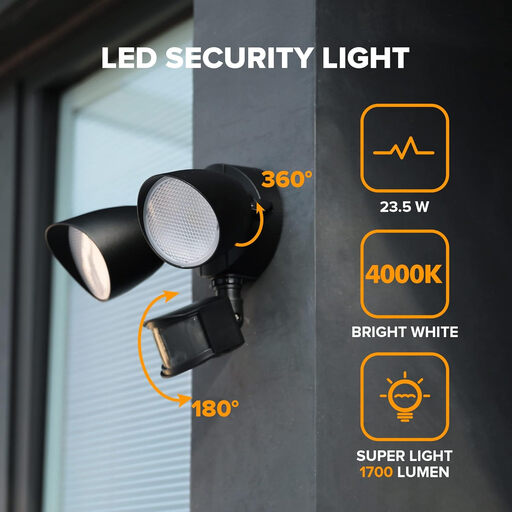
Why this model stands out: Designed first and foremost for security, this floodlight combines powerful illumination (1250 lumens) with a reliable PIR motion sensor. Its two adjustable heads allow you to precisely cover sensitive areas, such as a garage driveway or an entrance door.
It perfectly addresses the functionality pitfall by fully embracing its role as a security tool. Its die-cast aluminium structure ensures far greater durability than low-grade plastics.
PIR motion sensor and dual adjustable heads for customised light coverage.
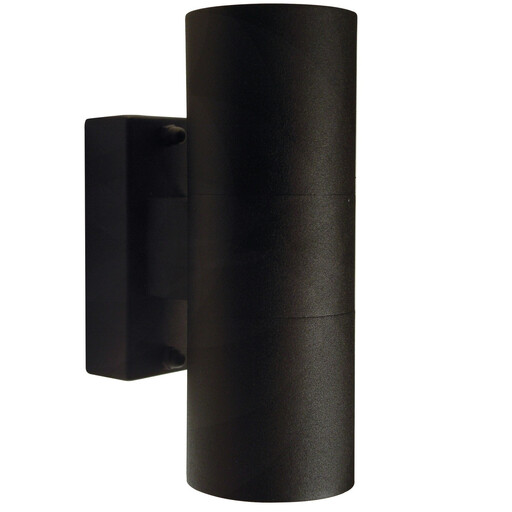
Why this model stands out: This **designer outdoor light** is the archetype of clean, Scandinavian style. Its dual up-and-down beam creates a very elegant graphic effect on a facade, ideal for highlighting modern architecture or creating **ambient garden wall lighting**.
It doesn't sacrifice robustness for the sake of design. With its IP54 rating and metal construction, it's equipped to face the elements, thus avoiding the pitfall of cheap waterproofing.
Bidirectional lighting (up/down) for a graphic effect and timeless design.
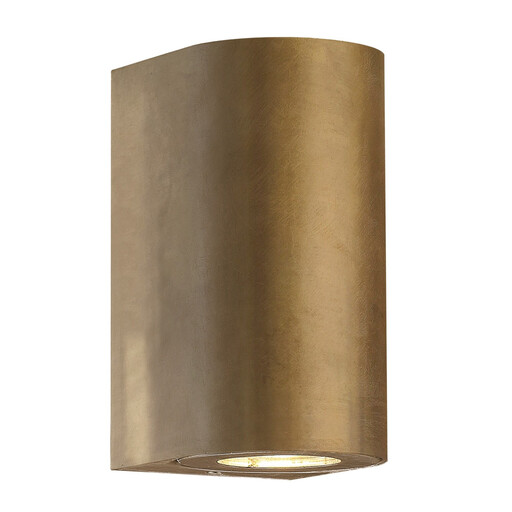
Why this model stands out: This model is from Nordlux's "Designed For Seaside" range. Its solid brass body is specifically designed to withstand salt air and extreme coastal weather conditions, where standard aluminium or steel would eventually corrode.
It tackles the pitfall of unsuitable materials head-on. Brass doesn't rust: it develops a patina. This natural and aesthetic oxidation process protects the metal's surface. In fact, Nordlux guarantees this treatment for 15 years.
Solid brass construction, guaranteed against corrosion in saline environments.
We have selected a complete range of products that meet these quality criteria and current safety standards.
The difference lies in the level of protection against dust and water resistance. An IP44 rating protects against solid objects larger than 1 mm (insects, etc.) and simple water splashes. An IP54 rating offers enhanced protection against dust and withstands powerful water jets (like driving rain), making it much safer for unsheltered walls.
Yes, many models allow for this. Look for the term "parallel connection" in the technical specifications. This means you can connect multiple lights to the same electrical line, which is very convenient for illuminating a long facade or a driveway uniformly. The installation must be carried out by a qualified electrician to ensure the compliance and safety of your setup.
As a general rule, a solar outdoor wall light is less powerful than an equivalent electric model. Solar models are excellent for pathway marking, ambient lighting, or occasional motion detection. For powerful, constant main lighting intended to illuminate a large patio or a true outdoor living space, a model connected to the electrical grid remains the most reliable solution.