
Livraison le jour même ou le lendemain

Qualité garantie

Débloquez vos offres de bienvenue: Livraison GRATUITE | Jusqu'à -80 % | 30 jours d'essai gratuits à JoyPlus
Téléchargez l'application
An outdoor wall light can transform a dark entrance, secure a passageway or highlight a façade. But a flattering photo and the simple mention “weather-resistant” are not enough to guarantee a lasting choice. A misunderstood IP rating, a bulb not included, or materials unsuitable for an exposed balcony – some mistakes only become apparent once installation is complete.
This guide helps you compare outdoor wall lighting solutions based on location, wiring, style and the demands of the British climate.
An IP44 outdoor light is resistant to water splashes, but it is not designed to be submerged, nor is it necessarily able to withstand a powerful jet. An IP54 outdoor light adds protection against dust and water splashes from all directions. This does not remove the need to choose a sufficiently sheltered location or to preserve the seal integrity during installation.
For a façade, terrace or entrance, IP54 offers a more comfortable safety margin than IP44. However, always check the manufacturer’s instructions and the intended installation conditions.
A light fixture perfectly suited to a wall under an awning can age much faster on a west-facing façade, near a swimming pool or in a coastal area. Sea salt, in particular, accelerates corrosion of certain metals. For an outdoor wall light for the seaside, look for compatibility explicitly stated for marine environments: the mere mention “outdoor” is not enough.
Solid brass or treated galvanised steel can be suitable for some coastal uses, depending on the manufacturer’s specifications. A standard painted metal model does not automatically offer the same level of resistance.
Many wall lights are sold without a bulb. You therefore need to budget for this extra cost and check the type of cap:
A dimmable bulb alone does not make a light fixture compatible with a dimmer switch: the dimmer, the bulb and the installation must all be compatible.
The first digit concerns protection against solid objects, the second against water. For a solar LED wall light installed on a balcony or along a path, also check the installation recommendations: the panel must receive enough direct light to charge the battery. A constantly shaded area can reduce battery life and brightness.
Solar models avoid running a cable to the mains, but their operation depends on the weather, the orientation of the panel and its maintenance. Regular cleaning of the photovoltaic surface helps maintain proper charging.
A downward-facing light suits a staircase, path or garage entrance. An up-and-down light creates an interesting graphic effect for façade lighting or a terrace. At the entrance, choose a diffusion wide enough to see the doorstep and lock without being dazzled.
Colour temperature also deserves your attention: warm light creates a cosy atmosphere, while neutral light makes details easier to see. To assess the output, look at lumens and beam angle rather than just electrical power.
Class I appliances require earthing. Class II appliances have double insulation and do not need an earth conductor, in line with the manufacturer’s instructions. A mains-connected installation must be carried out by a qualified person, in compliance with the electrical regulations applicable in the UK.
Measure the available height, the projection of the light and the space around the cable outlet. A designer wall light that is too deep can become awkward in a narrow passage. If you plan to install several lights, also check whether parallel connection is provided for.
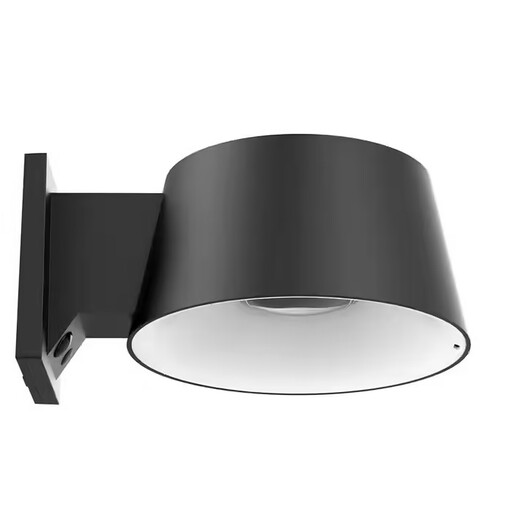
Why this choice suits this profile: This solar light is ideal for an entrance, balcony or path without an easily accessible mains supply. The wall mounting avoids running a cable to the grid.
It requires no mains wiring, but must be installed in a spot with enough direct light. Regular cleaning of the panel helps maintain charging.
Integrated solar panel, automatic activation at dusk, downward-facing LED beam and wall mounting.
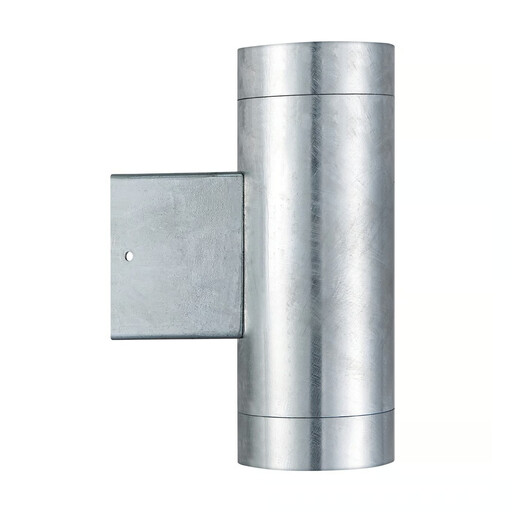
Why this choice suits this profile: Its up-and-down lighting complements a façade, terrace or carport, especially in areas exposed to sea spray.
Compatibility with coastal environments is explicitly stated by the “Designed For Seaside” range. The IP54 rating is also specified, without a vague promise of absolute protection.
Two GU10 sockets, hot-dip galvanised steel, IP54 rating, dimmable with compatible bulbs and a 15-year guarantee against surface deterioration, subject to the manufacturer’s conditions.
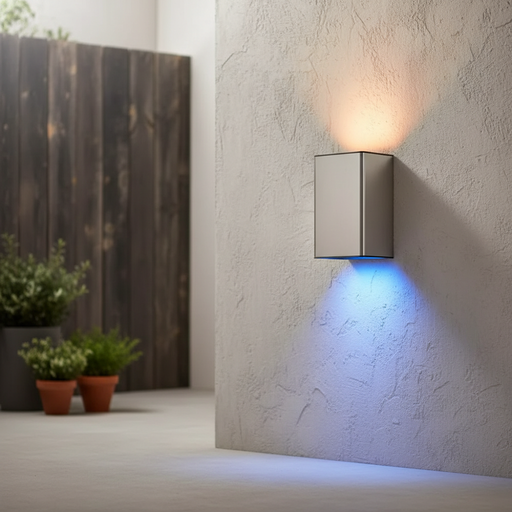
Why this choice suits this profile: This outdoor wall light is aimed at households already equipped with a Philips Hue system who want to automate the lighting of their entrance, terrace or façade.
Compatibility with the Hue app and voice assistants is clearly stated. However, you will need to arrange a mains connection and have the installation carried out by a qualified electrician.
Adjustable white and colour LED lighting, remote control, smart home integration and construction in stainless steel, glass and plastic.
We have compiled a comprehensive, real-time updated list of products that meet these strict selection criteria and European safety regulations.
The wattage mainly tells you about energy consumption. To compare brightness, look instead at the number of lumens. An entrance does not have the same needs as a decorative terrace. With a GU10 or E27 bulb, you can choose the brightness separately, within the maximum wattage indicated by the light fixture.
An IP44 light is designed to resist water splashes, but its location matters just as much as its protection rating. Avoid areas where water can pool or strike the light directly with force. In cases of greater exposure, an IP54 model offers enhanced protection against dust and water splashes.
Consumption depends on the light source used, its wattage and how long it is on. An LED bulb generally uses less than a traditional bulb for a comparable level of brightness. A solar model reduces the electricity drawn from the mains, but its battery life varies according to sunlight, the season and the condition of the panel.