
Livraison le jour même ou le lendemain

Qualité garantie

Débloquez vos offres de bienvenue: Livraison GRATUITE | Jusqu'à -80 % | 30 jours d'essai gratuits à JoyPlus
Téléchargez l'application
Want to light up your garden, patio, or balcony without inflating your electricity bill? The promise of outdoor solar string lights is tempting: effortless setup, zero wiring, and an immediate decorative effect. However, the experience can quickly turn to disappointment. Lights that die after the first downpour or battery life that melts away are frustrations many of us know all too well.
Before falling for marketing promises that are sometimes too good to be true, it's crucial to know the common pitfalls that can turn a joyful purchase into a regret.
This guide gives you the keys to decoding spec sheets, making an informed choice, and enjoying your luminous outdoor decor for years to come.
To avoid making a mistake, forget the marketing hype and focus on a few technical details. These are the true guarantors of quality and longevity for your future outdoor solar lighting.
The Ingress Protection (IP) rating is an international standard that assesses a device's resistance to dust and water. For any waterproof solar string lights worthy of the name, this is a non-negotiable criterion.
The runtime of your string lights depends directly on the efficiency of the solar panel and the capacity of its battery (expressed in milliampere-hours, or mAh).
Solar bistro lights or a solar lantern must withstand UV rays, frost, and impacts.
Because every outdoor space is unique, here are a few models that meet specific needs, all selected based on the reliability criteria we've just covered.
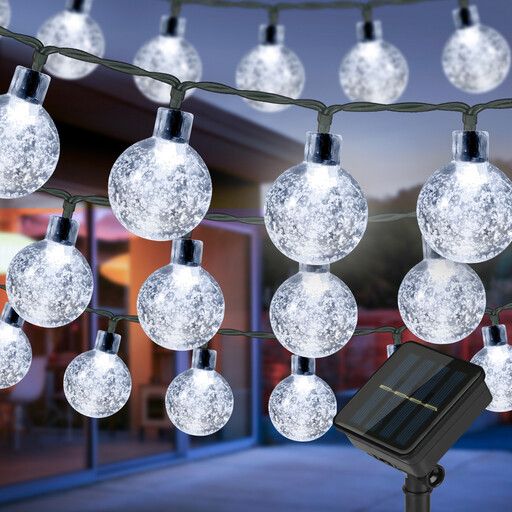
Why it's a great choice: With its compact 5-metre length, these lights are perfect for dressing up a balcony, railing, or small patio without the clutter of excess cable. The crystal bubble design creates a soft, subdued atmosphere, ideal for summer evenings.
The manufacturer claims a solar panel conversion efficiency of over 17%, a good safeguard against poor battery life. Its waterproof design is intended for year-round outdoor use.
Its 8 lighting modes let you vary the ambience, from a festive flash to a steady, calming glow. Installation is a breeze and requires no wiring.
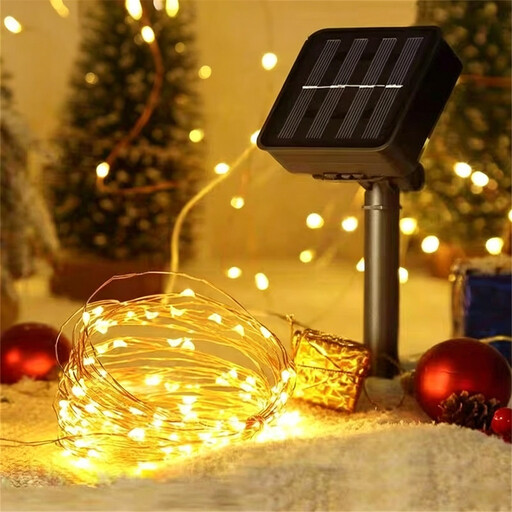
Why it's a great choice: This two-pack offers nearly 30 metres of light, enough to illuminate a large garden, a pergola, or decorate trees for an event. The thin copper wire and warm white light create an elegant, chic bistro vibe.
The manufacturer states that the solar panels have been enlarged for better light capture, directly addressing the problem of limited runtime. Its reinforced waterproofing ensures better durability against the elements.
The built-in memory function saves the last selected lighting mode. No more reconfiguring it every evening! A very welcome convenience for daily use.

Why it's a great choice: More than just a string light, this outdoor solar spot light is designed for functional pathway lighting. Ideal for securing a driveway, staircase, or patio edge, it installs flush with the ground for discreet yet effective illumination.
Its IP66 certification guarantees it is completely dust-tight and protected against powerful water jets. Its robust housing is designed to withstand heavy pressure (even being driven over by a car), neatly avoiding the fragility pitfall.
Its drive-over design and flush-mount installation make it a durable, safe, and ultra-discreet garden solar lamp solution that won't obstruct foot traffic or lawn mowing.
Discover our complete selection of products, rigorously chosen for their reliability and compliance with European safety standards.
The lifespan depends on two components: the LEDs and the battery. The LEDs themselves are very durable (tens of thousands of hours). The weak link is often the rechargeable battery, which loses capacity after 1 to 3 years depending on its quality and how often it's used. On many models, the battery (usually a standard AA or AAA Ni-MH) can be replaced to extend the life of the string lights.
Before writing them off, a few simple checks are in order:
For models rated IP65 or higher, there's no need to bring them in. They are designed to withstand frost and snow. Just expect reduced performance: the lack of sun and cold temperatures take a toll on the battery. If you don't plan to use your lights during the winter, it's best to clean them, turn them off, and store them in a dry place to preserve the battery.