
Livraison le jour même ou le lendemain

Qualité garantie

Débloquez vos offres de bienvenue: Livraison GRATUITE | Jusqu'à -80 % | 30 jours d'essai gratuits à JoyPlus
Téléchargez l'application
By the Joybuy Product Experts Team – Published on August 26, 2026
Lighting up your garden, patio, or balcony with an outdoor solar string light is an appealing idea: no cables to run, no soaring electricity bills, and an installation that's easy for anyone. Yet, the promise sometimes turns into a disappointment. A string light that doesn't survive the first rain, a light so dim it's barely noticeable, or a battery life that doesn't even last through dessert... these issues are unfortunately common.
As product experts at Joybuy, our mission is to guide you through the jungle of options for a successful purchase. Let's break down the pitfalls to avoid and the essential criteria for choosing a solar string light that will truly deliver on its promises.
The solar lighting market is full of marketing promises that often crumble after the first season. Here are the three key points to keep in mind.
To avoid these traps, there's nothing better than relying on objective technical specifications. They are the true guarantors of the quality and reliability of your future solar string light.
The Ingress Protection (IP) rating is an international standard that classifies a device's level of protection against solids (dust) and liquids (water). For worry-free outdoor use in regions with unpredictable weather:
The battery life of your string light depends entirely on the balance between these two components.
Beyond the technical aspects, aesthetics are paramount.
To help you see more clearly, here's how these criteria translate in practice with a few models suited for specific needs.
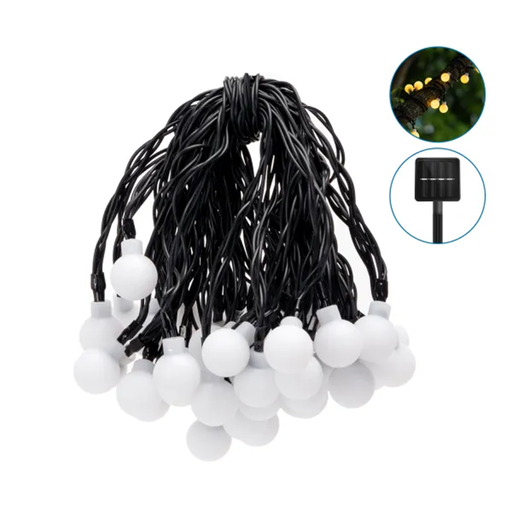
Why we love it: Perfect for recreating a "bistro" atmosphere on a balcony or small patio. Its warm white light (2700K) is especially inviting for summer evenings, and its 10-metre length is ideal for decorating a space without cluttering it.
With its IP65 certification, this string light is ready for any weather. Its spec sheet is clear: an 800 mAh battery and an 8 to 12-hour runtime. This transparency knocks out the trap of unrealistic battery life claims.
Its 8 lighting modes let you switch from a soft, steady light to a festive twinkle in the blink of an eye.

Why we love it: Ideal for path lighting that is both discreet and functional. This type of solar garden light can be embedded in a deck or pathway to make night-time navigation safer. Its flat, robust design is meant to be unobtrusive.
It boasts an IP66 rating, even more stringent than the recommended standard, for maximum protection. Its sturdy construction can even withstand the weight of a car, thereby avoiding the pitfall of low-quality materials.
Its durability and ultra-simple installation. Just place it in a sunny spot, and that's it. No work, no worries.
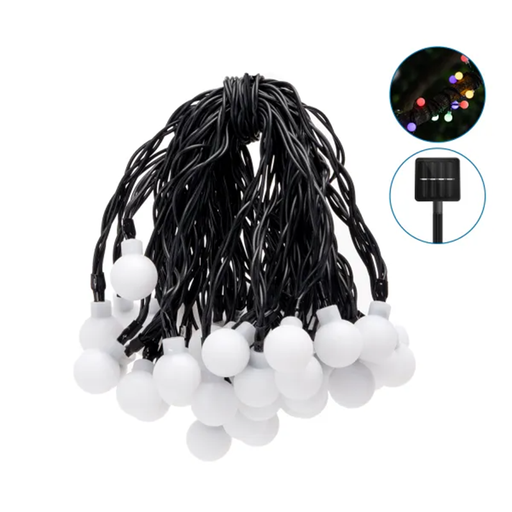
Why we love it: With its bright colours (RGBY) and dynamic modes, this string light is made for parties. Perfect for a birthday, a get-together with friends, or the holiday season, it adds an instant touch of vibrancy.
Like the other models in our selection, its IP65 certification guarantees worry-free outdoor use. The clear technical specs (800 mAh Ni-MH battery, 8-12h runtime) allow you to buy with confidence.
Its versatility: 8 modes and 4 colours (red, green, blue, yellow) to adapt the atmosphere to any party theme.
Explore our full selection of products that meet our strictest quality and safety standards.
The lifespan primarily depends on two elements. The LEDs themselves have a very long life, often exceeding 10,000 hours. The weak link is usually the rechargeable battery, which loses capacity over charge cycles. You can expect optimal performance for 1 to 3 years. The good news is that on many models, the battery (often a simple rechargeable AA or AAA) can be replaced, which extends the lifespan of the string light accordingly.
Before declaring it out of order, a few checks are in order:
Let's be honest: in winter, with shorter days and a weaker sun, performance will inevitably be reduced. Your string light will work, but its runtime will be more limited than in the middle of summer. To optimise charging, place the solar panel facing south, where it will capture the most light possible, away from the shade of trees or buildings.