
Livraison le jour même ou le lendemain

Qualité garantie

Débloquez vos offres de bienvenue: Livraison GRATUITE | Jusqu'à -80 % | 30 jours d'essai gratuits à JoyPlus
Téléchargez l'application
Outdoor solar lighting lets you illuminate a garden, patio or entrance without running any electrical cables. This wireless solution also appeals to campers looking for a portable, rechargeable lamp that’s easy to carry. Yet certain details that are rarely visible in commercial photos can quickly turn your purchase into a disappointment – sometimes within the first few weeks.
Before you buy solar garden lights or outdoor solar torches, check three things: the actual amount of light, the charging capacity in British weather conditions, and the sturdiness of the build. A decorative lamp won’t have the same requirements as a solar floodlight with a motion sensor installed above a garage.
The lighting duration depends on the sunlight received during the day, the season, the panel’s orientation and the temperature. In autumn or in a shaded spot, a battery can therefore deliver much less light than expected. When a product listing claims a duration “up to” a certain value, you should understand it as a maximum achieved under favourable conditions.
To limit unpleasant surprises, install the panel away from trees, walls and roof overhangs. Also remember to clean its surface regularly: dust and leaves reduce the charging efficiency.
A very powerful outdoor LED light can dazzle people on a patio or disturb the neighbours. Conversely, a small solar lantern won’t necessarily be enough to secure an entrance. Start by defining the intended use:
Protection against water and dust is verified by the IP rating, when it’s stated. For example, IP65 means the product is protected against dust and water jets, but not that it can be submerged. Rain, frost, impacts and prolonged sun exposure can also degrade the plastic, seals and battery.
Read the manufacturer’s warnings and avoid installing a lamp in an area that’s regularly flooded or subject to heavy water splashes.
The number of lumens gives an indication of the light output. A 100-lumen lantern is suitable for a camping table or a small corner of a patio, while a floodlight should be chosen based on the area to be covered and the beam angle.
Colour temperature also affects visual comfort. Warm light creates a soft atmosphere on a patio. Cooler light improves visibility around a door, gate or garage. Models offering multiple modes let you adapt the ambience to each moment of the evening.
Check the battery type, its capacity when stated, and the available charging options. A rechargeable solar lamp can be particularly handy if it also offers USB-C charging, especially during periods with little sunshine.
Automatic switch-on at dusk is useful for solar lanterns and bollards. A motion sensor will be more suitable for wireless automatic lighting intended for an entrance or path. However, check its position and whether the floodlight head can be angled.
A bollard with a spike goes into sufficiently firm soil or stable gravel. For wall mounting, examine the surface material and use suitable wall plugs. The solar panel needs several hours of direct sunlight: installing it under a tree can significantly reduce battery life.
On a patio, a freestanding or hanging model avoids any installation work. For camping, choose a lamp with a handle that’s light enough and has a backup charging mode.
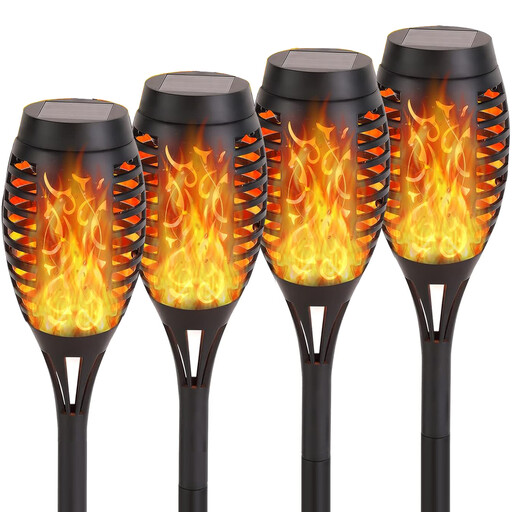
Why this choice suits this profile: This set of four 51 cm outdoor solar torches is ideal for a first decorative installation around a flowerbed, lawn or patio.
The IP65 rating stated on the listing provides a concrete benchmark for outdoor use, unlike a simple promise of resistance.
Four pieces, 12 LEDs per torch, automatic on/off, stated height of 51 cm.
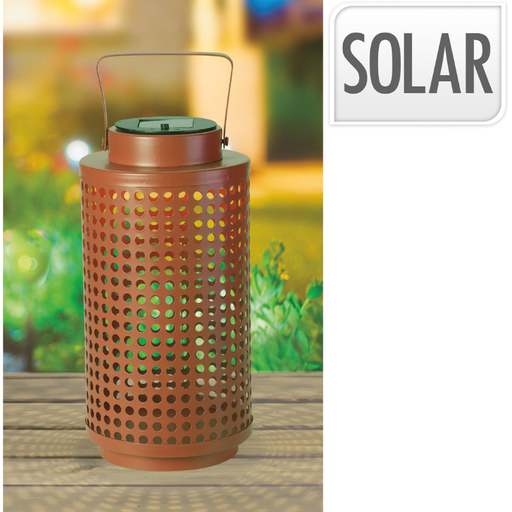
Why this choice suits this profile: Its metal casing and mauve finish blend into a carefully styled patio, terrace or pathway.
The listing specifies the panel type, the 250 mAh Ni-MH battery and a stated battery life of up to six hours, making comparison easy.
Integrated solar panel, warm white light, automatic switch-on and a 145 × 145 mm base.
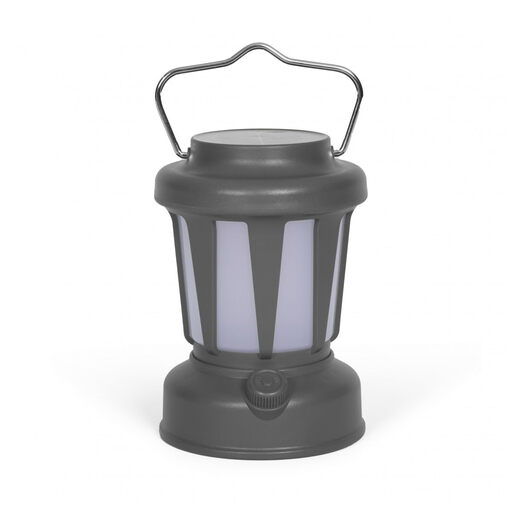
Why this choice suits this profile: This portable lantern is perfect for camping trips, garden evenings and situations where sunlight isn’t sufficient.
Solar charging is supplemented by a supplied USB-C cable, so you’re not entirely reliant on a very sunny day.
100 lumens, three modes, adjustable brightness, 1,200 mAh Li-ion battery and stated battery life of up to 22 hours.
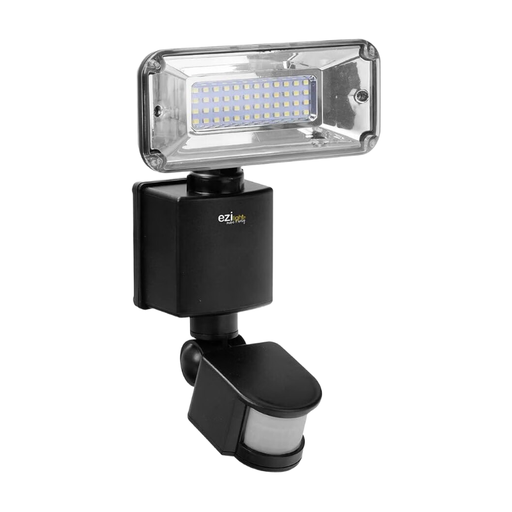
Why this choice suits this profile: Its motion sensor and adjustable head are ideal for a door, path, garage or entrance that needs occasional lighting.
The sensor turns the light on when someone passes, rather than keeping it on continuously and draining the battery unnecessarily.
Solar LED floodlight, built-in motion sensor, adjustable head and cable-free installation.
For marking out a path, the ezilight Solar Way S15 is another spike-mounted option, with a dusk sensor and integrated panel. It should be installed in an area that receives enough sunlight. To compare more lanterns, bollards and solar patio lighting solutions, check the technical information on each listing before placing your order.
We’ve put together a comprehensive, real-time updated list of products that fully meet these strict selection criteria and European safety regulations.
Generally, expose it to several hours of direct sunlight before first use. The exact time depends on the model, the panel, the battery and the weather conditions. On some portable models, USB-C charging can supplement the solar energy.
Yes, but its battery life may decrease when the days are shorter or the sky remains overcast. Point the panel towards the brightest area, remove dirt regularly and store portable models in a dry place if there’s heavy frost.
It doesn’t need to be connected to the mains to work, which avoids the consumption of a lamp that’s left on permanently. However, the running cost depends on any eventual battery replacement and the product’s lifespan. Follow local recycling guidelines for batteries, especially lithium-ion ones.