
Livraison le jour même ou le lendemain

Qualité garantie

Débloquez vos offres de bienvenue: Livraison GRATUITE | Jusqu'à -80 % | 30 jours d'essai gratuits à JoyPlus
Téléchargez l'application
Outdoor solar lighting appeals because it requires no wiring and switches on automatically. Yet some purchases fall short: light that’s too dim, a battery that doesn’t last the evening, or a panel installed in the shade. Whether you want to illuminate a path, dress a patio or create a welcoming atmosphere, the most important thing is to match your intended use with the features that are actually stated.
An outdoor solar string light or lantern usually gives off a soft glow. It’s perfect for decorating the garden, a balcony or a table, but this type of product won’t necessarily replace directional lighting for a path.
To make a walkway safer, it’s better to go for an outdoor solar bollard light, a solar LED spotlight or a lamp designed to guide movement. Check its height, the beam direction and the spacing you’ll need between each light point.
A high number of LEDs doesn’t guarantee more effective lighting. Colour temperature, diffusion, beam angle and battery capacity all matter just as much. A string of 120 LEDs is mainly for creating a warm atmosphere, whereas an adjustable floodlight will be better suited to highlighting a tree, wall or facade.
Even a waterproof solar light will run for less time if its panel gets little direct sunlight. A north-facing wall, a covered balcony or an area under trees will significantly limit charging. Before ordering, find a clear spot away from shadows cast by the house or plants.
The run times stated vary depending on sunlight, season, temperature and the condition of the panel. A battery life of several hours may be enough for an evening, but results will inevitably be poorer after an overcast day.
With a dusk sensor, the lamp switches on automatically as soon as light levels drop. Remember to check that the switch is turned on when you first install it. Then clean the panel regularly with a soft, dry cloth: dust can noticeably reduce charging.
For outdoor use, look for a clearly stated IP rating. The first digit indicates protection against solid objects and dust; the second shows water resistance.
An IP rating doesn’t mean the product can be submerged in water. The panel, housing and connections must remain properly positioned, with no area where water could pool.
ABS, stainless steel, glass and copper wire suit different uses. Lightweight ABS works well for stake-mounted installation. Steel and glass offer a more structured finish, especially along a garden border. Copper wire, meanwhile, lends itself to decorative setups around a railing, shrub or pergola.
For an outdoor solar bollard light or a path lamp, check the stability of the stake and the type of soil. In compact earth, a small pre-drilled hole will stop you forcing the base. On a patio, a flat lamp or a lantern to place down will often be simpler to install than a model you have to push into the ground.

Why this choice suits this profile: Its flat design and warm light are ideal for a first installation on a patio, border or outdoor walkway.
The IP66 rating is clearly stated, and the lack of cable makes installation considerably simpler.
Warm light at 3,200 K, 0.6 W panel, 500 mAh lithium battery and 360° illumination.
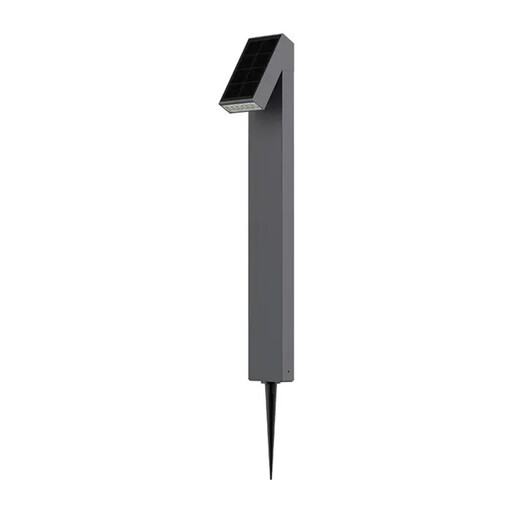
Why this choice suits this profile: Its angular, discreet design blends naturally into a path or contemporary landscaping.
The dusk sensor manages switching on automatically, while the sturdy stake makes for easy, even installation along a path.
Integrated solar panel, stake base, outdoor-rated housing and cable-free installation.
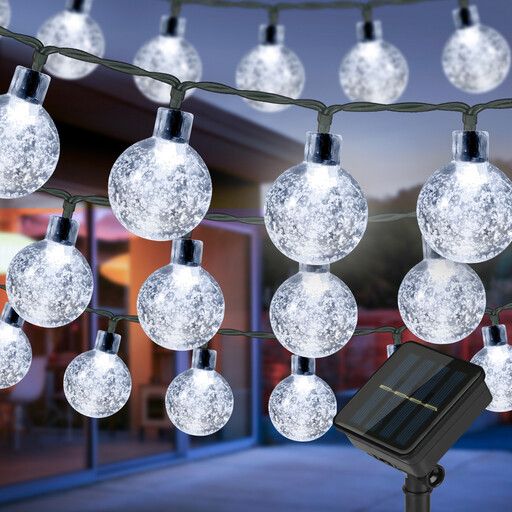
Why this choice suits this profile: Its 11 metres easily cover a large patio, pergola, entertaining area or extensive decorative zone.
The length, number of LEDs and IP65 rating are all specified, making it easy to compare with a shorter string.
60 LED globes, 8 lighting modes, automatic on/off, with a stated battery life of 8 to 14 hours depending on conditions.
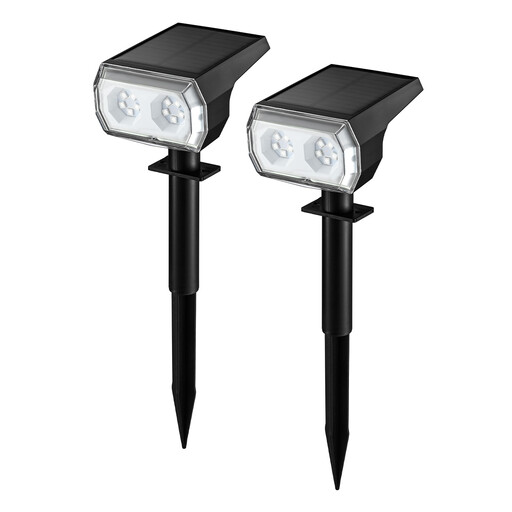
Why this choice suits this profile: The two adjustable spotlights let you easily change the setup to light up a tree, facade, fence or flowerbed.
The adjustable direction means you don’t need to add more lamps when highlighting several garden features.
We’ve put together a comprehensive, real-time updated selection of products that meet these demanding criteria and European safety standards.
It all depends on the panel, the weather and the exposure. Some models state around 6 to 8 hours of charging for a battery life of 8 to 14 hours. In autumn and winter, when direct sunlight is shorter, the lighting may last for less time.
For solar path lighting, choose bollards or stake lamps with a stable base and a beam directed towards the ground. Space them evenly to avoid gaps in the light. For a purely decorative touch, a lantern or string light can complement the setup, but these products don’t always provide enough light to guide movement.
A string light with an IP65 rating is designed to withstand water jets and rain, but not immersion. Bring the panel and the most fragile parts indoors if you’re not using them for a long period, inspect the cables before each season, and remove any leaves or debris that could interfere with charging.