
Livraison le jour même ou le lendemain

Qualité garantie

Débloquez vos offres de bienvenue: Livraison GRATUITE | Jusqu'à -80 % | 30 jours d'essai gratuits à JoyPlus
Téléchargez l'application
Outdoor solar lighting can transform a pathway, fence or balcony without requiring any wiring. However, some purchases fall short after just a few weeks: the light is too weak, battery life is unpredictable or the panel has been installed in a shady corner. To compare models properly, it is better to look beyond the number of LEDs and the claims printed on the packaging.
A solar fairy light string or small pathway light adds a warm touch, but it will not necessarily replace a lamp designed to illuminate an entrance or make a staircase safer. In this situation, lumens, beam direction and mounting height matter far more than the number of LEDs.
For warm garden lighting, aim for a colour temperature generally between 2,700 and 3,200 K. The result will be soft and welcoming. Cool white light, which is brighter and crisper, is better suited to a contemporary façade, a modern patio or an area where obstacles need to be clearly visible.
IP65 and IP66 ratings indicate protection against dust and water under specific conditions. They do not mean that the lamp can be submerged, withstand repeated impacts or be installed without any precautions.
A waterproof IP65 solar lamp can withstand splashes and water jets within the limits set by its classification. An IP66 model offers greater protection against powerful water jets, but the manufacturer’s recommendations must still be followed. Water resistance also depends on the condition of the seals and the quality of the installation.
A solar panel placed behind a hedge, beneath a balcony or facing a wall will not collect enough energy to provide the same battery life as it would in direct sunlight. In the UK, performance also varies depending on the season, cloud cover and the amount of daylight.
Before ordering, check the cable length between the panel and the LEDs, the available space and how easy it will be to access the panel for regular cleaning. A cable-free installation makes fitting easier, but it remains entirely dependent on where it is positioned.
For a garden solar lamp, pathway light or wall light, take the time to examine:
The rechargeable battery stores the energy produced during the day. Its capacity, expressed in mAh, provides an initial point of reference, but battery life also depends on light output, the selected mode and the weather. For example, a 500 mAh battery will not deliver the same results at different LED power levels.
Be wary of stated run times that do not specify the charging conditions. Prefer technical specifications that state the required exposure time, the different lighting modes and the usage limits. A string light with several lighting effects will not consume the same amount of energy depending on the programme selected.
LED solar lighting uses little energy compared with many traditional technologies. However, not all LED solar lamps are designed for the same purpose. A small decorative lamp may only need a few lumens, while a wall light positioned near an entrance will need to produce a better-directed beam.
Colour rendering, expressed as IRC or CRI, may also be worth considering. A Ra ≥ 70 rating, found on some models, provides typical colour rendering for decorative outdoor lighting. For an entrance light, also check the beam angle and installation height.

Why this choice suits this profile: Its flat, round design blends discreetly into a patio, border or passageway. As it works without a cable, it is particularly well suited to a first installation.
The IP66 rating is clearly stated, and the 0.6 W panel should be installed in an area directly exposed to sunlight. This makes it easier to anticipate the actual conditions in which it will be used.
Warm 3,200 K light, 500 mAh lithium battery, IP66 protection and 360° light distribution.
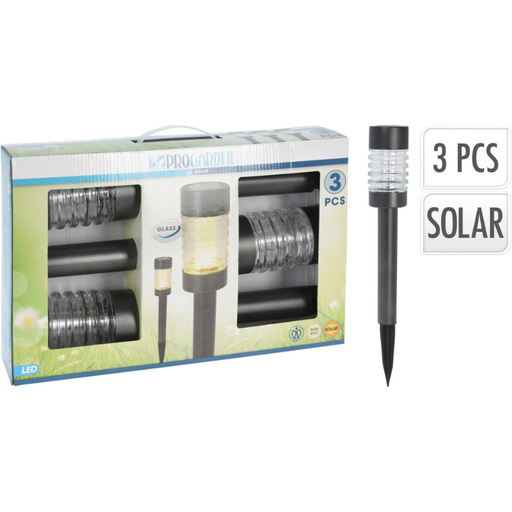
Why this choice suits this profile: This set of three lamps is a natural fit for a well-planned garden, along a pathway or beside a border where appearance matters just as much as lighting.
The dimensions are clearly specified: 540 mm high including the stake, with a 75 mm diameter head. This allows you to check their proportions against your pathway before placing your order.
Stainless steel structure, glass shade, warm 2,700 to 3,000 K light and a set of three lamps.
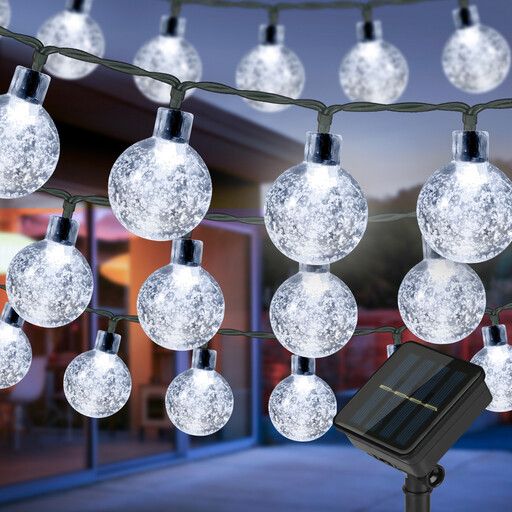
Why this choice suits this profile: This string light can easily decorate a fence, tree, balcony or patio for an evening outdoors. Its different lighting modes let you change the atmosphere in seconds.
The product details state that it takes 6 to 8 hours to charge in full sunlight, provides 8 to 14 hours of battery life depending on the weather and has IP65 protection. These figures offer a more realistic idea of what the string light can deliver day to day.
7 m cable, 50 cool white LEDs, eight lighting modes and automatic switch-on at dusk.
Why this choice suits this profile: At 11 m long, this string light can cover a fence, a large patio or several decorative features, while reducing the need for connections and for repositioning the panel.
The length, number of LEDs and limitations of the IP65 rating are specified. The panel must not be submerged: it should remain clean and unobstructed to ensure regular charging.
11 m cable, 60 cool white LEDs, eight modes with memory function and integrated rechargeable battery.
A solar wall light can be installed near an entrance, garage or balcony, or along a passageway. Choose a façade that receives several hours of direct sunlight each day and check the type of surface before getting out the drill. The beam should illuminate the useful area without dazzling neighbours or reflecting into windows.
The ezilight Solar Wall S28 features a wall-mounted design with an integrated panel, a downward-facing LED beam and installation without an electrical connection. Check its specifications and installation requirements before fixing it in place. As with any solar light, avoid shaded locations and clean the panel regularly.
We have brought together a comprehensive, regularly updated selection of products that meet these demanding criteria, as well as European safety standards.
It depends on the panel, battery and amount of sunlight. Several models state that around 6 to 8 hours of direct sunlight are needed for a full charge. In cloudy weather or during winter, battery life may naturally be reduced. Install the panel in an unobstructed location and leave the switch set to automatic mode.
A model designed for outdoor use can remain installed outside all year round, provided you follow its IP rating and the manufacturer’s recommendations. IP65 and IP66 do not mean that the lamp will withstand immersion or significant impacts. During exceptional weather, it is better to remove any detachable parts and check the seals, panel and housing.
The lamp works using energy collected by its panel and does not need to be connected to the mains. In normal use, it therefore does not incur electricity consumption from a power socket. However, you should still plan to clean the panel and, in time, replace or recycle the battery in accordance with the manufacturer’s instructions. Equipment containing a battery must be taken to a recycling facility suitable for waste electrical and electronic equipment.