
当日/次日达

品质保障

开启新人专享福利: 全场免邮 | 低至 2 折 | 免费试用 30 天 JoyPlus 会员
下载 Joybuy
A solar string light that switches off after just a few hours, a garden light installed in the shade or a spotlight with attractive colours but insufficient brightness: disappointment is often caused by details you may not consider before buying. To choose outdoor solar lighting suited to the climate and intended use in the UK, it is better to look beyond the number of LEDs and claimed battery life.
Here are the key criteria to check, the pitfalls to avoid and a selection of solutions for a patio, path, balcony, courtyard or festive lighting display.
The term “waterproof” does not mean that a product can be left underwater. An IP65 rating generally protects against water jets and dust, but the solar panel and housing must not be submerged. For weather-resistant garden lighting, check the IP rating stated in the product details and protect the connectors from puddles that may remain for long periods.
A solar light will not recharge properly behind a wall, beneath a dense tree or on a north-facing balcony. Claimed battery life, sometimes ranging from 8 to 14 hours, depends on sunlight levels, the season, how clean the panel is and the condition of the battery. An unobstructed panel, positioned in full sunlight and facing the brightest area, is essential.
A higher number of LEDs will often cover a larger area, but does not necessarily produce brighter light. A solar LED string light is primarily designed to create an inviting atmosphere, while an outdoor solar spotlight or path light should be chosen according to the area you want to illuminate. Also remember to check the cable length, the spacing between bulbs and the colour temperature.
Compare the stated charging time and lighting duration. Several models in this selection state that they fully recharge in 6 to 8 hours and can provide up to 8 to 14 hours of light, depending on weather conditions. The switch will generally need to remain set to “ON” to allow charging during the day and automatic activation at dusk.
A warm-white solar lantern, such as the Metal D14 × 28 cm model, provides up to 6 hours of light after a full charge. This format is more suitable for a table or seating area than for lighting a walkway.
For outdoor installation, choose a model with a clearly stated IP rating. IP65 is suitable for many decorative applications exposed to rain, while IP66 provides enhanced protection against water spray and dust. This does not, of course, remove the need to follow the manufacturer’s recommendations.
Flexible copper wire is well suited to shaping a string light around a railing, tree or pergola. ABS is often used for the solar housing. For a lantern, metal, stainless steel and glass offer different styles, but may require greater care to prevent damage from impacts and corrosion.
Measure the area you want to illuminate before ordering:
Lighting modes should also be chosen according to how you plan to use them. A fixed mode is suitable for a subtle ambience, while wave, twinkling or colour-changing effects are better suited to a party. However, a decorative solar RGB LED does not serve the same purpose as security lighting.
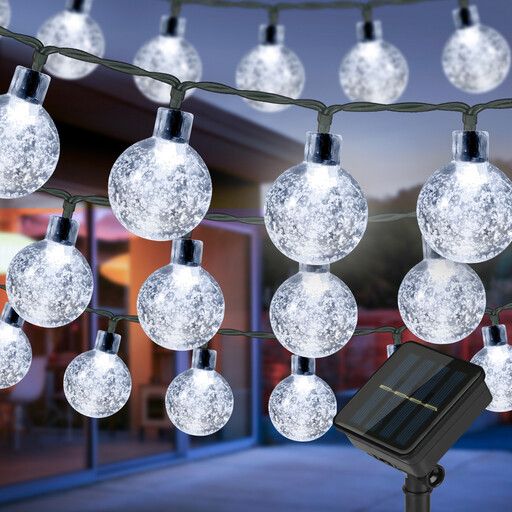
Why this choice suits this profile: This compact string light can be installed without an electrical cable on a small patio, balcony or planter. Its 30 cool-white LED globes and 8 modes make it easy to get started with decorative outdoor lighting.
The product details mention solar power, automatic activation and weather protection. However, the panel must still remain in sunlight and must never be submerged.
A 16-foot length, 30 LEDs, 8 modes and flexible copper wire. The product details also mention CE and RoHS certification.
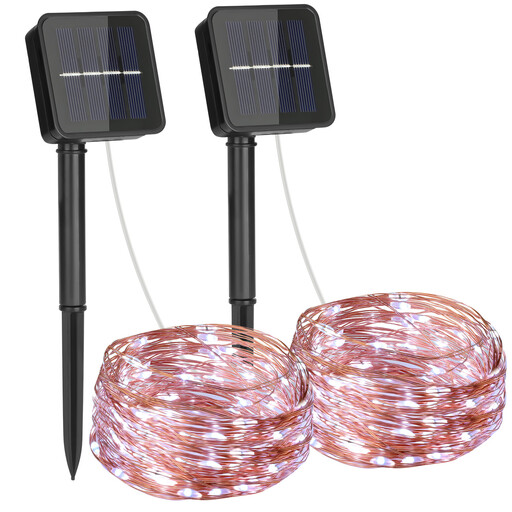
Why this choice suits this profile: With two 12-metre strings and 120 LEDs each, this solution is suitable for large patios, pergolas and reception decorations.
The product details specify an IP65 rating, and the panels feature a sealed design. However, the manufacturer states that the units must not be immersed in water.
Two strings, 120 LEDs per string, 8 modes with memory and a claimed battery life of 8 to 14 hours, depending on charging conditions.

Why this choice suits this profile: Its round, flat design is suitable for ground installation beside a path or in an area exposed to water spray. Its warm 3 200 K light creates subtle pathway illumination.
The product details specify an IP66 rating, but recommend a stable surface and direct exposure to sunlight. Avoid impacts and repeated foot traffic that could crush it.
IP66 rating, 360° lighting, 0.6 W panel and 500 mAh lithium battery, according to the product details.
We have put together a complete, real-time updated selection of products that meet these demanding criteria, as well as European safety requirements.
For consistent lighting, install the panel in an unobstructed location, clean it regularly with a soft, dry cloth, and check the switch position before the first charge. Avoid abrasive products and do not hide the panel behind a decorative item.
A waterproof string light should be installed without pulling excessively on the wire. For a party, decide where to position the panel before securing the LEDs, so that it receives sufficient sunlight. Rechargeable batteries gradually lose capacity; their actual lifespan depends on the quality of the components, the number of charging cycles and the temperatures to which they are exposed.
For a path, choose well-spaced light points and a warm tone that is less dazzling. For Christmas, birthday or wedding decorations, multi-coloured modes and animated effects can be reserved for areas designed to create an atmosphere, while walkways remain marked out with fixed lighting.
The energy required for recharging comes from the sun, so the lighting does not generate any directly billed electricity consumption. However, the overall cost includes the purchase price, maintenance and any battery replacement. Battery life varies according to sunlight levels and weather conditions.
Choose a location that receives several hours of direct sunlight, push or place the light on a stable surface, then activate the switch. For a string light, position the panel away from the cable if necessary so that it remains correctly oriented towards the sun. Always consult the model’s instructions.
An outdoor RGB solar spotlight is mainly used to highlight a tree, wall or flowerbed with its colour-changing effects. A solar path light generally provides subtler, more consistent illumination designed to mark out a walkway. The right choice therefore depends on the function you need, not just the number of LEDs.