
当日/次日达

品质保障

开启新人专享福利: 全场免邮 | 低至 2 折 | 免费试用 30 天 JoyPlus 会员
下载 Joybuy
Outdoor solar lighting seems to have it all?: effortless setup, zero impact on your electricity bill, and it's a great choice for the planet. Yet, the experience often ends in disappointment. It's easy to get lost between marketing promises and real-world performance, and end up with a product that just doesn't hold up.
As our editorial product expert, my mission is to guide you through this jungle. Here are the common pitfalls to avoid and the true quality benchmarks to help you make the right choice.
Before you click “?Buy?”, keep these three red flags in mind, as they too often turn a promising purchase into a regret.
solar garden light is likely to fail after the first heavy downpour. A low IP rating is the number one cause of premature failure.solar garden decoration that falls apart after a few months is neither budget-friendly nor eco-friendly.To avoid falling into these traps, focus on these key technical specifications. They, not the marketing hype, are what guarantee the quality and durability of your future outdoor solar light.
The IP rating is an international standard that classifies a device's level of protection against solid objects (like dust) and liquids (like water). It consists of two digits?:
outdoor solar spot light on the lawn or a solar wall light on an unsheltered wall.The runtime of a wireless outdoor light depends on a trio of factors?: the solar panel's efficiency, the battery's capacity (in milliampere-hours, or mAh), and the LED's power consumption.
The secret is balance. Be wary of very bright lights with a tiny solar panel and a low-capacity battery (less than 600?mAh is often too little, even for decorative use). A reputable product page will list a charging time (e.g., 6-8 hours) and a realistic runtime (e.g., 8-12 hours). And remember?: these figures are always based on perfect sunlight conditions.
The durability of your light depends directly on its materials. Prioritise ABS (Acrylonitrile Butadiene Styrene) plastic, which is far more resistant to impacts, UV rays, and temperature fluctuations than standard polypropylene (PP). For solar string lights, the cable quality is also crucial?: it should remain flexible and not crack over time.
Because every garden is unique, here are products that meet specific needs, all selected according to the quality criteria we've just detailed.
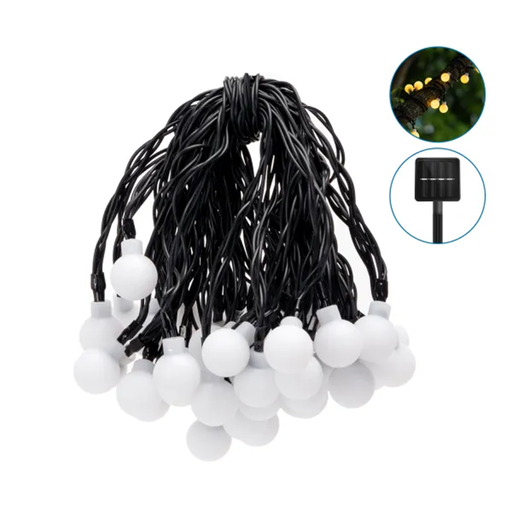
The editor's verdict : Perfect for dressing up a balcony, patio, or tree for summer evenings. Setup is a breeze and requires no wiring. A real bonus for renters or for temporary decor.
With its IP65 rating, there are no nasty surprises after the first downpour. Its stated 8 to 12-hour runtime is realistic and consistent with the size of its solar panel, avoiding the trap of empty promises.
Its 8 lighting modes to change the mood on a whim and its ultra-fast, completely wireless installation.
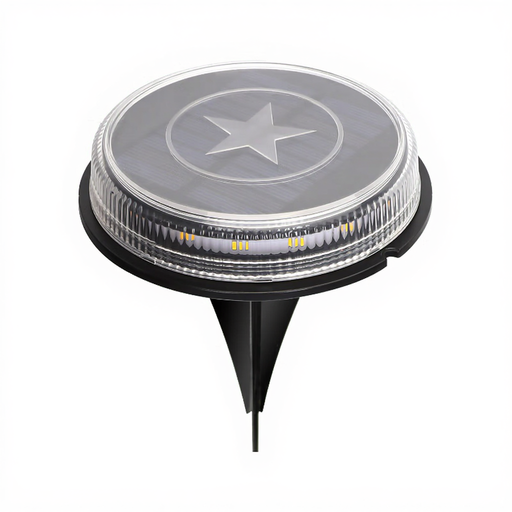
The editor's verdict : Designed for those seeking functional, indestructible lighting to mark a driveway, path, or steps. Its flat design allows it to be recessed into the ground without creating an obstacle—you can even drive over it.
It shatters the flimsy material pitfall : its shell can withstand the weight of a car. Its IP66 rating ensures maximum protection against dust and powerful water jets, far exceeding typical standards.
Its ultra-durable, ground-recessed design and its 360° illumination for perfect path marking.
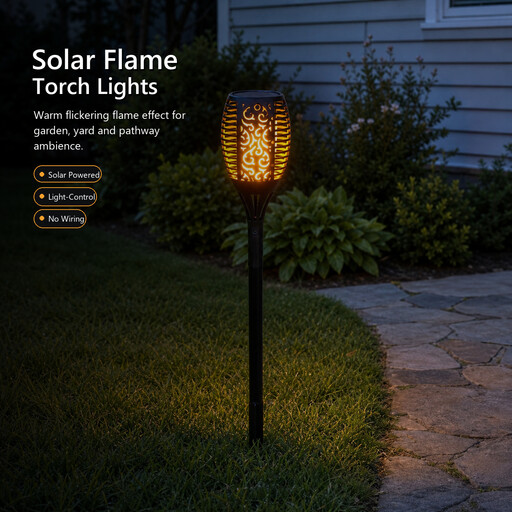
The editor's verdict : For those who want a solar garden decoration that truly makes a statement. The dancing flame effect is stunningly realistic and creates a warm atmosphere without the risks of a real torch. Perfect for lining a pathway or setting the scene on a patio.
These torches avoid the disappointing-gadget trap thanks to a genuinely impressive and consistent “ dancing flame ” effect. The IP65 certification ensures they will get through the rainy season without any issues.
The truly unique flickering flame visual effect, and the automatic dusk-to-dawn sensor.
Discover our complete selection of products that meet our quality and durability standards, all tested and approved by our editorial team.
It all depends on the components. LEDs have a virtually unlimited lifespan (often over 10,000 hours). The weakest link is the rechargeable battery?: expect a drop in performance after 2 to 3 years. As for the housing, its longevity will depend on the quality of its materials and its exposure to the elements.
An IP44 rating protects against splashes, so it's sufficient for a sheltered area (under a porch, a covered balcony, a pergola). But for lighting in the open air, directly exposed to rain (staked in the lawn, fixed to a wall...), you should absolutely aim for an IP65 rating or higher. It's your guarantee of much greater longevity.
There could be several reasons. Here's a quick troubleshooting checklist?: