
Livraison le jour même ou le lendemain

Qualité garantie

Débloquez vos offres de bienvenue: Livraison GRATUITE | Jusqu'à -80 % | 30 jours d'essai gratuits à JoyPlus
Téléchargez l'application
Outdoor solar garden lighting lets you dress up a patio, path or balcony without running cables or increasing your electricity bill. But not all solar lights are created equal, and they don’t all serve the same purpose. A decorative string light won’t illuminate a step the way a path light will, while a lantern is primarily for creating atmosphere.
Before you buy, there are three pitfalls to watch out for.
A solar LED lamp needs several hours of direct light to charge its battery. Position the panel in an open area, away from walls, trees and roof overhangs. Product listings may state a charging time of 4 to 6 hours or 6 to 8 hours, and a lighting duration of 5 to 8 hours or 8 to 14 hours. However, these figures are heavily dependent on the weather, the season and how clean the panel is.
For everyday use, look for:
An IP65 rating means protection against dust and water jets from any direction. IP66 offers enhanced protection against powerful water jets. In both cases, avoid submerging the panel or housing.
To choose a durable solar garden light, also consider the materials. ABS, stainless steel, glass and copper wire each offer a different look and level of mechanical strength. A stake light needs a stable spike; a string light installed on a fence should have a flexible enough wire that’s properly secured.
A solar path light should remain visible without obstructing the way. Stake models are ideal for borders, flower beds and paths. A lantern placed on a table or low wall is better suited to decorating a patio. For lighting a pergola or several shrubs, compare the cable length and the number of LEDs.
The lighting modes are also worth a look. Some string lights offer eight effects, such as steady light, twinkle, sequences or gradual fade. This feature can be nice for a party, but a steady light is often more relaxing for everyday use.
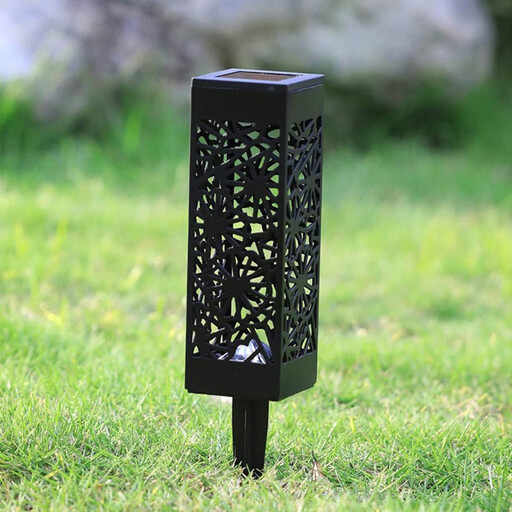
Why this suits this profile: These six stake lights let you quickly mark out a border, flower bed or small path, with no wiring or tools needed.
The listing states a charge time of 4 to 6 hours and a battery life of 5 to 8 hours, with an IP65 rating. You will still need to choose a sunny spot.
Warm white light, cut-out patterns and stake installation. The six-pack ensures more consistent path marking.
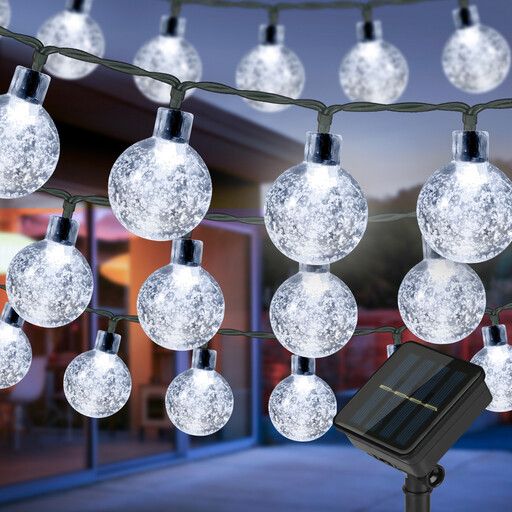
Why this suits this profile: With its 11-metre cable and 60 LEDs, this string light is ideal for a pergola, fence or large patio where you want a polished decorative look.
The listing mentions an IP65 rating, eight lighting modes and a memory function. The stated battery life of 8 to 14 hours still depends on sunlight.
A length suited to larger spaces, cool white light and wireless installation. The copper wire is easy to shape around a railing or tree.

Why this suits this profile: Its flat design works well in exposed areas, on patios and in walkways where a stake light might get knocked over.
An IP66 rating is stated, with a round body and cable-free installation. Despite its claimed resistance to water jets, avoid deliberate impacts.
Warm light at 3,200 K, a 0.6 W solar panel and a 500 mAh lithium battery, according to the product listing.
We’ve put together a comprehensive, real-time list of products that meet these demanding selection criteria and comply with European safety regulations.
Before first use, set the switch to ‘ON’ and let the panel charge in direct sunlight. For an outdoor solar light, check that the cable doesn’t pose a trip hazard and that the stakes are properly pushed into stable ground.
Once a month, clean the panel with a soft, slightly damp cloth. Remove leaves, dust and deposits that can reduce charging efficiency. In case of heavy frost or a long period without use, consult the manufacturer’s instructions on how to store the product. Batteries should be disposed of at the appropriate collection point, in line with local regulations for electrical waste.
Charging from the sun incurs no electricity bill during use. The real cost includes the purchase, maintenance and, eventually, battery replacement if that’s possible. Battery life depends mainly on sun exposure and the season.
A model with an IP65 or IP66 rating is designed for outdoor use, according to its product listing, but it must not be submerged. Protect the panel from standing water, impacts and soil splashes. Also check the housing materials and the manufacturer’s instructions before permanent installation.
Leave the switch in the ‘ON’ position, install the panel in a bright area and avoid any artificial light shining directly onto the sensor. The light charges during the day and typically turns on when brightness drops. The first few cycles may require a full charge before reaching the stated performance.