
Livraison le jour même ou le lendemain

Qualité garantie

Débloquez vos offres de bienvenue: Livraison GRATUITE | Jusqu'à -80 % | 30 jours d'essai gratuits à JoyPlus
Téléchargez l'application
Securing your home's perimeter, lighting up a dark pathway, or simply enjoying your patio after sunset are all valid concerns. The outdoor solar floodlight with a motion sensor stands out as a solution that is cost-effective, eco-friendly, and easy to install. As a product recommendation specialist at Joybuy, my role is to help you navigate the available options, providing objective criteria to make an informed choice, cutting through the often-exaggerated marketing claims.
The appeal of outdoor solar lighting is undeniable: no trenches to dig, no added electricity bills, and an installation process anyone can handle. But how can you be sure you're choosing a high-performance, durable model?
Before diving into specific models, it's helpful to understand a few technical criteria that determine a product's quality and suitability for your needs.
This is a critical factor for any device intended for outdoor use. The IP rating, standardised across Europe, consists of two digits:
For outdoor security lighting, an IP44 rating is the minimum, signifying protection against objects larger than 1 mm and water splashes from all directions. For more direct exposure to the elements, an IP65 rating or higher offers enhanced protection against dust and water jets, ensuring greater longevity.
The effectiveness of a wireless solar lamp depends on its ability to capture energy during the day and release it at night. Two components are key:
The sensor is the brain of your floodlight. Make sure its features match your intended use. Key points to check include:
Based on these criteria, here is a selection of products that meet various needs for securing and illuminating your outdoor spaces.
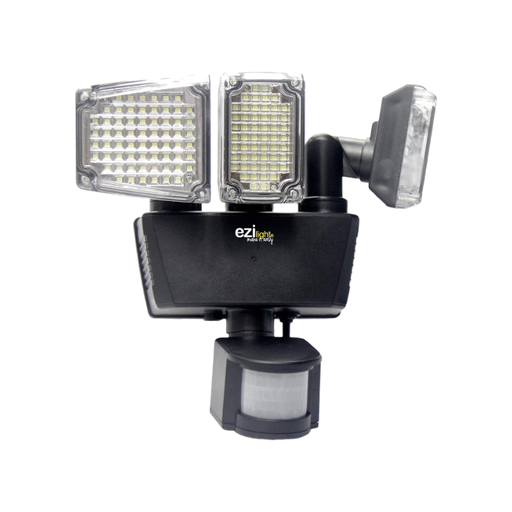
Why We Recommend It: This model stands out for its exceptional flexibility. Its three LED panels can be aimed independently of one another. This modularity allows a single unit to cover wide or complex areas, such as the corner of a building or an L-shaped patio. It's a major advantage for customised lighting.
Advantages:
Who It's For: Ideal for homeowners who need to light up large areas or zones with specific angles (courtyards, large gardens, complex facades) and are looking for an all-in-one solution.
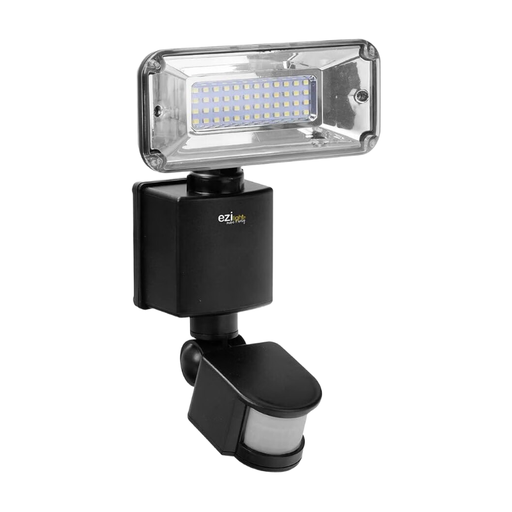
Why We Recommend It: The Solar Pro 1 is an excellent example of a powerful and targeted solar LED floodlight. Its compact design and single, adjustable light head make it a smart choice for specific needs: illuminating a front door, a garage door, or a narrow passageway. Its effectiveness is concentrated right where you need it most.
Advantages:
Who It's For: Perfect for users looking to secure a specific access point. It's a highly functional solar outdoor wall light for entrances, garages, or pathways.
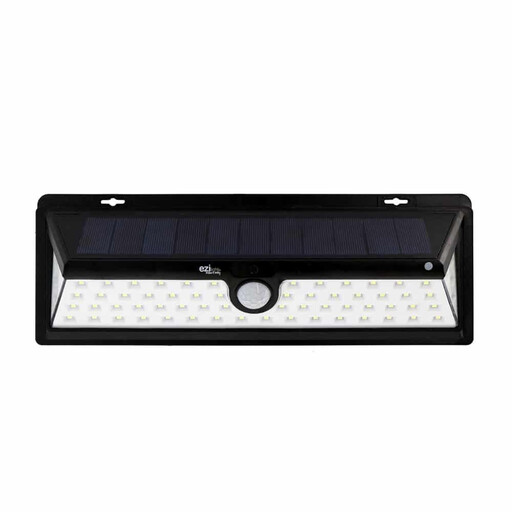
Why We Recommend It: As its name suggests, the Solar XL focuses on power and a wide illumination area. It is equipped with a large number of LEDs and a high-capacity solar panel to deliver intense light over a vast surface. It's a robust solution for those who want to make no compromises on visibility.
Advantages:
Who It's For: Recommended for people with large open spaces, such as a car park, a large courtyard, or a vast garden, whose priority is to achieve powerful and extensive lighting.
The selection above focuses on floodlights with motion sensors. However, outdoor lighting needs are diverse. If these models don't perfectly match your requirements, or if you're looking for other types of lights such as bollard lights, stake lights, or decorative string lights, other options are available.
We invite you to explore our full range of Outdoor Garden Accessories to discover more solutions suited to your project.
Light output is measured in lumens. For pathway lighting (a walkway, a staircase), 100 to 300 lumens may be sufficient. For lighting a living area (like a patio), aim for 400 to 800 lumens. For true outdoor security lighting intended to deter intruders and provide clear visibility, a brightness of 1000 lumens or more is recommended.
Yes, but their performance may be reduced. The days are shorter and sunlight is less intense, which decreases charging time. However, modern solar panels are increasingly sensitive and continue to charge even on cloudy days. The nightly runtime might be shorter than in summer, but the light will remain functional, especially if it is primarily activated by the motion sensor rather than being on continuously.
Absolutely. That's one of its main advantages. Installation typically involves just mounting the bracket to a wall with a few supplied screws. No electrical connection is required. Simply choose a location with good sun exposure for the solar panel and ensure the motion sensor's field of view is unobstructed.