
Livraison le jour même ou le lendemain

Qualité garantie

Débloquez vos offres de bienvenue: Livraison GRATUITE | Jusqu'à -80 % | 30 jours d'essai gratuits à JoyPlus
Téléchargez l'application
Controlling your garden lights, pool pump, or Christmas decorations with a tap on your smartphone is an appealing promise. Yet, choosing the right outdoor smart plug can often be a minefield. Caught between marketing hype and real-world conditions, many users end up with an unsuitable device—or worse, a dangerous one. To avoid falling into these traps, here are the three most common pitfalls to be aware of before you buy.
The first and most obvious trap is misleading weatherproofing. A product might be marketed as "designed for outdoor use" but fail to withstand a heavy downpour. The second pitfall is limited software compatibility, which can lock you into a clunky app, isolated from the rest of your smart home ecosystem. Finally, the most critical point: underestimating power requirements. Plugging a high-draw appliance into an under-specced plug poses a very real risk of overheating and even fire.
This guide is here to arm you against these common traps and help you select a reliable model that truly meets your needs.
To make an informed decision, ignore the marketing jargon and focus on objective technical criteria. Here are the three non-negotiable checkpoints.
The Ingress Protection (IP) rating is an international standard that assesses a device's resistance to the intrusion of solids (like dust) and liquids (like water). For outdoor use, where the weather can be unpredictable, an IP44 rating is the absolute minimum.
An outdoor smart plug with a rating lower than IP44 should be avoided for direct exposure to the elements. Its use is restricted to fully sheltered areas, such as a covered porch protected from both wind and rain.
Not all electrical appliances have the same power needs. A simple string of LED lights might only use a few watts, whereas a pool pump or a patio heater can demand significantly more power.
Always check the maximum power the plug can handle, expressed in Watts (W), and the maximum current, in Amps (A). For the most power-hungry devices, a plug rated for 16?A (approximately 3680?W) is an essential safety feature. Using an undersized plug exposes you to irreversible damage and a genuine fire risk. The added bonus? A smart plug with energy monitoring allows you to keep a real-time eye on power consumption—a valuable asset for managing your electricity bill.
Most smart plugs communicate via Wi-Fi. Ensure the model you're considering is compatible with the 2.4?GHz Wi-Fi band. This is the standard for IoT devices because its range is much better than 5?GHz for penetrating walls and obstacles.
The other absolutely crucial point is the software ecosystem. Opt for an outdoor Wi-Fi plug compatible with open and widely-used platforms like Tuya Smart or Smart Life. These apps have the immense advantage of centralising control over devices from many different brands. They allow you to create advanced scenes (for example, automatically turning on garden lights at dusk) and ensure much better long-term software support. Remember, a programmable outdoor plug is nothing without a quality app to run it.
Rather than just a list, we've selected models that cater to specific user profiles, strictly applying the safety and practicality criteria we've just detailed.
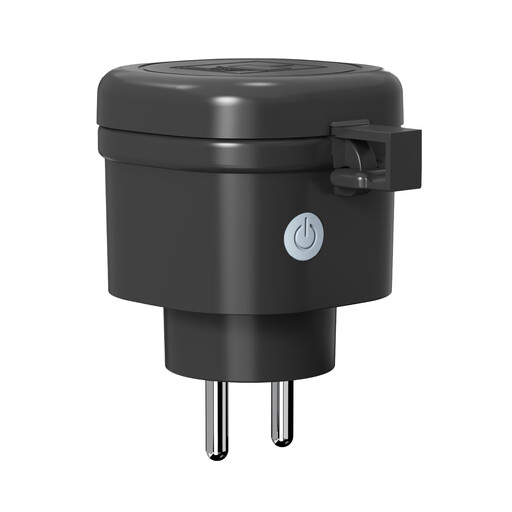
Why it's the right choice: Ideal for most outdoor uses, whether automating balcony string lights or controlling a fountain pump. Its plug-and-play design makes it operational in seconds.
This model checks all the boxes: it's IP44 certified, supports a high load of 16 A (3680 W), and integrates seamlessly with the Tuya/Smart Life ecosystem.
It combines serious weather protection, ample power handling, and precise energy monitoring, all in an ultra-simple-to-install format.
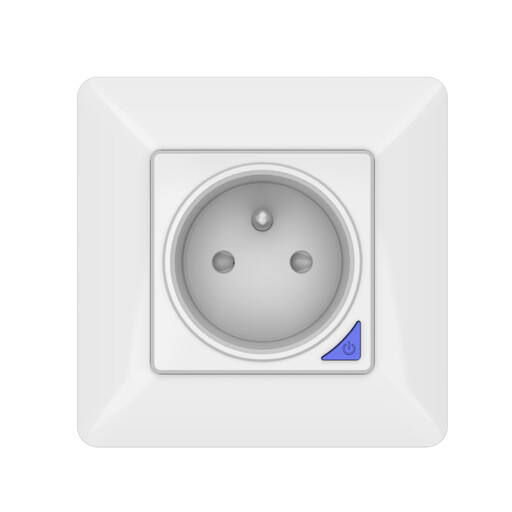
Why it's the right choice: Perfect for those who want a permanent and invisible solution in a sheltered outdoor space (covered terrace, pool house, summer kitchen). It replaces a standard wall socket for a flawless finish.
Although its IP20 rating restricts it to sheltered use, it provides a robust, integrated solution rated for 16 A (3000 W). By leveraging the Tuya/Smart Life ecosystem, it bypasses the headache of external adapters and closed, proprietary apps.
Its flush-mount installation ensures a professional finish with zero clutter. The energy monitoring is a real bonus for optimising your energy spending.
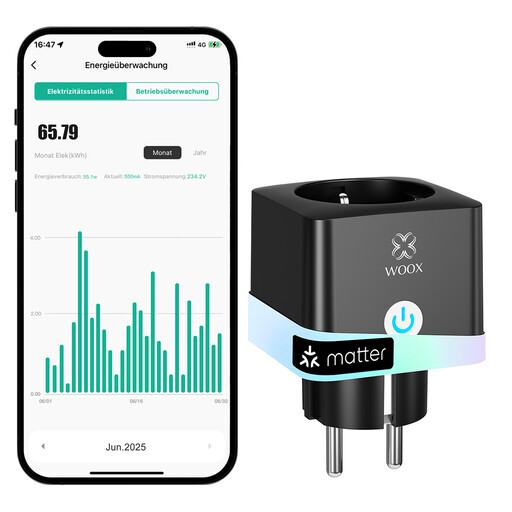
Why it's the right choice: For those who primarily want to closely monitor the consumption of an outdoor appliance (pump, space heater) by plugging it into an indoor socket (in a garage, garden shed, or basement).
This indoor model easily handles a high power load of 16 A (3680 W) and offers very detailed energy monitoring via the Woox app (Tuya compatible). It thus bypasses the risks associated with under-specced power and closed ecosystems.
Its absolute strength: precise energy monitoring (real-time and historical) to track waste and optimise costs. Its broad compatibility with voice assistants allows for very convenient voice control.
We have curated a full range of products that meet our strict selection criteria and safety standards.
No, their standby power consumption is negligible, typically less than 1 watt. The savings you'll achieve by scheduling your devices to turn off (garden lights, filtration pumps, etc.) far outweigh this near-zero cost. The energy monitoring feature on some models even lets you see these savings in concrete terms.
The range depends on the model and your environment, but you can expect 30 to 40 metres in an open area. Be aware that thick concrete walls, metal doors, or other obstacles can significantly reduce this signal. A simple trick: before you buy, go to the spot where you plan to install the plug and check the Wi-Fi signal strength with your smartphone.
Fortunately, no! That's the whole point of choosing a product based on an open ecosystem. By opting for plugs compatible with universal platforms like Tuya or Smart Life, you can control devices from dozens of different brands from a single app. This is the key to preventing your smart home management from becoming an overly complicated mess.